Get Full Government Meeting Transcripts, Videos, & Alerts Forever!
Get email alerts on the Oversight And Budget topic
No spam. Unsubscribe anytime.
Baltimore City inspector general asks council for one investigator to address mounting caseload
Summary
The Baltimore City inspector general told a council committee the office is handling hundreds of complaints, dozens of active investigations and a backlog of vetted cases, and requested one special agent position and funding for an ethics platform maintenance fee.
The Baltimore City inspector general asked a City Council committee for one additional special agent to help manage an expanding caseload and a backlog of vetted investigations.
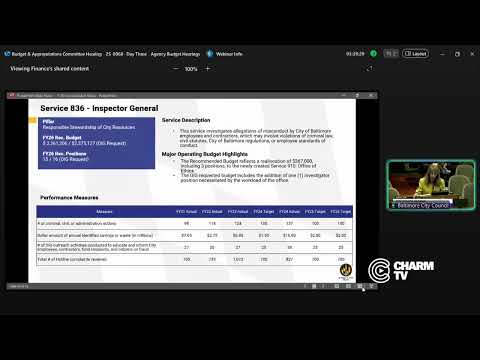
The request came during a budget hearing in which the inspector general described the office’s recent work — including multiple Department of Public Works investigations, review of grant spending and ethics enforcement — and said the office has 18 funded positions, 33 active investigations, 23 vetted but pending investigations and more than 800 complaints received so far this fiscal year.
The request is for a single special agent position with a total cost the inspector general described as $113,921, including a $75,000 salary and benefits. The office also requested and reported that the Bureau of Budget and Management Research approved a $50,000 annual maintenance fee for a new ethics platform.
Why it matters: the inspector general’s office said its work produces measurable savings and waste avoidance and provides oversight across city agencies. The office reported identifying $10,675,671 in savings or avoided waste in the first three quarters of fiscal 2025 and said it identified more than $17,000,000 the prior year. The inspector general framed the staffing request as an operational need to investigate matters more timely and to prevent failures like problems previously found at the Department of Public Works.
Office function and jurisdiction: the inspector general described the office’s jurisdiction as covering city money, city employees and contractors paid with city funds. The inspector general said many complaints are resolved by referral to the appropriate agency but that vetted matters that meet the office’s jurisdiction go on a pending list for investigation. The office said each investigator typically carries three to five active cases.
Budget outcome and process: the inspector general said the city’s budget process limited funding for new positions and that the mayor’s balanced budget did not include the requested new positions. The inspector general said the citizen-based advisory board had approved two additional positions in its enhancement request, but those positions were cut during review; the mayor’s budget included hundreds of new positions across the city while the OIG’s enhancement was not funded. The $50,000 ethics platform fee, by contrast, was approved by BBMR.
Ethics and board staffing: the inspector general and the city’s ethics director discussed efforts to align Baltimore City’s ethics code with Maryland’s public ethics law, tighten unclear language, and make disclosures more accessible. The ethics director asked the council for time to deliver a written list of recommended clarifications and a roadmap to change the code. Separately, the inspector general said the citizen advisory board that helps select and advise the inspector general has had an open seat since Dec. 31, 2023; the mayor’s nominee must come from a non-majority party, the inspector general said, and the mayor’s office said it was vetting candidates.
Council reaction and next steps: several council members thanked the inspector general for the office’s work on Department of Public Works and sanitation safety. Vice President Middleton and others pressed for specifics about what investigators do day to day and how one new hire would be used; the inspector general said a new hire would “hit the ground running” and would help work through the vetted backlog but would not, by itself, eliminate all pending cases. The ethics director agreed to provide a written response within six weeks describing areas of legal ambiguity and recommendations to clarify the code.
The hearing ended with requests for follow-up from the mayor’s office about nominating a member to fill the ethics advisory board vacancy and with no formal vote or change to the inspector general’s staffing in the record.