Get Full Government Meeting Transcripts, Videos, & Alerts Forever!
Get email alerts on the Solid Waste topic
No spam. Unsubscribe anytime.
DPW keeps street sweeping, contracting and composting options on the table while planning fleet and crew expansions
Summary
DPW confirmed investments in street sweeping, routine collections and composting planning: a $5.3 million stormwater-funded street-sweeping allocation, $5 million to contract haulers this summer while hiring 15 new crews, and a $600,000 study and planned $29 million East Side composting facility at Baldy's Lane.
Council members questioned DPW leaders about the department’s plans to improve diversion and recycling rates, expand composting, modernize the fleet and reduce reliance on the incinerator and landfill.
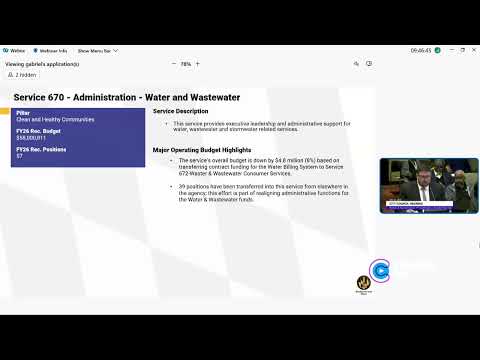
Matthew Garbark and Director Zaid said the FY26 package includes both near-term contract funding and longer-term investments. Garbark noted Service 661 includes $5,300,000 for street sweeping (funded through the stormwater utility) and Service 663 includes an additional $5,000,000 to maintain contractual hauling this summer while DPW hires 15 new in‑house crews to begin work in January 2026. Garbark said $2,000,000 will transition 10 crews previously funded by ARPA into the general fund as ongoing staffing.
On composting and diversion, DPW said a multi‑phase approach is under way. Director Zaid described a proposed East Side facility at Baldy's Lane (also referenced as Bowleys/Baldy's Lane in the presentation) with an expected two‑phase capital investment of roughly $25–$29 million; that facility would include composting as part of its scope. DPW also included a $600,000 study in the budget to analyze options for landfill life extension, rail or public‑private partnerships and other waste diversion strategies before committing to a large expansion of Quarantine Road landfill capacity.
Sophia Hossein, the city’s zero-waste manager, said DPW is piloting contamination‑reduction tactics such as school recycling programs using “oops” tags to identify contaminated bins; the agency is using the tags inside the schools program but has not yet expanded curbside tagging due to operational and safety constraints for route crews. DPW said it will evaluate a curbside composting pilot but wants to study operational impacts and staffing models first so the pilot does not disrupt routine services.
Fleet modernization remains a near-term operational priority. DPW said it is procuring new street-sweeping vehicles and expects to replace and modernize a large portion of its fleet; officials said the new fleet will reduce the need for contracted sweepers once delivered and crewed.
Ending: DPW committed to follow-up details including the $5 million contractual cost analysis, the schedule for fleet deliveries, and the operational study outcomes that would shape a curbside composting pilot.