Get Full Government Meeting Transcripts, Videos, & Alerts Forever!
Get email alerts on the Budget topic
No spam. Unsubscribe anytime.
DPW outlines FY26 budget shifts, adds crews and transfers positions to support services
Summary
The Baltimore City Department of Public Works presented its proposed FY26 budget, describing service reassignments, new crews for routine services, transfers of positions between service centers, and targeted capital and operating allocations across solid waste and water/wastewater bureaus.
Director Zaid, director of the Baltimore City Department of Public Works, presented an overview of DPW’s proposed fiscal year 2026 budget, saying the plan aims to sustain core services while modernizing infrastructure and meeting federal consent-decree obligations.
The budget proposal reallocates staff and contract funding among 12 budget service centers. Matthew Garbark, interim deputy director for DPW, described moves the department made inside the solid waste and water/wastewater bureaus, including transfers of positions between service centers and the realignment of the Office of Waste Diversion into a separate service center with $200,000 to pilot curbside composting.
DPW’s submission anticipates continued investment across solid waste and utility enterprise funds. Garbark said service centers were adjusted to reflect actual contract and equipment costs; for example, Service 661 (public right-of-way cleaning) includes $5,300,000 funded by the stormwater utility to support expanded downtown sweeping operations. Service 663 (routine trash and recycling collections) increases by $5,000,000 to continue contractual support while the department transitions to 15 new crews. Separately, $2,000,000 is allocated to shift 10 crews that had been funded by ARPA into the recurring DPW budget.
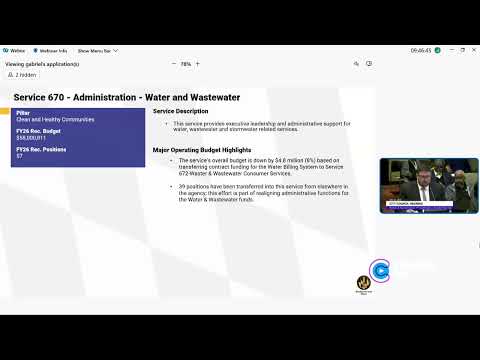
The water and wastewater bureaus also show shifts. Garbark said Service 670 (water and wastewater administration) is 8% lower after moving budgeting for the UMAX billing system into Service 672 (consumer services) and reallocating 39 positions across services; he emphasized these are internal transfers, not net position losses. Service 671 (drinking water management) is increasing, and the department expects to produce roughly 200,000,000 gallons a day while estimating a treatment cost near $330 per million gallons. Service 673 (wastewater) is increasing principally because of higher chemical supply costs.
DPW told the council it will begin hiring crews in January 2026 and will use a temporary contract in FY26 to bridge capacity needs through the summer. Garbark and other DPW leaders said the contract funding is intended as a transition: contract crews will support the department until the in‑house crews are trained and deployed.
The presentation closed with DPW officials offering to follow up on several council requests for detailed contract and staffing numbers.
Ending: The council hearing moved to Q&A after the presentation; DPW officials said they will provide detailed breakdowns of contractual spending, position transfers, and other line-item clarifications on request.