Get Full Government Meeting Transcripts, Videos, & Alerts Forever!
Get email alerts on the Law Department Budget topic
No spam. Unsubscribe anytime.
Baltimore law department reports nearly $700 million in recoveries, seeks funding for environmental and affirmative litigation teams
Summary
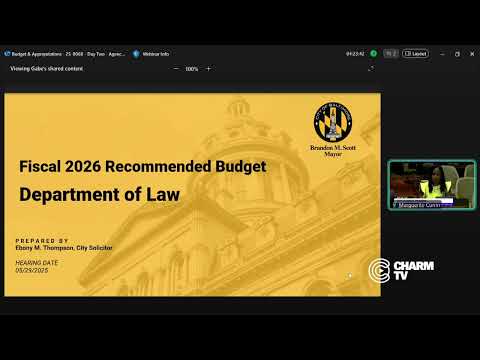
City Solicitor Ebony M. Thompson told the Budget Appropriations Committee the Department of Law achieved record recoveries this fiscal year, detailed major litigation and program priorities, and requested funding for new environmental and affirmative litigation positions.
City Solicitor Ebony M. Thompson told the Baltimore City Budget Appropriations Committee that the Law Department achieved nearly $700 million in financial recoveries this fiscal year and is seeking new funding to expand environmental and affirmative litigation capacity.
Thompson said the department recovered roughly $700,000,000 in total, singled out a $1,200,000 settlement with Polymer80, and said more than $668,000,000 came from a series of settlements and a landmark jury verdict against opioid manufacturers and distributors. She said the city is awaiting an abatement ruling tied to that litigation with a court deadline of June 6. "The law department serves as both sword and shield for Baltimore," Thompson said, adding, "This has been the most successful fiscal year in the law department's history."
The request before the committee includes $750,000 to create an environmental litigation team and $1,000,000 to expand the affirmative litigation team, funded in part by the opioid restitution fund, Thompson said. She also noted three new attorneys joining the department and emphasized the department's recent consumer-protection litigation, naming lawsuits filed against DraftKings and FanDuel for allegedly engaging in deceptive practices under Baltimore's consumer protection ordinance and a suit against Philip Morris International under the city's consumer protection ordinance for marketing ZYN oral nicotine products.
Why it matters: Thompson argued the recoveries and litigation successes preserve city revenue and authority, support public-safety and public-health remedies, and reduce reliance on outside counsel. She credited the mayor and the council for supporting the city's independent litigation strategy against large defendants.
Key details and supporting items - Litigation recoveries and cases: Thompson described about $668 million from opioid-related settlements and a landmark jury verdict; she said the department is awaiting a court ruling on abatement by June 6. She cited a $1.2 million settlement with Polymer80 and said the department has filed consumer-protection suits against DraftKings, FanDuel and Philip Morris International under the city's consumer protection ordinance. - Collections, taxes, real estate and contracts: Thompson said the collections division recovered more than $12,400,000 to date, with another $2,500,000 secured through repayment agreements; real estate work included a $43,000,000 MoEd headquarters project at 850 West North Avenue; the contracts division supported oversight of $641,000,000 in ARPA funds. - Staffing and budget asks: Thompson asked for $750,000 for an environmental litigation team and $1,000,000 to expand affirmative litigation (to be supported, she said, by the opioid restitution fund). She said three new attorneys are joining the department and reported three current vacancies. - Vacant housing and blockchain deed pilot: Thompson described the mayor's $3,000,000,000 vacant housing initiative and said the law department helped launch a blockchain property deed pilot that recorded more than 238,000 deeds in partnership with Medici Land Governance and Princeton University's guidance. - Internal operations and caseloads: The Central Bureau of Investigation handled more than 1,400 new liability claims this year, the workers' compensation group manages a very large caseload (Thompson discussed multi‑thousand claim counts), and police legal affairs resolved 417 misconduct cases in FY24 after addressing a backlog (vs. a 200-case target). Thompson called the workers' compensation caseload "one of the law department's heaviest caseloads." - Internships and pipeline: Thompson highlighted paid and unpaid internship programs and noted five law‑school interns this summer, plus high‑school and college pipeline programs.
Questions from council members and staff exchanges included requests for agency‑level workers’ compensation payout numbers for FY24 and FY25 year‑to‑date (Thompson offered to provide those figures), clarification that the new consumer protection board will be separate from the law department while the law department retains subpoena and litigation authority, and discussion of when the department uses outside counsel (conflicts or specialized expertise). Councilmembers praised the department's opioid litigation strategy and the in‑house handling of major matters. Councilmember Gray said, "where other cities said we'll take the settlement, you took on Big Pharma, and you kicked their butts."
What the meeting did not decide: The transcript records no formal votes or budget approvals on the requested amounts; the discussion was a budget presentation and Q&A. Thompson said the department will continue testimony with prepared slides and follow up with data requested by council members.
Ending: The Law Department's budget presentation emphasized litigation recoveries, proposed staff and program expansions, and ongoing legal actions that the solicitor said will shape city operations and revenue for the coming year. Council members asked for follow‑up data on workers’ compensation payouts and were given a promise to provide those numbers; the abatement ruling in the opioid case remains pending with a court date noted by Thompson.