Get Full Government Meeting Transcripts, Videos, & Alerts Forever!
Get email alerts on the Arpa Implementation topic
No spam. Unsubscribe anytime.
Baltimore City: ARPA fully obligated, 70% spent as recovery office outlines project timelines
Summary
Elizabeth Tatum, acting chief recovery officer for the mayor's office of recovery programs, told the Baltimore City Council’s Budget & Appropriations Committee on June 1, 2025, that the city has fully obligated its $641,170,126 American Rescue Plan Act allocation and has spent roughly 70% as of April 2025.
Elizabeth Tatum, acting chief recovery officer for the mayor’s office of recovery programs, told the Baltimore City Council’s Budget & Appropriations Committee on June 1, 2025, that the city has fully obligated its $641,170,126 American Rescue Plan Act allocation and that roughly 70% of that money has been expended.
Tatum said, “we met the federal obligation deadline of 12/31/2024, and we ensured that every dollar of the city's $641,170,126 ARPA allocation was committed in compliance with US Department of Treasury rules.” She reported that, as of April 2025, about $443.4 million had been expended and that 48 grants were fully closed out.
The nut graf: the city must spend all ARPA funds by the federal deadline of Dec. 31, 2026, and Tatum said the recovery office is monitoring projects closely and coordinating with city agencies to meet that deadline while acknowledging economic and political uncertainty.
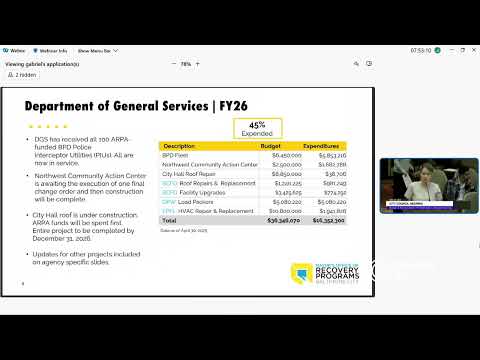
Major project highlights in Tatum’s presentation included: DOT commitments (a $13.1 million allocation, 32% spent, ADA ramp contracts under way with sidewalk work progressing after procurement delays); Department of General Services projects (about $3.4 million for multiple fire facility upgrades, $6.85 million for city hall roof replacement, and $10.8 million toward HVAC replacements at six Pratt Library locations with four already under construction); Department of Public Works (79% of a $15 million commitment spent, including equipment purchases, 30 recycling crew positions in 2024 and a waste contract); and DHCD housing and blight work (home-repair programs with two of three at 60%+ spend and a $13.7 million Park Heights infrastructure investment complete).
Tatum described patterns common to capital projects: some have late, large drawdowns rather than steady monthly spending. For example, the Housing Accelerator Fund’s nine capital projects only executed some grant agreements late in 2024; DHCD, MOHS and the recovery office are coordinating spend plans and monitoring drawdowns with developers.
On workforce and positions funded by ARPA, Tatum said the city cannot sustain all ARPA-funded staffing levels long term. She described three paths: transition of some roles to the general fund, redeployment of staff into other vacant funded positions, or (as a last resort) agencies may request enhancements in the FY27 budget. She said agencies are reviewing vacant positions and staff skill sets to avoid unnecessary layoffs.
Other program updates included: Clean Core (64 Baltimore residents employed to date; 95% of funds disbursed to the fiscal agent); digital equity/broadband (46 recreation centers and eight senior centers connected to the city network); food security (produce-box contract extended through Dec. 2026); and health department programs such as contact tracing and the "Be More Healthy Babies" equipment and staffing support (agreement through June 30, 2026).
Tatum said the recovery office’s ARPA work will continue through closeout activities, with the office expecting to finish ARPA reporting and closeouts in April 2027. She also described that, in FY26, the recovery office will apply lessons from ARPA implementation to administering grants from the opioid restitution fund, including improved indirect-cost guidance, stronger budget templates, and clearer time-tracking expectations for grantees.
Ending: Council members asked follow-up questions about which programs might be sustained in the general fund and requested program-level lists and evaluations. Tatum said the administration and program evaluators (University of Baltimore-led evaluations were referenced) will provide information to inform those decisions, and she invited councilmembers to continue sharing district-level feedback about programs that have been effective.