Get Full Government Meeting Transcripts, Videos, & Alerts Forever!
Get email alerts on the Liquor License Regulation And Enforcement topic
No spam. Unsubscribe anytime.
Baltimore liquor board seeks staff and tech investments after new settlement program and enforcement push
Summary
The Board of Liquor License Commissioners briefed the City Council budget committee on a new “monetary penalty in lieu of hearings” program, enforcement and outreach plans, staffing gaps including a key part‑time liaison, and coordination with police and the sheriff to address illegal parties and neighborhood nuisance issues.
The Board of Liquor License Commissioners for Baltimore City told the City Council Budget and Appropriations Committee on Day 3 of budget hearings that it plans to expand enforcement, outreach and licensing services next fiscal year but needs additional staff and resources to fully implement the changes.
Douglas K. Page, executive secretary for the Board of Liquor License Commissioners for Baltimore City, opened the presentation by describing the agency’s responsibilities: “The Board of Liquor License Commissioners for Baltimore City is tasked with enforcing and regulating the rules and state law governing alcoholic beverage” sales and, separately, adult entertainment licensing.
In a detailed overview, Deputy Executive Secretary and general counsel Michelle Wurzberger said the board created a monetary‑penalty‑in‑lieu‑of‑hearings program that went into effect after Sept. 20 and has been used in 21 cases so far. “To date, we have offered 21 settlements. Two were denied. We’re waiting for three to come in,” Wurzberger told the committee. She said the program has collected roughly $14,000 to date and will be refreshed this summer to reflect recent legislative changes.
Why it matters: the board said the program speeds resolution of many violations that previously took months to reach a hearing and eases the burden on witnesses and staff. Wurzberger and staff also emphasized that the settlement option excludes the most serious offenses — for example, sales to minors, alleged human‑trafficking incidents, gambling, discrimination or cases involving illegal conduct on the premises — and that a licensee may only use the in‑lieu option up to twice in four years for eligible, lower‑level violations.
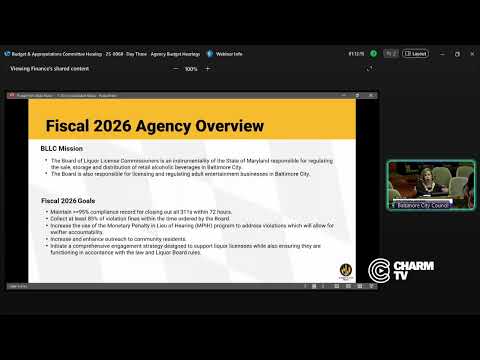
The agency described enforcement targets and performance goals for the coming year: maintaining a 95% rate of responding to 3‑1‑1 complaints within 72 hours (the agency said many responses occur within about two hours), collecting at least 85% of ordered fines within the board’s payment deadline, and sustaining at least 90% of charge violations at board hearings. The licensing operation seeks to process about 1,150 license renewals annually and to hold roughly 180 public hearings for new licenses, transfers and expansions.
Committee members asked about on‑the‑ground nuisance issues. Councilmember Odette Ramos and Vice President Sharon Green Middleton raised signage and window coverings, and Middleton asked whether the board enforces blocked windows that may hide activity. Wurzberger said outreach and information sessions for licensees will emphasize permitted practices and safety obligations; she described multiple monthly information sessions (one in person, one virtual last year) and new flyers for licensees covering issues such as live‑entertainment permissions, hookah and rules for extended closures. Wurzberger said the board also created a formal process to implement the city’s long‑standing 50% rule — which allows nearby residents and property owners within a 200‑foot footprint to object when a license is new or expanded — and now uses Department of Planning lists to identify affected owners so both sides receive the same information and timelines.
On illegal and uncertified operations, Chief Inspector John Chris Amales described operational limits the inspectors face and the need for partners. “My inspectors go. They can obviously violate the establishment. There’s nothing they can do to the people across the street in the parking lot drinking out of their cars,” Amales said. He and Wurzberger said the board is expanding cooperation with the Baltimore Police Department and an enhanced Sheriff’s Office neighborhood service unit — an arrangement that officials said will go into broader effect Oct. 1 — so deputies can address activity outside licensed premises and attend joint enforcement visits.
Council members pressed the board on capacity. Wurzberger repeatedly cited a critical liaison who is currently a part‑time contractual employee known as Matt and said she has been trying to secure funding to make that position full time. “Matt is a part‑time contractual employee,” Wurzberger said, and the agency requested roughly $70,000 in gap funding to make the position full time. She said the board also requested a licensee liaison to provide more ongoing support to businesses now paying higher state license fees.
Other operational items discussed: the board has moved hearings to a new hearing room, has begun using video evidence in cases, has improved trainings for inspectors so they can better prepare evidence and testimony, and now distributes a docket two weeks before hearings that includes district information on each case. The board said it is tracking repeat violators and “hot spots,” monitors social media and flyers, and has worked with 3‑1‑1 staff to prevent bad actors from watching incoming complaints in real time.
On legal and fee changes, Wurzberger said the General Assembly increased certain penalties for operating outside authorized hours and authorized a new expedited $250 fee for one‑day liquor permits; the board is developing rules to implement these changes. She also cautioned that most fees remain regulated at the state level.
Public safety and trafficking: Council members asked whether the liquor board coordinates with the Baltimore City Human Trafficking Collaborative. Wurzberger and Amales said inspectors received trafficking training and that the agency participates in the task force and refers suspected trafficking investigations to federal, state and city partners when warranted.
No formal votes or budget actions were taken during the presentation; council members said they would consider the agency’s enhancement requests as part of the broader budget process.
The presentation highlighted conflicts the board is trying to balance: helping licensed businesses comply and succeed while tightening enforcement against recurring bad actors and unlicensed events, improving transparency for neighborhoods, and filling staff gaps to sustain outreach and enforcement.