Get Full Government Meeting Transcripts, Videos, & Alerts Forever!
Get email alerts on the Parking topic
No spam. Unsubscribe anytime.
Parking Authority drops annual doctor recertification for disabled permits; pledges mobile payments and revenue estimate
Summary
The Parking Authority of Baltimore City told the City Council it has removed the annual doctor recertification requirement for permanently disabled residential parking permits, plans a citywide mobile-payment rollout by year-end, and will provide an estimate of lost meter revenue requested by the council.
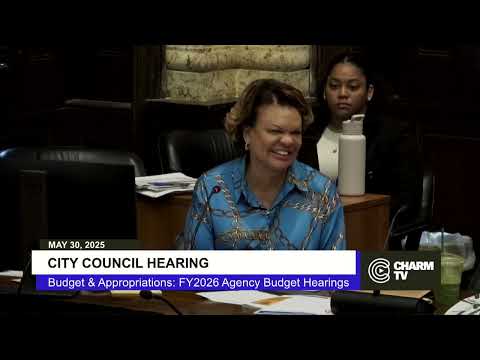
Pete Little, executive director of the Parking Authority of Baltimore City, told City Council members the agency has removed the annual requirement that medically certified, permanently disabled residents obtain a doctor’s recertification for residential reserved disabled parking spaces and has begun expanding payment technology and capital work at city garages.
“Their mission is to find or create and implement parking solutions for Baltimore City,” Little said, introducing the authority’s team and summarizing recent progress. He said the authority has installed new access and revenue control equipment at 11 of 12 city-owned or -leased garages, is completing one remaining installation this summer, and plans a citywide rollout of multiple mobile payment apps and a text-pay option by the end of the calendar year.
The change to remove the doctor recertification requirement was made after a regulatory process, Little said: “we removed that requirement for that recertification by a doctor.” Council members raised the issue as a recurring burden on disabled residents who previously were required to get annual medical documentation.
Little answered questions about meter revenue trends, reporting that revenue fell during the pandemic to “6 or $7,000,000 annually,” rose to about $10,000,000 per year and has stayed around that level, and that pre-pandemic revenue reached “a little over $15,000,000.” In response to a formal request from Councilman Blanchard, Little said the authority will provide an estimate of lost parking-meter revenue tied to enforcement lapses “probably by the end of next week.”
Council members pressed on enforcement, residential permit program rules, and valet operations. Little said enforcement is carried out by the Department of Transportation’s Safety Division and that the Parking Authority is working closely with that division to increase enforcement activity after pandemic-era staffing challenges. On valet operations he said that officers who park cars on-street rather than in contracted off-street lots are violating the rules: “They should not. That’s a sightable offense.”
On residential reserved disabled parking, Little said the authority currently requires applicants to renew annually but that the doctor recertification component has been removed. He also said the city code currently requires neighbor petitions for some reserved-space requests and that the authority is working with the Mayor’s Office of Government Relations to seek removal of that code requirement, which would require a change by the City Council.
Little provided additional operational details: the authority employs 51 team members; it manages maintenance and operation funding for more than 1,000 multi-space meters and over 2,000 single-space meters; it oversees 12 city-owned or -leased garages and 20 city-owned parking lots; and it aims to increase revenue per garage space by 2% or more in the coming fiscal year. Capital projects listed include structural repairs at the Penn Station, Franklin Street and Little Italy garages and elevator replacement at the Baltimore Street garage, plus LED lighting retrofits funded in part by a Maryland Department of the Environment grant.
Council members said the authority’s responsiveness is appreciated but sought follow-up information, including an updated list of garages the authority owns or leases and the requested revenue estimate. Little said two garages are leased and that the authority manages 10 owned garages and two leased garages on the city’s behalf.