Get Full Government Meeting Transcripts, Videos, & Alerts Forever!
Get email alerts on the State Land Use Boundary topic
No spam. Unsubscribe anytime.
Committee discusses Haleiwa Quadrangle land-use boundary change as neighbors and developers spar over future housing
Summary
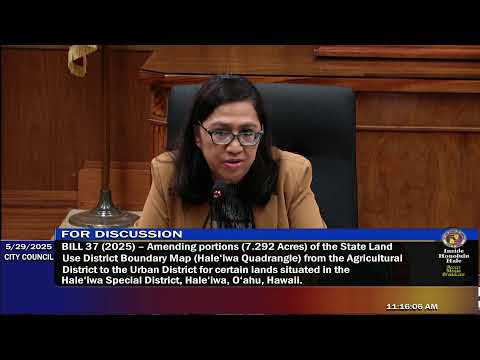
The Zoning Committee discussed Bill 37 (2025), a proposed state land-use district boundary amendment to move about 7.3 acres of the Haleiwa Quadrangle from the State agricultural district to the State urban district, a first step toward a potential zone change for housing and commercial development.
The Zoning Committee held an extended discussion of Bill 37 (2025), a proposed state land use district boundary amendment to reclassify approximately 7.292 acres of the Haleiwa Quadrangle from the State agricultural district to the State urban district. Passage of the state boundary amendment would remove state-level land-use jurisdiction (HRS ch. 205) from that portion of the parcel, enabling the landowner to pursue a city zone change for proposed infill development including approximately 50–56 low-rise apartment units and roughly 30,000 square feet of commercial space.
Jim Hayes of Planning Solutions Inc., representing the applicant, told the committee the parcel is a remnant of bypass construction, has limited agricultural water access, irregular shape and topography, and contains soils and fill that reduce its suitability for commercial-scale agriculture. Hayes noted the parcel is outside SMA and coastal hazard zones, lies within the North Shore sustainable communities plan community growth boundary and the Country Town District, and has two points of access to Kamehameha Highway with bus routes and utilities.
“Our application goes into the details… this land has not been identified as an important agricultural land,” Hayes said, adding that prior use was limited and that the bypass construction disturbed soils and brought fill onto the site.
The applicant presented a conceptual plan showing workforce-oriented rental housing and commercial space and said the minimum affordable housing obligations under ROH chapter 29 (5% minimum) would be addressed during a future zone-change process and unilateral agreement; Hayes said the developer expects to negotiate higher affordable set‑asides (DPP often requests up to 30% during zone change). Panelists discussed rent estimates and AMI calculations and noted market rents and AMI-based rents can vary; developer estimates were described as conceptual only.
The North Shore Neighborhood Board Chair Kathleen Pahinui testified in-person on behalf of the Neighborhood Board and the broader community, stating the neighborhood board and local farmers overwhelmingly oppose the project and asked that the council delay action until the North Shore sustainable communities plan update is released. Pahinui said community members at the neighborhood board meeting disputed the applicant’s characterization that the land could not be farmed and said local farmers believed they could make the parcel productive. Other remote and in-person speakers urged affordable housing but expressed concern about traffic and community impacts.
DPP chief planner Dina Wong told the committee DPP supports Bill 37 as consistent with the current North Shore sustainable communities plan and said infill development within the growth boundary supports affordable housing goals and prevents sprawl. DPP clarified that, if the parcel becomes urban at the state level, the city’s land use rules (ROH ch. 21) would still apply and a subsequent city zone change would be required for non-agricultural uses.
Committee members discussed logistics for additional community engagement, including the possibility of a field hearing or a remote evening meeting to accommodate farmers and working residents. Council members noted the broader misalignment among state land use districts, city zoning, sustainable communities plans, and special district boundaries and suggested a comprehensive review. Chair Kiana said she will consider a field hearing request but also suggested that neighborhood or district town halls could supplement committee hearings.
No formal action on Bill 37 was taken; the item remained in discussion-only status. Members signaled the desire for additional outreach and a future hearing, and several council members asked for ongoing coordination among DPP, the neighborhood board and council offices.