Get Full Government Meeting Transcripts, Videos, & Alerts Forever!
Get email alerts on the Otat Sewer Funding topic
No spam. Unsubscribe anytime.
Council debates using Oahu transient accommodations tax to offset sewer costs; administration warns of bond risk
Summary
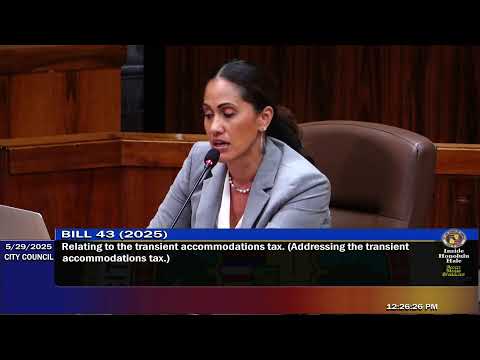
Council members and city finance officials debated Bill 43 (2025) — a proposal to reallocate a portion of the Oahu transient accommodations tax (OTAT) to reduce a proposed large increase in sewer rates — during the Committee on Executive Management meeting May 28 in the City Council chamber.
Council members and city finance officials debated Bill 43 (2025) — a proposal to reallocate a portion of the Oahu transient accommodations tax (OTAT) to reduce a proposed large increase in sewer rates — during the Committee on Executive Management meeting May 28 in the City Council chamber.
The committee heard competing fiscal and policy views about whether to use OTAT revenue, vacancy savings or other cash to reduce the amount the city must bond for sewer upgrades. Andy Kawano, director of Budget and Fiscal Services, told the committee the administration strongly opposes using OTAT or other general-fund cash to pay sewer operations, maintenance or capital improvements because doing so would conflict with sewer bond covenants and could cause a downgrade. "We strongly oppose this bill," Kawano said.
The issue matters because the Department of Environmental Services (ENV) projects large capital needs for wastewater upgrades, and the proposed rate path in the department's study would substantially raise sewer fees for residents. Proponents of Bill 43, including Council Chair Waters, argued redirecting visitor-paid OTAT revenue would reduce the burden on households while still allowing the city to meet upgrade and consent-decree obligations. Opponents — including the Budget director — said diverting general-fund resources undermines the sewer fund's self‑sufficiency and risks higher debt costs in the long run.
Key facts and positions
- Bill: The agenda listed "Bill 43 2025 relating to the transient accommodation tax" as the item under discussion; the chair said the measure would reallocate OTAT revenue toward sewer affordability.
- Administration view: Andy Kawano, director of Budget and Fiscal Services, told the committee that OTAT (also called OTAT or Oahu transient accommodations tax) has historically flowed into the city's general fund and is used to balance the budget. Kawano said using an estimated $50,000,000 per year from OTAT for sewer projects would reduce the general-fund revenue base and require cutting about $50 million in projects or programs elsewhere. He warned that rating agencies and bondholders would not treat transfers from other funds as credit for sewer debt coverage and that doing so could trigger a downgrade of sewer revenue bonds, increasing long‑term debt costs.
- Proposals and alternatives discussed: Council Chair Waters and other proponents suggested a mix of approaches to reduce borrowing and rate pressure: redirecting a portion of OTAT, applying vacancy savings (the chair’s slide deck suggested $30,000,000 from vacancy savings), using resilience or climate funds for targeted measures, and pursuing lower‑cost borrowing such as WIFIA loans or general obligation bonds where appropriate. Council Member Tupelo specifically recommended exploring the EPA's WIFIA program as an alternative financing source and noted successful WIFIA projects in other jurisdictions.
- Cash vs. bonds: The chair's presentation compared paying projects with cash (vacancy savings plus OTAT) versus bonding. Slides cited examples such as a $190,000,000 bond with $111,000,000 in interest and presented a citywide six‑year CIP totaling roughly $1.9 billion. The chair's slide calculations indicated that applying $50,000,000 (OTAT) plus $30,000,000 (vacancy) could reduce the principal the city needs to bond and save interest costs; the presentation estimated a $128,000,000 reduction in interest costs in one scenario.
- Earmarking concerns: Kawano cautioned that creating more carve-outs and dedicated funds (for example through charter amendments) reduces the general fund's flexibility to respond to future budget needs.
Public comment and council input
Remote testifier Natalie Wasser said she opposed diverting general funds to the sewer fund and urged council members to stop using general dollars to cover sewer costs: "I oppose this, and I'm actually surprised that you're still continuing to talk about using general funds for the sewer fees." Angela Melody Young, testifying for a community group, urged the committee to consider jurisdictional differences and new technologies, and to look at alternatives such as energy or hydrogen recovery from wastewater.
Process and immediate outcome
No vote was taken on Bill 43 at the May 28 meeting. Council Chair Waters told members she did not intend to ask for a vote that day: "I'm not gonna ask you folks to vote on this bill today." The committee recessed at the end of the session. The chair also verbally appointed Council Member Tupelo for quorum purposes during the hearing.
What remains unresolved
Committee members and staff agreed there are financing alternatives to explore — smaller rate increases, WIFIA loans, targeted cash pay‑fors, GO bonds for some projects — but there was no formal action to change the ordinance or to allocate specific cash in the meeting. The administration emphasized that rating agencies are unlikely to credit transfers from outside the sewer fund toward required debt-service coverage; proponents argued that targeted cash application could reduce the total borrowing need and lower overall cost to ratepayers.
Next steps
Committee members left the matter open for further study and for additional discussions with ENV, the Budget Office and potential federal partners. No ordinance or funding change was adopted at the session.