Get Full Government Meeting Transcripts, Videos, & Alerts Forever!
Get email alerts on the Climate Element topic
No spam. Unsubscribe anytime.
Sedro‑Woolley planners review draft climate element and greenhouse‑gas subelement required by state law
Summary
Consultants presented a new climate element and a mandatory greenhouse‑gas emissions reduction subelement required by Washington House Bill 1181; commissioners asked for clearer local data, grantable actions and follow‑up on implementation steps including an implementation plan and a return hearing in June.
Sedro‑Woolley planning commissioners heard a presentation May 27 on the city’s draft climate element, including a required greenhouse‑gas (GHG) emissions reduction subelement under Washington House Bill 1181.
The presentation, led by Facet environmental planner Alexandra Plum and Kimley Horn consultant Heidi Roos, described the state guidance that mandates a resilience subelement and — for cities in fast‑growing counties above certain population thresholds — a GHG reduction subelement. Plum said the law “requires the integration of a new climate element and resiliency subelement that has an emphasis on climate resiliency, greenhouse gas emissions reduction, hazard mitigation, and advancing, environmental justice.”
Why it matters: House Bill 1181 creates a new, audited requirement for the city’s comprehensive plan. The planning commission’s review will shape language used to support future grant applications, capital projects and regulatory changes; commissioners repeatedly asked for data and edits that would make the plan responsive to Sedro‑Woolley’s local conditions and funding needs.
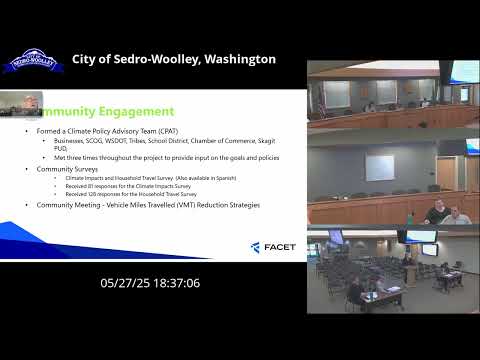
Consultants outlined the work done so far. The team met with a climate policy advisory group that included local businesses, Skagit Council of Governments, the tribes, school district representatives, the chamber of commerce and Skagit PUD. The city posted two community surveys: the climate impacts survey received 81 responses and the household travel survey received 28 responses, the presenters said. The consultants also completed an asset‑hazard screening using University of Washington Climate Impacts Group projections and a Commerce “climate workbook” to rank vulnerability and composite risk for local assets.
On greenhouse gases, Roos presented an initial GHG inventory for 2021 and 2022, noting year‑to‑year swings are common and that inventories are estimates intended to be updated over time. She described the city’s per‑capita results falling from about 10.86 metric tons of CO2e per person in 2021 to 10.54 in 2022 and said transportation and natural gas consumption were the largest contributors. Roos explained the inventory work focused on major local emission sources (building energy, on‑road transportation and waste) and recommended short‑, medium‑ and long‑term measures to reach the state’s goals.
The draft targets and example measures the consultants discussed include sector‑specific reductions and measures to lower vehicle miles traveled (VMT) — a state priority. The consultants reported an estimated annual VMT per person for Sedro‑Woolley of about 9,251 in 2022 and described statewide targets that call for large per‑capita reductions by 2035 and 2050. Roos stressed the inventory and the implementation plan are living documents: “You really have to kinda get that mindset of you’re kicking off a process. Right? It’s not a product.”
Commissioners pressed for local detail and funding pathways. Commissioner Joe Fournette repeatedly emphasized local conditions and hazards — “We got this thing called the Skagit River. We got this thing called Mount Baker” — and asked how the plan would translate into concrete, funded actions to protect residents and infrastructure. Several commissioners said many of the draft policies reflect efforts the city already undertakes and asked the consultants to highlight existing programs and to tighten language so the plan supports grant applications and capital planning.
On implementation and agency roles, consultants recommended an implementation plan that assigns tasks and timelines and establishes measurable indicators. They also flagged limits on city authority: several measures are “encourage” or “coordinate” actions that depend on utilities, county agencies and state programs. Plum and Roos pointed to specific local references already incorporated into the draft, including the Skagit PUD strategic plan, the 2024 water system plan and the Skagit County multijurisdictional hazard mitigation plan.
Emergency management, transportation resilience and equity were recurring themes. The draft includes policies to: map vulnerable transportation infrastructure and plan alternative routes; develop wildfire‑smoke notification and sheltering strategies; prioritize urban tree canopy in overburdened neighborhoods; and protect stream and riparian corridors. Commissioners asked the staff and consultants to clarify whether policies would require new regulations or only provide guidance and to avoid language that could be read as an immediate acquisition mandate for private property.
Next steps: the consultants said they will return with revised language and an implementation plan. Commissioners scheduled additional review and noted the draft will be sent to the commission’s next meetings for focused discussion on transportation and economic development; staff indicated the climate element would be brought back in a subsequent session in June.
Votes at a glance: the only formal recorded motion during the meeting was to adjourn; the commission approved the motion at the end of the session.