Get Full Government Meeting Transcripts, Videos, & Alerts Forever!
Get email alerts on the Criminal Justice Drug Treatment topic
No spam. Unsubscribe anytime.
Putnam County proclaims May as Problem-Solving Court Month; drug court participants and staff describe program outcomes
Summary
The Putnam County Board of County Commissioners adopted a proclamation designating May as Problem-Solving Court Month and heard testimony from drug court participants and staff about the program's structure, completion figures and recidivism outcomes.
Judge Elizabeth Morris asked the Putnam County Board of County Commissioners to adopt Proclamation 2025-033 designating May as Problem-Solving Court Month; commissioners approved the resolution by voice vote.
The measure recognizes the county drug court’s role in “restoring lives, renewing, reuniting families and making communities safer,” and notes that since the program’s local inception in 2002, 252 people have completed the Putnam County Drug Court program, the proclamation states.
Judge Elizabeth Morris, who leads the local program, told commissioners the drug court is a four-phase program that typically takes participants 15 to 18 months to complete but allows up to three years. She described the program as a team effort involving prosecutors, public defenders, treatment providers and probation, and credited a community partner, Stuart Marchman, with delivering drug treatment and residential services used by participants.
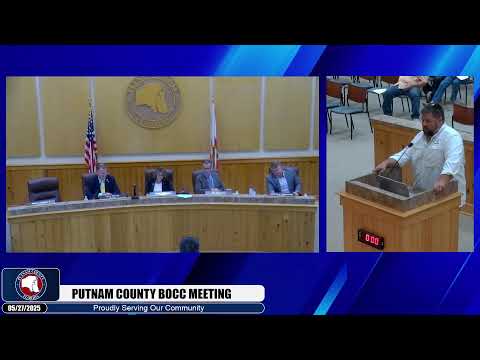
Several current and former participants addressed the board during the proclamation presentation. A participant who identified herself as Nikki described a long history of opioid use beginning after a childhood accident and said the court helped her “change my life” and that she expected to “graduate in October.” A current participant who identified himself as Ward said the program was “giving me my life back.” A recent graduate, Jess, said she now works two jobs and has custody of her son, and told the commissioners, “Drug court 100 percent saved my life.”
Judge Morris told the board drug court participants receive frequent probation check-ins, random drug screening and both group and individual counseling; she said the program partners with Stuart Marchman for treatment and residential placement when needed. She also cited a local recidivism estimate, saying “about a 75 to 80 percent deal where these people don’t get arrested again.”
Commissioners praised the program and its staff; Commissioner Harvey said the 252 reported program completions “amount to something” and expressed gratitude to the team. The board did not take further budgetary action during the presentation.
The proclamation formalizes the county’s recognition of problem-solving courts and highlights the program’s stated role in treatment and reduced recidivism. County officials told the board the program depends on the continued cooperation of judicial, law-enforcement, treatment and probation partners.