Get Full Government Meeting Transcripts, Videos, & Alerts Forever!
Get email alerts on the Physician Discipline topic
No spam. Unsubscribe anytime.
Medical Board hears oral argument in Dr. Rowena Garcia Chua Poco disciplinary case; panel reserves decision
Summary
On May 14, 2025, the Medical Board of California, Panel A heard oral argument on an accusation against Dr. Rowena Garcia Chua Poco. Counsel disputed whether oxygen saturation readings and delayed charting supported discipline; the record was closed and the panel will deliberate in closed session with no decision issued today.
The Medical Board of California, Panel A heard oral argument May 14, 2025, in the disciplinary accusation against Rowena Garcia Chua Poco, MD (physicians and surgeons certificate number A51290). After argument the panel closed the record and moved to closed session for deliberation; the parties were told they would not receive a decision that day.
The hearing focused on three contested factual and procedural issues: whether the procedure record showed true hypoxia during the colonoscopy, whether the physician’s contemporaneous charting and later edits were accurate and timely, and who carried primary responsibility for monitoring sedation during the procedure. The parties also debated how much weight the panel should give the presiding administrative law judge’s proposed decision and which statutory standards apply.
Respondent counsel Cyrus Tabari told the panel the issue of discipline should be viewed in the context of Dr. Garcia Chua Poco’s experience and subsequent corrective steps. Tabari said the doctor had performed “over 15,000 colonoscopies in her career” and that, after the incident, she “convinced [her partners] that they should start using certified registered nurse anesthetists for all endoscopy procedures.” He argued that the presence of a CRNA “alleviated and mitigated” monitoring concerns and that the Administrative Law Judge’s findings deserve the panel’s great weight under the Business and Professions Code as stated in counsel’s argument.
Deputy Attorney General Thomas Ausley, representing the Medical Board’s enforcement side, disputed the characterization of the clinical record and emphasized evidence the patient had critically low oxygen-saturation readings. Ausley argued the record contained two hypoxic readings he said were 11 minutes apart and that the failure to timely correct or supplement the charting was significant. He told the panel the respondent had 10 weeks after the procedure to correct entries and did not do so, and that experts for the complainant had relied on the low oxygen readings in reaching causation opinions.
Both sides also disputed whether particular entries should have been in the medical record or reported to other agencies. Tabari said the death-report form required under the Business and Professions Code was properly completed and that the respondent even provided a supplemental summary beyond what the form required. Ausley contended the charting and incident reporting left material inconsistencies that the ALJ should have addressed and that the absence of timely, accurate documentation undermines the respondent’s position.
Dr. Garcia Chua Poco spoke under oath and described typical procedural focus and division of responsibilities in endoscopy: “I focus most of my attention to the monitor because I don't want to perforate... If that 39% happened while I did not see it or if my eyes were not on that monitor, I expect the nurse to alert me.” Panelists asked follow-up questions about the monitor alarms and the interval in which vital signs were recorded; Dr. Garcia said clinicians at the facility sometimes switch to alternate monitors that do not produce a permanent recorded printout and that she could not say whether alarms were turned down or disabled that day.
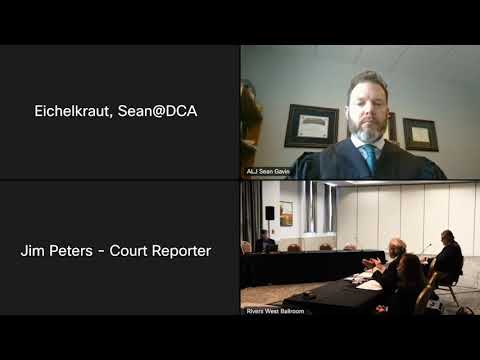
The panel chair, Administrative Law Judge Sean Gavin, instructed the parties that oral argument was limited to the existing record and that no new evidence would be received. After closing remarks the ALJ announced: “The record is closed. The case is submitted,” and the panel moved into closed deliberations. The ALJ told the parties, “The parties will not receive a decision today, but will receive it sometime in the future.”
The panel did not vote or issue a decision at the May 14 session. The closed deliberation and any future decision will determine whether the accusation is adopted, modified, or dismissed.
Votes at a glance: no formal votes were taken during this oral-argument session; the record was closed and the matter submitted to the panel for closed deliberation.
Timeline and next steps: the panel convened closed-session deliberations immediately after oral argument; the parties were told a written decision will be issued at a later date. A full board meeting is scheduled the following day at 9 a.m., per the hearing office’s announcement.