Get Full Government Meeting Transcripts, Videos, & Alerts Forever!
Get email alerts on the Budget topic
No spam. Unsubscribe anytime.
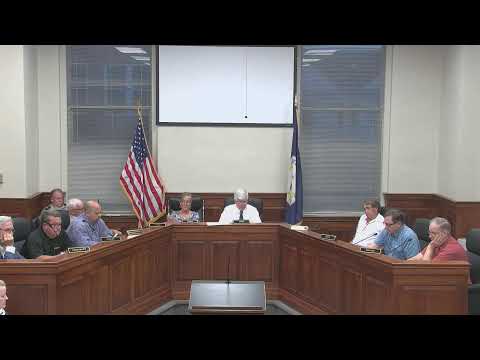
Clark County Fiscal Court approves balanced budget after last‑minute cuts
Summary
County officials approved a revised fiscal-year budget in June after weeks of changes and a lengthy meeting to close a projected shortfall.
County officials approved a revised fiscal-year budget in June after weeks of changes and a lengthy meeting to close a projected shortfall.
County Judge Yates warned that state law requires submission of a proposed budget to the Kentucky Department for Local Government by the end of June and that failure to do so would leave the fiscal court at risk of having the state step in. "If we don't get something passed, this court will be held in default come Monday morning," Judge Yates said.
The meeting focused on sharply higher estimates for emergency medical services and 911 dispatch costs, several capital requests that had been included in operating lines, and a continued pattern of prior-year carryover shortfalls and one-time federal spending. Bruce Manley, city manager for the City of Winchester, told the court the agreed operating budget for EMS is $4,583,000. "If you take the general fund expenses for EMS, subtract out the revenue, then we split the deficit at a 61/39% as agreed upon by the EMS joint contract," Manley said. He presented the county portion of the EMS deficit as $968,370 and a county capital portion of $491,665, bringing the county total exposure to $1,460,035.
Magistrates and department heads pressed for ways to bring the budget into balance without creating further structural deficits. County staff and elected officials identified several recurring causes of the county's liquidity problems, including two prior years of overstated carryover (the court recorded shortfalls of about $1.4 million in 2023 and $1.6 million in 2024, figures discussed during the meeting) and the use of one-time ARPA funds for projects that left fewer reserves for operating needs.
Discussion: major points - EMS and 911: Officials said the EMS operating budget and associated capital purchases were the largest single drivers of the shortfall. Manley presented the city/county split and capital amounts for EMS; commissioners discussed dialing the county EMS appropriation down for the budget submission and addressing capital financing separately. - Revenue carryover and estimates: County staff said prior years had overestimated carryover and miscellaneous revenue; several magistrates pushed to use more conservative carryover estimates for the proposed budget. - Capital versus operating: Multiple speakers recommended moving large, one‑time capital items (air‑handling unit, cascade air system, sirens, microwave communications upgrades) out of operating and into capital/financing so they do not inflate the county's annual operating requirements. - Fire department staffing and overtime: Fire Chief French and others described unusually high unscheduled overtime and turnover; Chief French said, "We can fix unscheduled overtime, which is what we've been preaching all year. That would save us a lot of money." The court discussed staffing tradeoffs, potential use of a battalion chief or part‑time positions, and training costs for new hires. - Other line items: The court reviewed and trimmed dozens of smaller appropriations (utilities, equipment repair lines, animal control salary line, EOC building maintenance) to get closer to a balanced budget.
Directions and next steps identified during the meeting - For the immediate budget submission, the court agreed to reduce several operating appropriations and to remove selected capital items from operating so the budget can be submitted to the Kentucky Department for Local Government by the statutory deadline. - Staff were directed to prepare and file the ordinance/order reflecting the agreed appropriation changes and to provide final printed backup for the records. - The court and city will reconvene the joint EMS board to review operational and capital options; Manley said the joint EMS meeting was being rescheduled for June. - Officials asked county staff to explore financing options (including working with county financing partners) for capital equipment so those costs can be repaid over time rather than in a single operating year.
Formal action The court voted to approve the revised proposed budget for submission to the Kentucky Department for Local Government. The motion passed on the roll call taken at the meeting (votes recorded in the transcript included: Clerk Miller — yes; Magistrate Davis — yes; Magistrate Glenn — yes; Magistrate Constance Douglas — yes; Magistrate Pasley — no; County Judge Yates — yes). The court clerk was directed to finalize the ordinance and forward the budget to DLG.
Context and why it matters County officials said the submission deadline and the risk of state intervention made quick action necessary. The EMS and 911 increases, along with prior years' carryover overestimates and the inclusion of capital in operating accounts, left the court with an urgent need to reallocate and, where possible, finance one‑time costs. The approved package balances the books for the short term but does not resolve structural issues officials said need a longer-term plan: more conservative revenue forecasting, a separate capital budget or financing program, and measures to reduce overtime and turnover in public safety departments.
What remains unresolved Officials said capital financing details and the final split of certain capital costs between city and county will need additional discussion. The court also flagged follow-up work on staffing and overtime in the fire department and on mapping and prioritizing siren/microwave communications upgrades so the county can limit replacement needs and try to recover outside funding where available.
Ending With the vote, county staff will prepare the ordinance for filing with the Kentucky Department for Local Government and pursue financing and interlocal discussions on the largest capital expenses. Officials said further budget monitoring and a potential amendment process will follow as actual revenue receipts and final interlocal decisions become clearer.