Get Full Government Meeting Transcripts, Videos, & Alerts Forever!
Get email alerts on the Timely Use Of Funds Policy topic
No spam. Unsubscribe anytime.
Staff propose interim 'timely use of funds' policy to extend deadlines for wildfire‑impacted projects
Summary
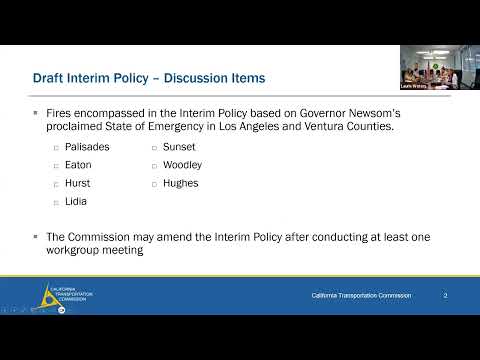
Commission staff presented a draft interim "timely use of funds" policy at a Transportation Commission working group meeting proposing extended deadlines for projects delayed by recent wildfires in Southern California.
Commission staff presented a draft interim "timely use of funds" policy at a Transportation Commission working group meeting proposing extended deadlines for projects delayed by recent wildfires in Southern California. The draft would extend allocation deadlines for affected projects from June 2025 to the December 2025 commission meeting, automatically lengthen the contract‑award window, and allow amended time extensions for projects that can show delays directly attributable to the fires.
Staff said the policy would apply to the Active Transportation Program, the Local Partnership Program, the Solutions for Congested Corridors Program and the Trade Corridor Enhancement Program. It would not apply to the State Transportation Improvement Program (STIP), because timely‑use provisions for the STIP are set in statute and would require legislative change to alter.
Alika Changizi, Manager, Active Transportation Program, told participants that "the time extension request under this interim policy must be submitted directly to Caltrans for processing," and that agencies must tie any request to fire‑related impacts. She said the draft would be presented for adoption at the June commission meeting and that staff would work with Caltrans on implementation details.
What the draft would do
- Allocation deadlines: For projects programmed in fiscal year 2024–25 and identified as affected by the declared emergency, the draft would move the allocation deadline from June 2025 to the December 2025 commission meeting. - Contract award window: The automatic period to award construction contracts would increase from 6 months to 12 months for the duration of the interim policy; the change would be retroactive and include allocations approved at the January, March, May and June 2025 commission meetings. - Amendments and maximums: Projects that previously received a shorter time extension could request an amendment so that the total extension for a given milestone could reach 20 months. Agencies may request additional time beyond 20 months if they can demonstrate that further delay is directly attributable to the covered wildfires; such requests would be considered case‑by‑case. - Normal program requirements remain: Staff emphasized that program rules (environmental clearance, right of way, allocation application content) remain in effect; only the timely‑use timelines would be modified.
Why staff proposed the policy
Commission staff framed the draft as an interim, emergency measure intended to give agencies predictable, standardized options when project delivery is delayed by wildfire impacts such as site inaccessibility, damaged infrastructure, labor and material shortages, and utility delays. Staff said the governor's state of emergency proclamations for Los Angeles and Ventura counties were the proximate trigger for standing up the draft policy, and they invited agencies in nearby counties to request inclusion if they can document fire‑related delivery impacts.
Concerns and implementation steps
Agencies pressed staff for clarifications on retroactivity and process. Marcelino Asencio, Bureau of Engineering architecture division, said his office has seen "bids have been coming back substantially higher" as a result of post‑fire labor and market conditions and asked whether those projects would qualify. Staff replied that projects must demonstrate delays tied to the covered wildfires and that Caltrans district offices would process time‑extension requests following the same submission pathways used for previous emergency policies (for example, COVID‑era extensions), with additional instructions to be provided once the draft is finalized.
Staff listed next steps including: soliciting example documentation from counties and cities (staff asked Riverside County to provide examples tied to Southern California Edison impacts), working with Caltrans to specify submission forms and procedures, and presenting a draft for the commission's June meeting. Staff also said they would evaluate the continued need for the interim policy on a quarterly basis and recommended that provisions remain in effect through completion for any project that receives an approved extension under the policy.
Ending note
Staff asked agencies with imminent deadlines to follow up directly so staff and Caltrans can review specific projects. "If there are specific projects that any of you are worried about because time is, deadlines are nearing, I would suggest ... a separate conversation about specific projects," Laurie (Commission staff) said during the discussion, inviting one‑on‑one follow‑up.