Get Full Government Meeting Transcripts, Videos, & Alerts Forever!
Get email alerts on the Blasting Complaints topic
No spam. Unsubscribe anytime.
Miami Lakes blasting committee warns complaints are falling; agrees outreach campaign to boost filings
Summary
Committee members said state complaint counts have fallen even as blasting continues; they agreed to treat data analysis and marketing as priorities, and to seek town approval to use committee funds for events and sponsorships.
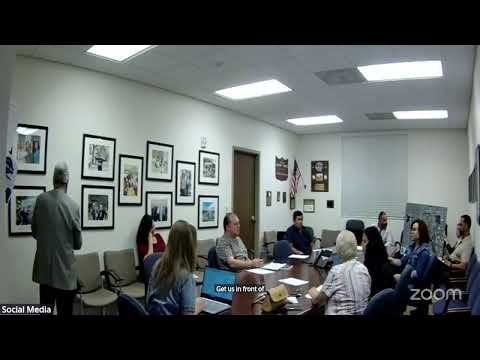
At a meeting of the Miami Lakes Blasting Committee, members reviewed state blasting data and discussed a multi-pronged outreach plan after reporting that new complaint filings to the state clearinghouse have dropped sharply this year.
Committee data presenter Edwin said the committee’s review of the state clearinghouse shows “so far this year, there's only been 88 new addresses being placed as complaints,” and highlighted differences in measured peak particle velocity (PPV) for blasts that generated complaints versus those that did not.
The committee said the gap in filings matters because state and industry officials use the clearinghouse counts and PPV metrics when evaluating mining operations and potential regulatory changes. The presenter pointed to average PPV figures offered in the state data set — about 0.16 for blasts without associated complaints versus about 0.23 for blasts with complaints — and noted a repeated pattern the group tied to a proposed 0.15 PPV threshold as a practical point at which complaints tend to diminish.
Why it matters: committee members said lower complaint counts weaken the public’s leverage with state regulators and make it harder to demonstrate ongoing community impacts from mining operations. Members also raised concerns about the accuracy and completeness of miner-submitted reports to the state and about a legal/geographic limit to state enforcement: the committee discussed how the urban development boundary (UDB) can affect whether state rules apply to particular mines or locations.
What the committee discussed doing
- Outreach and marketing: the committee reviewed a short social-media reel produced by the town marketing team and agreed to a targeted campaign to encourage residents to file complaints. The campaign would prioritize: Miami Lakes residents using the Miami Lakes Connect app and out-of-town residents using the state clearinghouse link; HOA briefings; attendance at local events such as the farmers market; and targeted messaging to neighborhoods with repeated or recent blasts.
- Data-driven messaging: members asked the data lead to produce regular, simplified metrics that the marketing work can use — for example, month-to-month complaint counts, company-level comparisons (the presenter noted that SDI and Polar Rock had no complaints recorded so far in the year), and maps showing complaint locations. The committee discussed flagging the first year a complaint was recorded at an address to show long-term patterns.
- Organizing and sponsorships: members discussed forming a small subcommittee combining data and marketing to produce one consistent, vetted set of outreach materials. They also discussed seeking event sponsorships (for example, a vendor tent or a booth at the farmers market) and noted vendor fees mentioned in the meeting ranged roughly from $70 to $140. The committee agreed staff should confirm whether committee budget lines could be used for outreach and whether council approval would be required.
Concerns and limits discussed
Committee speakers repeatedly warned against relying solely on the miner-submitted official reports. One member recounted receiving a boilerplate response from the state bureau after filing a complaint, which cited state statutes and an administrative code provision and concluded the reported blasts were “within the limits of the current adopted rules or regulations.” The speaker said that response undercuts resident confidence in filing complaints.
Members also discussed resident reluctance to file: fear of drawing attention to private property, confusion between the terms “complaint” and “claim” (insurance claim versus administrative complaint), and discouragement from prior, perceived lack of enforcement. The presenter and other members stressed that the committee’s monitoring equipment and independent university work allow the group to corroborate whether blasts occurred and compare those results to the state clearinghouse.
Next steps
Committee members agreed to form a small ad hoc group combining the data lead and volunteers from the marketing discussion, to produce a clear set of outreach materials and metrics for a campaign. They asked staff to check the committee’s budget lines and to confirm whether council approval is needed to spend funds for a marketing campaign or to accept sponsorship for a town event. Members also proposed a schedule for future meetings to coordinate campaign milestones and a plan to report campaign results as “pre-campaign” and “post-campaign” metrics so effectiveness can be measured.
Ending: The committee left the meeting with assigned tasks — data refinement, marketing material creation, and budget confirmation — and with a direction to pursue public-facing outreach (HOA presentations, farmers market presence and social media) intended to increase complaint filings and provide more robust, verifiable data for regulators and elected officials.