Get Full Government Meeting Transcripts, Videos, & Alerts Forever!
Get email alerts on the Short Term Rentals topic
No spam. Unsubscribe anytime.
Board shortens waiting period for Harding Place owner after unpermitted stays
Summary
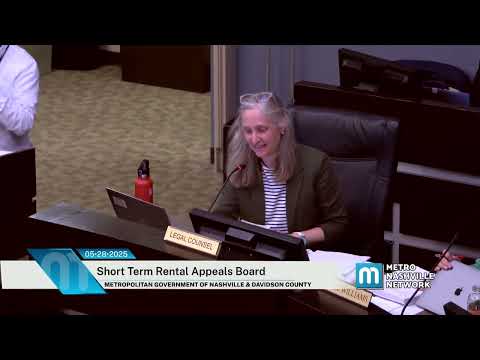
On May 28 the Metropolitan Short Term Rental Board of Appeals reduced the waiting period for an applicant at 676 Harding Place to nine months from April 1, 2025, after finding mitigating facts though staff retains discretion to determine final permit eligibility.
The Metropolitan Short Term Rental Board of Appeals on May 28, 2025 offered limited relief to an owner whose short‑term rental permit application was denied after the property at 676 Harding Place was operated without a permit.
The board voted unanimously to allow the appellant, Yirasi Rocha Bez, to reapply nine months from April 1, 2025, rather than wait the full 12‑month ineligibility period that applies when a property is found to have operated without a permit. The board explicitly left final eligibility — and the question of whether an owner‑occupied permit could ever be issued for the property — to staff to determine when a future application is filed.
Metro staff told the board the property is in an RS‑10 zone where only owner‑occupied short‑term rental permits are allowed. The staff report said the address was advertised on Airbnb and that stays were documented from late 2024 into March 2025, including six documented stays in December 2024. Staff cited the code provision that creates a one‑year waiting period from the date of a zoning administrator determination that an STRP was operated without a permit (cited in the file as section 6.280.030 and related sections).
Appellant Yirasi Rocha Bez told the board she had not realized Nashville required a short‑term rental permit and said she obtained a business license but not the STRP permit. “It was just a big mistake,” she said through an interpreter, and testified she canceled bookings the same day a stop‑work order was posted on the door.
Board members discussed the timeline and the applicant’s prompt action after municipal enforcement contacted her. Several members said the cancellation of bookings and the applicant’s attempt to come into compliance weighed in favor of partial relief. The board’s motion found that the zoning administrator had not necessarily erred in issuing the notice but that the totality of circumstances justified reducing the mandatory waiting period to nine months from 04/01/2025. Staff reiterated that the applicant must still obtain whatever permit is appropriate and that a future application will be reviewed for eligibility.
The board advised the appellant to follow up with staff to confirm what documentation will be required when she reapplies and to resolve remaining eligibility questions.
Details from the staff report, the appellant’s testimony and the board’s discussion are reflected in the record; the board’s action is procedural relief shortening the statutorily described waiting period but not a final determination that a permit must be issued.
The board’s vote was unanimous among voting members present.