Get Full Government Meeting Transcripts, Videos, & Alerts Forever!
Get email alerts on the Hhp Metrics Data Gaps topic
No spam. Unsubscribe anytime.
Stakeholders question HHP 'served' metric and call for better coverage data and year-round options
Summary
At a MassDEP workshop, participants criticized the use of a simple 'households served' metric that counts jurisdictions as served if they have any nearby option, and urged better data on actual participation rates, seasonal coverage gaps and consideration of permanent commercial options.
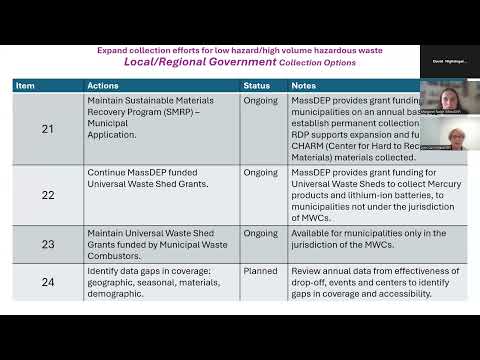
Stakeholders at a MassDEP Household Hazardous Products workshop debated how to measure program effectiveness and highlighted gaps in geographic, seasonal and demographic coverage.
David Grangell (participant) said the workshop’s metric that counts a jurisdiction as "served" if a program exists nearby is misleading and recommended measuring active participation instead. He told the group that prior work suggested a periodicity of about 7.4 years for household hazardous-waste visits, meaning program planners should expect roughly 13–14% of households to attend collection events in a typical year if the goal is to serve everyone over that cycle: “there's a periodicity of how often people show up to bring household hazardous waste is about 7.4 years,” he said.
MassDEP staff responded that the table’s “households and population served” language indicates the presence of a nearby option and does not mean residents participated. Participants urged MassDEP to identify data gaps — geographic, seasonal and demographic — and to collect participation counts rather than relying on proximity-based measures.
Attendees also pointed to limited year-round options and suggested engaging commercial facilities and haulers. Bill (participant) recommended MassDEP reach out to commercial operators, noting examples such as Clean Harbors in Braintree and at least one facility in western Massachusetts and urging the agency to explore business models for permanent collection centers that could operate year-round and charge for service.
No formal decisions were made; MassDEP said it will collect comments, seek additional data and return to the group with updated analyses in future meetings.