Get Full Government Meeting Transcripts, Videos, & Alerts Forever!
Get email alerts on the Epr Expansion topic
No spam. Unsubscribe anytime.
Stakeholders urge MassDEP to broaden EPR work to include paint, lithium‑ion batteries and other product categories
Summary
Participants recommended that MassDEP expand its producer responsibility efforts beyond paint to include mattresses, lithium‑ion batteries and mercury products; they also urged the agency to study and adopt models from other states such as Vermont and to clarify the EPR commission’s role.
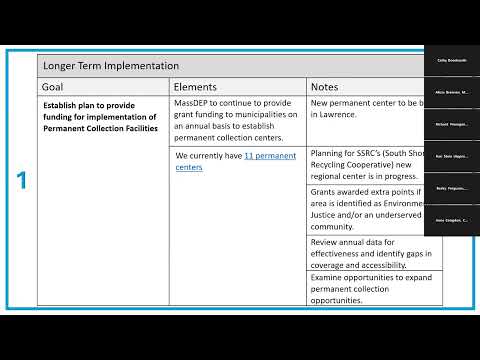
Stakeholders at a virtual MassDEP meeting on the Household Hazardous Products Action Plan recommended broadening the department’s producer responsibility (EPR) work beyond paint care to include additional categories such as lithium‑ion batteries, mattresses and mercury‑containing devices.
The discussion cited existing programs elsewhere and urged MassDEP to research other state models and clarify the EPR commission’s role in advocating for specific legislative proposals. Commenter Jan Amin said Massachusetts “doesn't have to create the wheel” and recommended outreach to states such as Vermont, which have existing EPR structures for various product categories.
Why it matters: Extended producer responsibility programs can shift collection and end‑of‑life costs from municipalities to manufacturers and retailers, increase collection convenience and change how hazardous household materials are managed.
Participants recommended priorities and specific categories. Phil urged including lithium‑ion batteries in the EPR discussion, calling batteries “massive” because of the fire hazard they present at transfer stations and collection points. John Fisher confirmed the EPR commission’s work and MassDEP staff said they would include batteries as a focus for EPR research.
David Nightingale and others recommended including convenience metrics and planning benchmarks in any EPR program — for example, population‑based targets for facility coverage. Jan Amin and Phil recommended outreach to the retail sector and industry associations, not only individual retailers, to make retailer take‑back or incentive programs feasible.
Participants also noted existing, sometimes fading, programs for mercury thermostats and other items and urged MassDEP to inventory those programs to ensure continuity. The meeting included multiple suggestions to coordinate with other states and the EPR commission to learn from enacted programs and to consider future products that could become problematic as the waste stream evolves.
No formal policy decisions were made at the meeting; staff said they would incorporate comments into the draft tables and accept follow‑up input by email.