Get Full Government Meeting Transcripts, Videos, & Alerts Forever!
Get email alerts on the Permanent Collection Facilities topic
No spam. Unsubscribe anytime.
Stakeholders urge MassDEP to develop statewide master plan and larger funding for permanent household hazardous product collection centers
Summary
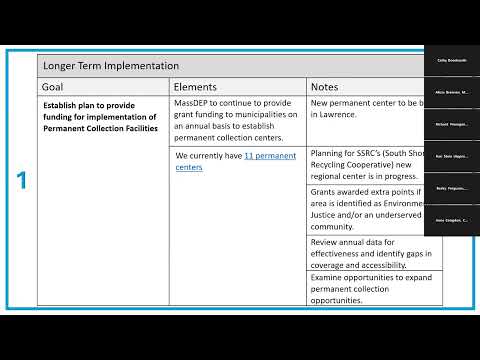
Massachusetts Department of Environmental Protection staff and outside stakeholders discussed the need for a statewide master plan and significantly larger funding to establish permanent household hazardous products (HHP) collection centers during a virtual meeting on the plan's second draft.
Massachusetts Department of Environmental Protection staff and outside stakeholders discussed the need for a statewide master plan and significantly larger funding to establish permanent household hazardous products (HHP) collection centers during a virtual meeting on the plan's second draft.
The group said the current annual grant program that supports municipal collection centers is useful but limited by the amount of funding available through waste‑to‑energy credits. Commenter Phil said the state should consider a larger financial approach—such as an environmental bond bill—to develop a comprehensive, statewide system rather than continuing a piecemeal, town‑by‑town model.
Why it matters: Permanent facilities require substantial capital and operational investments and, stakeholders said, a statewide approach would enable strategic siting, consistent services and full geographic coverage. The discussion focused on how to move from scattered local efforts toward a coordinated network of facilities.
Stakeholders described facility costs and planning needs. Phil said permanent facilities can be “in the range of $3,000,000” and recommended MassDEP pursue a master plan. He said he submitted a request to the Executive Office of Energy and Environmental Affairs for $250,000 to pay for contractor work to produce a master plan that would size facilities, estimate costs, and recommend funding options. Commenter David Nightingale recommended planning targets for facility siting, saying an effective level for major facilities is “something around a hundred thousand to 200,000 population per facility.”
MassDEP staff described current funding limits. John Fisher, who oversees the agency’s solid waste programs, said the department’s “available funding [is] through the waste energy credits,” and that those credits are the primary funding source used across recycling, waste reduction and reuse programs. Fisher added that the recent increase in waste‑to‑energy credit levels is expected to raise the overall amount available for waste reduction grants over time.
Participants urged the agency to consider a separate financing model if the state wants to build a network of permanent centers. Phil said a statewide effort could require “tens of millions of dollars” or more and recommended engaging the commissioner’s office and the governor’s administration early to pursue bonding or other large funding mechanisms.
MassDEP commitments and next steps were limited to process items discussed at the meeting: staff said they would share the PowerPoint tables extracted from the draft plan after the meeting and accept email follow‑ups and meetings to collect further input. No formal votes or policy adoptions occurred at this meeting.
The conversation reflected long‑standing concerns among municipalities and regional coalitions about contractor availability, permitting and long lead times for large procurement and construction projects. Stakeholders asked MassDEP to coordinate more actively with regional planning agencies and other state offices to develop templates for permitting, siting and financing permanent collection centers.