Get Full Government Meeting Transcripts, Videos, & Alerts Forever!
Get email alerts on the Household Hazardous Waste Collections topic
No spam. Unsubscribe anytime.
MassDEP draft HHP plan spotlights expanded collections, funding strain and EPR as a policy option
Summary
Participants at a MassDEP workshop reviewed a draft household hazardous products (HHP) action plan that proposes expanded collection for items such as thermostats, rechargeable batteries and electronics, and flagged municipal budget strain and the potential role of extended producer responsibility (EPR) and statewide funding.
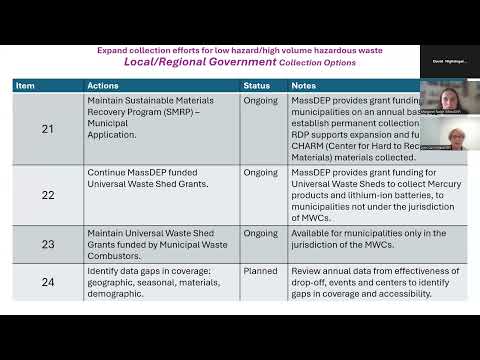
Massachusetts Department of Environmental Protection officials presented a draft Household Hazardous Products action plan that recommends expanding local and regional collection of low-hazard, high-volume wastes — including mercury thermostats, rechargeable batteries and electronics — and asked stakeholders for feedback on costs and implementation.
The plan matters because many municipalities told MassDEP they lack recurring budget capacity to run larger or more frequent collections. Claire (participant) said the community dilemma is “the environmentalist part of me being like, yay. We got more stuff out of households, and the, you know, budget side of me going like, oh my god. How are towns gonna pay for this?” That comment captured repeated concern from municipal representatives about the trade-off between increased participation and local cost.
MassDEP staff listed specific collection recommendations in the draft, calling out rows that would 1) collect mercury thermostats, 2) collect rechargeable batteries, and 3) collect TVs, computers and other electronics. The draft also asks stakeholders to consider “supporting/expanding legislation such as extended producer responsibility (EPR) and expand waste categories,” language attendees discussed as a policy lever to shift costs from municipalities to producers.
Stakeholders said private-sector collection and statewide procurement could mitigate municipal cost. One commenter noted that Call2Recycle is no longer free and that FAC 110 contractors recently compared as more affordable per pound for rechargeable and button batteries. Bill (participant) noted that a small number of commercial facilities, including a Clean Harbors facility in Braintree, serve as year-round disposal options and urged MassDEP to engage commercial haulers and facilities about models to expand permanent collection options.
Participants also urged MassDEP to publicize statewide contracts and promote the FAC 110 contract and related procurement vehicles so municipalities can rely on shared purchasing and management rather than individually recreating programs. Phil Goddard (participant) summarized the funding question succinctly: “There may need to be a statewide funding approach.”
No formal votes or policy adoptions occurred at the meeting; MassDEP staff said they will collect written comments, revise the draft and return with updated slides and information at upcoming meetings.
MassDEP asked participants to email additional inputs and flagged that the HHP action plan draft and tables are available as an attachment to the meeting invitation.