Get Full Government Meeting Transcripts, Videos, & Alerts Forever!
Get email alerts on the Tobacco Nicotine Regulation topic
No spam. Unsubscribe anytime.
Committee debates regulation and penalties for nicotine products; tax removed from amendment
Summary
House Bill 2528A would expand regulation of nicotine-containing products; the committee considered an A3 amendment that removes taxation and switches criminal penalties to civil enforcement, and members asked OHA for clarifications on scope, penalties and rulemaking authority.
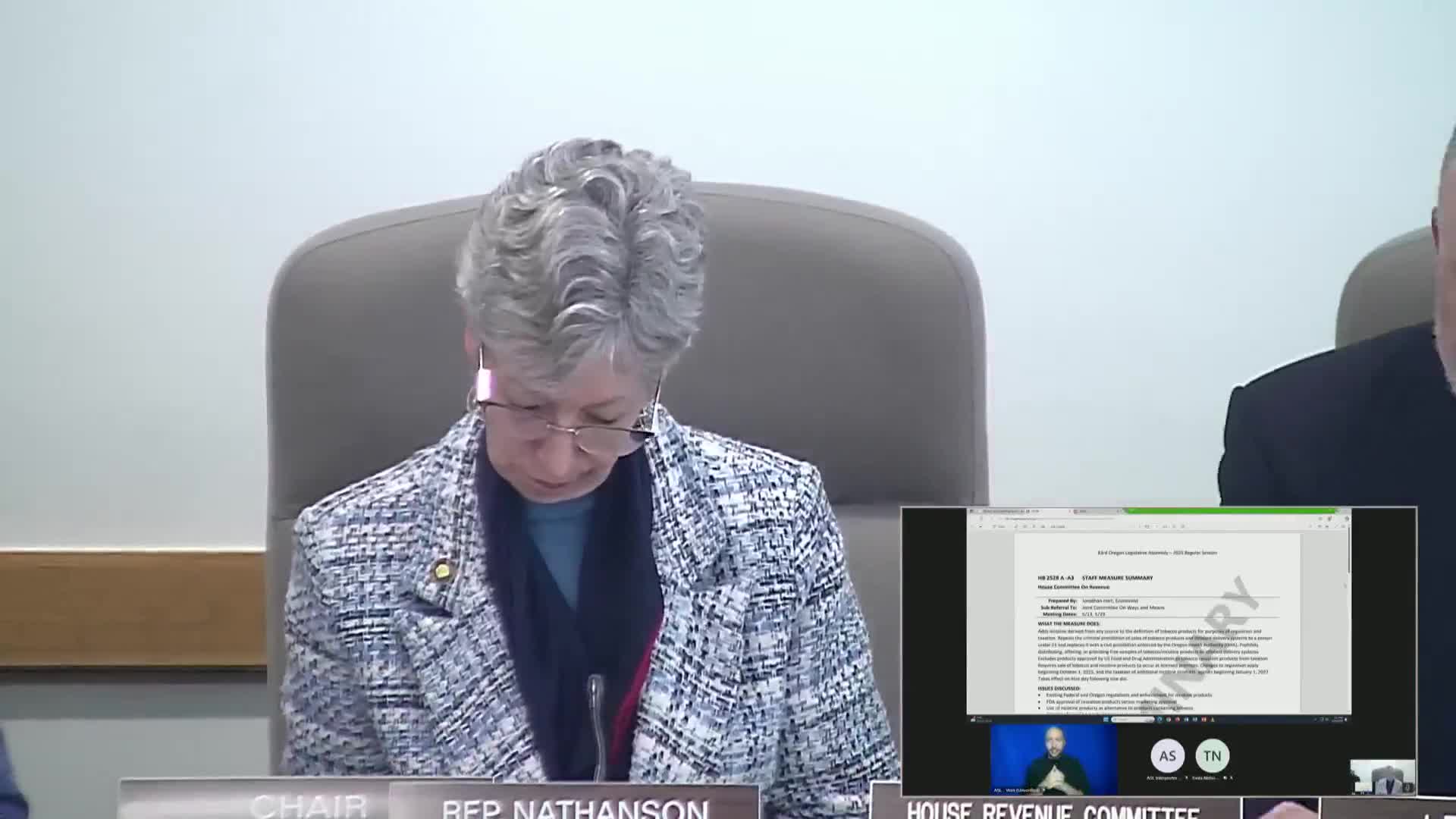
House Bill 2528A, which would add nicotine derived from any source to the definition of regulated tobacco products, was the subject of a work-session discussion May 29 in the House Committee on Revenue. The committee considered an A3 amendment that removes the bill’s taxation provisions and focuses the bill on regulation and civil enforcement.
The A3 amendment adds "nicotine derived from any source" to the definition of tobacco products for regulation, removes the taxation section of the introduced bill, replaces criminal prohibitions on sales with civil enforcement administered by the Oregon Health Authority (OHA), prohibits distribution of free samples, and requires sales to occur only at licensed premises with an effective date of Oct. 1, 2025, per testimony.
Representative Reschke raised concerns about unintended coverage of products that naturally contain trace nicotine, such as some vegetables; he said OHA provided a letter clarifying that the bill’s phrase "products containing nicotine derived, from any source" intends "derived" to mean nicotine that is extracted and added to products, not naturally occurring trace levels. "I looked and there are no vegetables in there, so I think we're good on that," Reschke said after reviewing OHA’s guidance.
Reschke and other members also questioned the penalty structure. The introduced bill converted a criminal penalty range (roughly $50 to $1,000) into a civil penalty up to $5,000 per occurrence under the amendment. Reschke said $5,000 per occurrence could be "quite steep" for small retailers and suggested discussing a graduated scale. The committee asked OHA for clarification on rulemaking authority for products such as nicotine pouches.
Some legislators commented on taxation policy: one member said taxing addictive products is appropriate but must be sized to keep certain products as a lower-cost "step down" option compared with cigarettes. Others favored advancing the regulatory components now and returning to taxation later. Rep. Marsh supported moving the bill with the A3 amendment, saying it advances important safeguards like curbing mail-order sales and restricting signage.
Committee members agreed to give OHA material a few days for review and planned a work session at the committee’s next meeting; the work session on HB 2528A closed with no final vote on the bill or the amendment.