Get Full Government Meeting Transcripts, Videos, & Alerts Forever!
Get email alerts on the Charitable Checkoff topic
No spam. Unsubscribe anytime.
Bill would allow charities to collect checkoff signatures electronically
Summary
Lawmakers heard testimony on Senate Bill 546, which would let charities submit the 10,000 signatures required to qualify for Oregon’s personal income tax charitable checkoff via electronic means beginning Jan. 1, 2026.
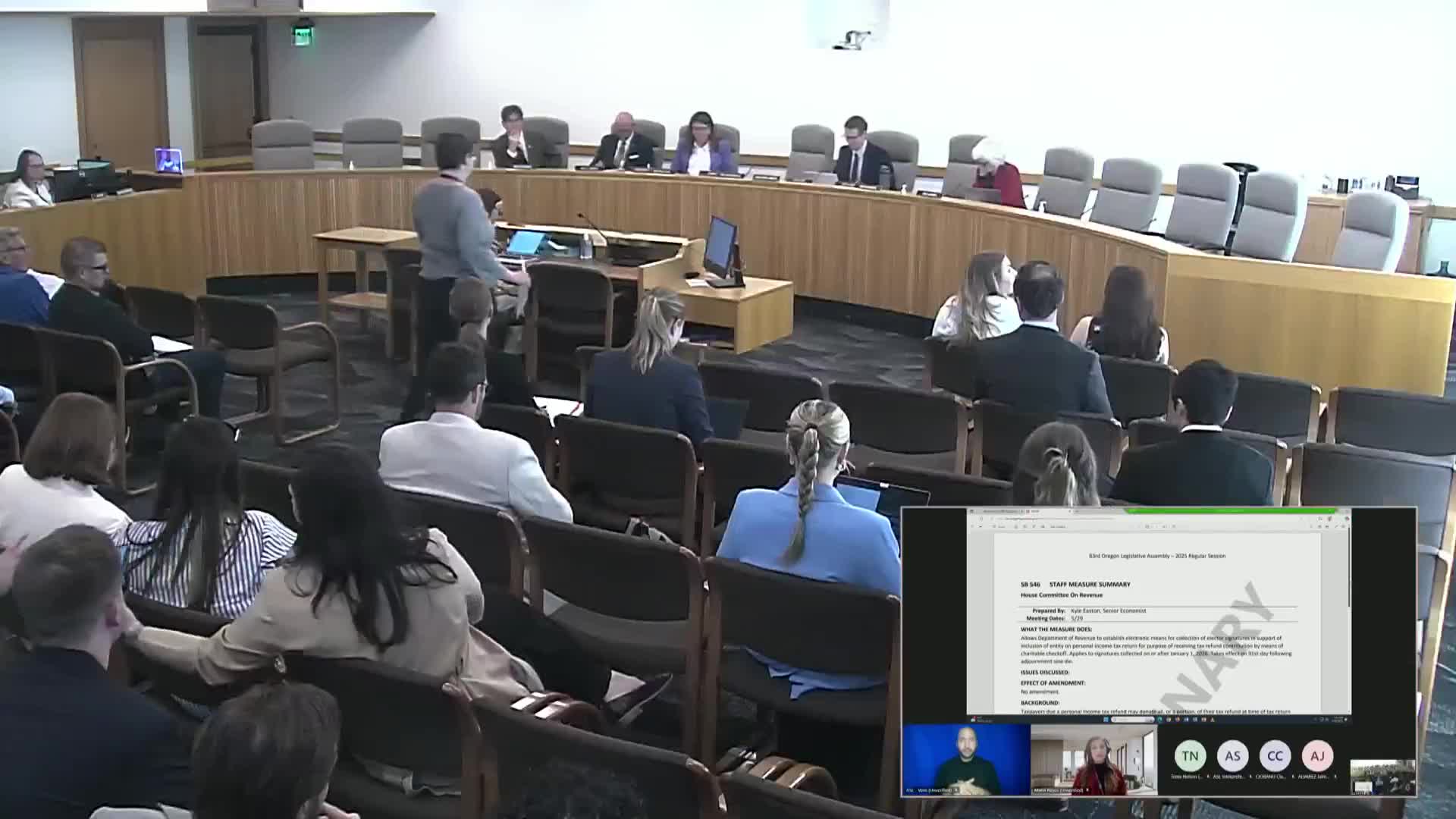
Senate Bill 546, which would allow charities to submit the 10,000 required signatures for Oregon’s personal income tax charitable checkoff by electronic means, was the subject of a public hearing before the House Committee on Revenue on May 29.
The bill would change current law that requires charities to deliver 10,000 physical signatures to the Department of Revenue to qualify for the list of charities that can receive donations from taxpayers’ refunds. "One of the current law requirements is that a charity needs 10,000 signatures to be submitted to the Department of Revenue, and these have to be actual physical, signatures, delivered to the Department of Revenue," said Narmin Rasheed, a legislative intern for Sen. Salman, while testifying in support.
The change would allow those signatures to be submitted electronically for signatures collected on or after Jan. 1, 2026, Rasheed said. "This bill would make it easier for those nonprofit organizations to be included on that list," she added, noting that no new charities had been added in almost 10 years.
Megan Dennison of the Oregon Department of Revenue told the committee the agency would convene a rules advisory committee to design and implement the electronic process if the bill is approved. "If this bill is approved, our plan is to convene a rules advisory committee that would determine how best to implement and administer the electronic process for charities to gather the signatures," Dennison said, and she noted that the Girl Scouts of Oregon and Southwest Washington used paid signature gatherers to qualify two years ago.
Representatives of nonprofits urged the committee to pass the bill, arguing the electronic option would reduce cost and increase equity for smaller organizations. "By changing this law to allow for electronic signature collection, it can help nonprofits that meet all other requirements of the law to qualify," said Tanya Nelson of the Oregon Zoo Foundation. Maria Reyes, also speaking for the Oregon Zoo Foundation and identifying herself as a city councilor, said the change would reduce waste and help smaller groups that cannot afford paid gatherers.
The public hearing closed after testimony; no work session or vote on SB 546 occurred at this meeting.
The bill would take effect for signatures collected on or after Jan. 1, 2026; further implementation details would be determined through rulemaking if the statutory change is enacted.