Get Full Government Meeting Transcripts, Videos, & Alerts Forever!
Get email alerts on the Workforce Development topic
No spam. Unsubscribe anytime.
Nebraska lawmakers adopt workforce-development overhaul after floor fight over minimum-wage amendment
Summary
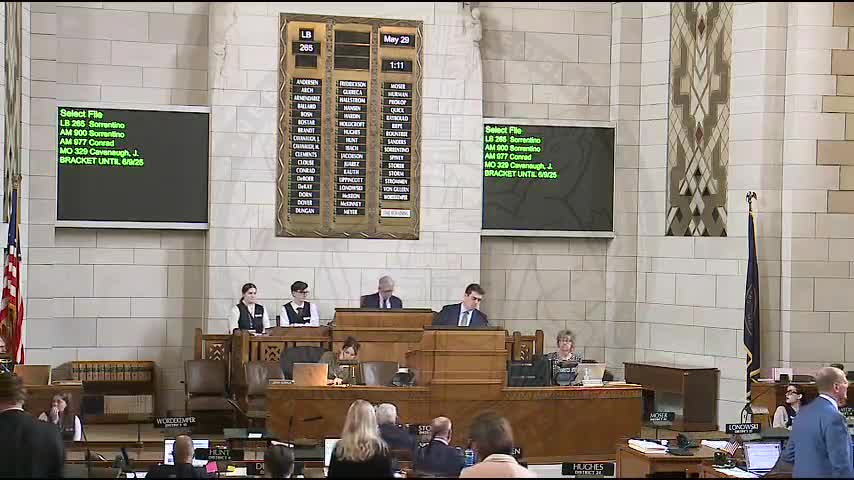
The Nebraska Legislature on the floor adopted a package of amendments to Legislative Bill 265 that consolidates workforce-development funding and advisory structures, after a contentious sequence of floor speeches about a late-filed minimum-wage amendment that its filer said she would withdraw.
The Nebraska Legislature on the floor adopted a package of amendments to Legislative Bill 265 that consolidates workforce-development funding and advisory structures, after a contentious sequence of floor speeches about a late-filed minimum-wage amendment that its filer said she would withdraw.
The bill sponsor, Senator Sorrentino, told colleagues the bill “provides a simplified and consolidated funding mechanism for Nebraska’s workforce development programs” and moves multiple workforce cash funds into a single workforce development program fund administered by the Department of Labor. He said the bill also creates an advisory role for the Nebraska Workforce Development Board and includes a one-year manufacturing pilot program with a matching requirement.
Senators cast the episode as a clash between an effort to finalize a negotiated compromise and a late procedural move that briefly diverted debate. Supporters said the substitute amendment negotiated by Senator Conrad, Senator Clements and stakeholders preserved apprenticeship supports and grant programs, maintained Department of Labor administration, and added guardrails for grant approvals; opponents had objected to what they called an eleventh-hour amendment that touched on the ballot-initiative minimum-wage issue.
Most of the floor debate focused on process and the minimum-wage amendment that had been attached to LB 265 earlier in the day. Several senators said the amendment was filed at the “eleventh hour” and risked “hijacking” a broadly negotiated bill. Senator Hunt called the late filing “a disappointment,” saying the measure threatened other compromise-driven work on the chamber’s calendar. Senator Frederickson and others described the underlying LB 265 and its negotiated amendments as a product of cross-sector work with chambers of commerce, labor, and the Department of Labor.
Senator Raybould, who had filed the minimum-wage-related amendment onto LB 265 earlier in the session, addressed the floor and said she planned to withdraw that amendment and asked colleagues to remove “dilatory bracket motions” that were blocking the negotiated debate. “I do plan to withdraw my amendment,” Raybould said on the floor, and she defended her approach in earlier rounds of debate as data-driven and respectful of voters while disputing characterizations that she was obstructing the process.
After several procedural steps, Senator Conrad moved to withdraw a previously filed substitute amendment (AM 977) and substitute in a collaboratively negotiated amendment identified as AM 16‑43. The motion to withdraw and substitute was adopted on a 42-0 recorded vote. The combined amendment package (AM 16‑43 to AM 900) passed on the floor and AM 900, the white-copy amendment to LB 265, was later adopted 43-2. The Legislature then advanced LB 265 for engrossing.
Key provisions recorded in the adopted language include: - Consolidation of separate Department of Labor cash funds into a single Workforce Development Program Fund for awarding workforce grants and streamlining administration. - A formal advisory role for the Nebraska Workforce Development Board (the board established under the federal Workforce Innovation and Opportunity Act, WIOA) to submit grant proposals to the commissioner of labor; the commissioner retains discretion to approve up to three grant proposals without prior board approval provided they do not in the aggregate exceed 25% of the unobligated beginning annual balance of the fund and that required reporting occurs. - A one‑year manufacturing pilot program that includes a required local match and a cap on the pilot’s total state match funding (sponsors described a matching structure and a one‑year pilot cap; the amendment text references a $50,000 match and a $250,000 cap in the pilot language as introduced on the floor). - Budget technical fixes and a companion funding step from the cash reserve to the general fund described by Senator Clemens to cover green-sheet items and ensure the biennial books balance; Clemens described a $5 million transfer from the cash reserve that would leave an estimated cash reserve balance at roughly 12.3% of general‑fund expenses (figures presented on the floor as part of the amendment debate).
Lawmakers repeatedly placed the negotiated compromise and protecting apprenticeship and career‑technical funds at the center of arguments for adoption. Multiple senators described long stakeholder negotiations—including labor unions, chambers of commerce, Department of Labor staff and legislative offices—that produced the substitute language now adopted. Senator Sorrentino said the adopted language preserves federal‑aligned workforce governance while allowing the state to align funding and streamline grant-making.
The floor debate also included repeated procedural objections and public remarks about institutional trust. Several senators said earlier informal “handshake” agreements and off‑the‑mic deals were harder to rely on this session, and that contributed to the heightened rhetoric. Raybould’s withdrawal of the amendment removed the immediate procedural stalemate and allowed the chamber to adopt the negotiated package and move LB 265 forward.
The amended bill now returns to the engrossing process; sponsors and supporters said they expect Department of Labor staff and the Workforce Development Board to implement the grant procedures and pilot program within the parameters set by the adopted amendments.
The record of the floor votes and the adopted amendment text will be available as the bill moves toward final reading and engrossment.