Get Full Government Meeting Transcripts, Videos, & Alerts Forever!
Get email alerts on the Legislative Oversight topic
No spam. Unsubscribe anytime.
Legislature advances bill creating Division of Legislative Oversight; members debate information‑sharing timelines and criminal‑investigation notices
Summary
Lawmakers advanced LB298, a bill creating a Division of Legislative Oversight that groups the performance audit office and two inspector general offices under a single division and replaces the Performance Audit Committee with a Legislative Oversight Committee.
Lawmakers moved LB298 forward on the floor after a day of debate and several amendments that clarified the new division's duties, information‑sharing processes with agencies, and how the legislature will be notified about criminal investigations involving state facilities and clients.
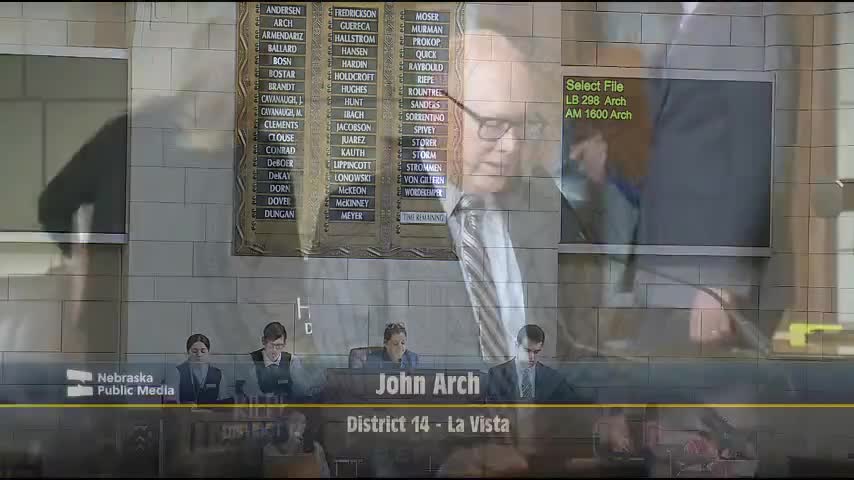
Sponsor Senator Mike Arch described LB298 as the vehicle to create a Division of Legislative Oversight that would house the office of performance audit, the offices of inspector general for child welfare and for the Nebraska correctional system, and the Legislative Oversight Committee to replace the Performance Audit Committee. "LB298 creates a new division within the legislature," Arch said, "the office of performance audit, the office of inspector general for child welfare, and the office of inspector general for the Nebraska correctional system would all be housed under the umbrella of the Division of Legislative Oversight."
Amendments adopted: AM1600 and AM1616 were presented as technical and clarifying changes. AM1600 clarified the corrections OIG must investigate deaths or serious injuries of any individual "in the custody or under the supervision of the department," the sponsor said, to cover county arrestees held as "county safe keepers." The amendment also removed outdated references to the former division of parole supervision after last year's organizational changes. AM1616 added a notification step so that agencies provide notice when a criminal investigation has begun and when it ends, allowing inspector generals and legislative oversight to step back during criminal probes and to know when to resume oversight.
Disputed amendment: Senator Teresa Conrad offered AM16‑14, a floor amendment that would have required state agencies to respond to information requests from inspector generals within seven days unless both parties agreed otherwise. Conrad argued the seven‑day timeframe mirrored public‑records practices and would make oversight more effective. "I believe at the very least the state agencies subject thereto should have to respond within 7 days," Conrad said. Arch and others opposed fixing a specific day in statute, arguing the current language requires timely and least‑burdensome cooperation and that agencies were already providing material in fewer than seven days in many cases. AM16‑14 failed on a roll call recorded in the transcript (17 ayes, 21 nays).
The body adopted the clarifying amendments AM1616 and AM1600 (adoption recorded in the transcript) and then advanced LB298 to engrossing.
Why it matters: LB298 reorganizes several oversight offices under a single legislative division and creates clearer procedures for when inspector generals can obtain records and when they must defer to criminal investigators. Debate focused on balancing investigative confidentiality with timely legislative oversight; proponents said statutory guardrails will help restore routine oversight the chamber said had been limited by a prior attorney general opinion, while opponents urged caution about statutorily locking in specific timelines.
Ending: Sponsors and opponents asked the executive board and the speaker to monitor the new division's operations and to return with statutory refinements if specific problems — such as delays in producing requested records — recur.