Get Full Government Meeting Transcripts, Videos, & Alerts Forever!
Get email alerts on the Budget topic
No spam. Unsubscribe anytime.
Lompoc budget workshop: staff outlines draft operating budget, enterprise fund pressures and options for streets maintenance
Summary
Management Services Director Christy presented the city’s draft operating budget and enterprise fund outlook at the Lompoc City Council’s May 27 budget workshop, warning of multi‑year pressures in several enterprise funds and outlining choices for street maintenance, staffing and capital projects.
Management Services Director Christy presented the city’s draft operating budget and enterprise fund outlook at the Lompoc City Council’s May 27 budget workshop, warning of multi‑year pressures in several enterprise funds and outlining choices for street maintenance, staffing and capital projects.
Christy told the council that the water fund is projected to run operating deficits without changes to rates or service levels — an estimated net operating shortfall of about $1.7 million in fiscal year 2026 and $1.9 million in fiscal year 2027, figures she said are covered by existing fund balance but present ongoing concern. She also identified capital and debt entries that affect the appearance of year‑to‑year operating results and warned that reported operating totals in the presentation differ from final audited statements because of closing entries that move capital purchases to the balance sheet.
Why it matters: Several enterprise funds — water, electric, wastewater and solid waste — face near‑term capital and operating pressures that could require rate actions, debt financing or reallocation of reserves. Council discussion focused on how to balance short‑term pothole repairs and responsiveness with cost‑effective large paving projects that generate bigger PCI (pavement condition index) gains per dollar.
Streets and maintenance options. Staff presented two general approaches: (1) sustain a cost‑effective capital paving program (larger, contractor‑led projects such as cape seals and slurry seals that raise PCI substantially across many blocks) or (2) invest the same money in added in‑house capacity to patch and place thin overlays on many small residential blocks.
Christy summarized staff estimates: adding three street maintenance employees (including equipment) would cost about $900,000 per year; paving materials and delivery for in‑house overlays would add roughly $600,000 per year; the combined two‑year cost was presented at about $3.0 million. Staff said shifting that $3.0 million from capital projects to in‑house operations would reduce the city’s larger contract‑scale paving program by roughly 36 percent and would lower the council’s projected annual PCI gain from approximately 2.5 points to about 1.35 points per year. The staff recommendation was to sustain core crew staffing and maintain the larger capital paving program while exploring additional revenues before changing the capital plan.
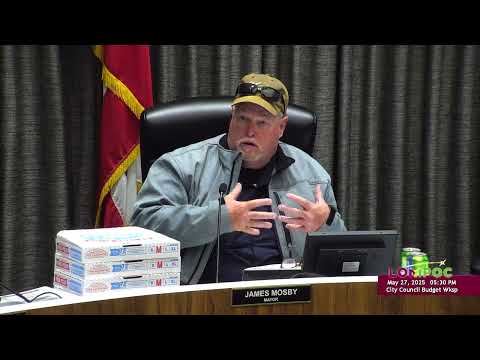
Council consensus. After discussion the council reached consensus to sustain core staffing levels in the streets maintenance division and to preserve the cost‑effective capital paving program rather than reallocate the $3.0 million to add three full‑time street maintenance crew members. Several councilmembers urged staff to examine other revenue sources and report back; Mayor James Mosby and others said streets are a high public concern.
Enterprise fund highlights and other items. Christy reviewed the enterprise funds: electric and wastewater show different patterns once capital and closing entries are considered; solid waste continues to recover from multi‑year deficits related to landfill and equipment costs and may need debt financing or internal loans for essential projects; the airport fund has a recommended CIP match for a hangar rehabilitation grant; transit’s larger projects were listed as potential CIP items.
Specific requests for follow-up. Council members asked staff to provide clearer line-item detail in several areas and to return with additional analysis: breakdown of professional services (large year‑over‑year swings were highlighted), detail on the cost allocation / interfund reimbursement methodology and the basis for merchant/credit card fee allocations, an explanation of capital projects that appear carried forward across multiple budget years, and a review of impact fee balances and whether some restricted fee funds could be applied to paving or operations.
Budget calendar and near‑term decisions. Staff asked for council direction on streets staffing (consensus achieved), on any position changes (none added at this meeting), and on two contribution requests: the Human Services Commission recurring request of $30,000 per year (already included in the draft budget) and a new Mural Society request of up to $50,000 annually (the council deferred further action; staff will bring the request back for later review once year‑end results and other priorities are clearer).
Key quotes from the meeting: Management Services Director Christy: "I am confident that our revenue numbers are good estimates, but they are just estimates." Mayor James Mosby, discussing public safety staffing: "I'm trying to get 5 more positions for the police department." Resident Carl Jones during public comment asked the council to consider fee reductions and “shop local” strategies to increase local revenue.
Next steps and dates. Staff will post a draft budget book and merged CIP for the June 3 meeting and return a final draft for council adoption on June 17; the staff presentation identified June 24 and June 30 as contingency dates if additional meetings are required to adopt the budget. The council also asked staff to bring back, in subsequent weeks or months, supplemental materials requested above for council review.