Get Full Government Meeting Transcripts, Videos, & Alerts Forever!
Get email alerts on the Homelessness topic
No spam. Unsubscribe anytime.
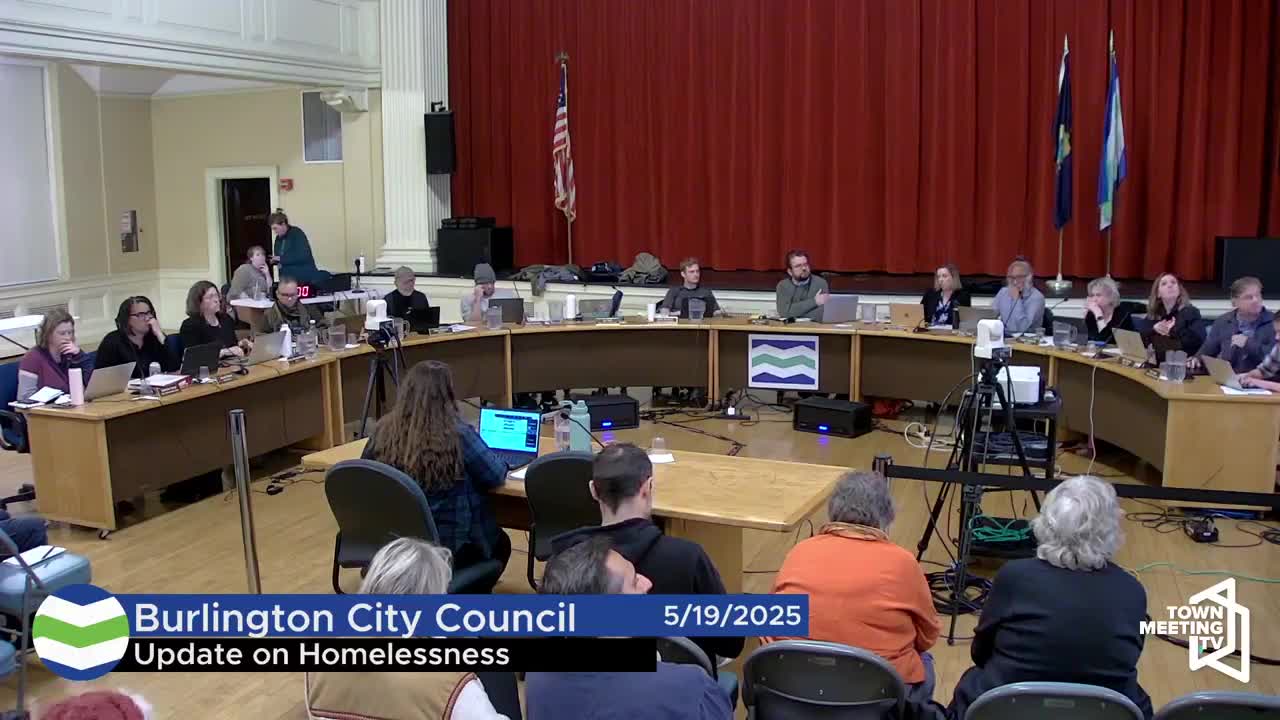
Mayor's office briefs council on unsheltered counts, shelter capacity and House Bill 91 (v-HEARTH) planning
Summary
Sarah Russell, the mayor's homelessness specialist, told the City Council on May 19 that unsheltered counts peaked after exits from a state emergency-housing program and that April's sheltered census recorded 162 people sleeping unsheltered locally; she also outlined shelter capacity and summarised House Bill 91 (v-HEARTH) planning funds and schedule.
Sarah Russell, the mayor's homelessness specialist, briefed the City Council on May 19 about recent changes in the city's unsheltered population, current shelter capacity and a pending state statute (House Bill 91) that aims to shift some homelessness funding and planning responsibilities.
Key data and shelter inventory
Russell said unsheltered homelessness in Burlington rose sharply after several people were exited from the state's general-assistance emergency-housing program; the city hit an all-time high in September the presenter said. She told the council that April data indicated 162 people self-identified as sleeping unsheltered; the city collects that figure in partnership with the Community Resource Center (CRC).
"In April, we had 162 folks who self identified as sleeping unsheltered," Russell said.
She noted a complication in interpreting month-to-month counts: the CRC relocated a meal site and the move reduced the CRC's daily census in April, which altered how many unsheltered people appeared in local counts.
Russell described current and planned shelter capacity: Champlain Place is being renovated to provide 42 year-round shelter beds plus an anticipated 20 seasonal beds; the Waystation currently operates 36 beds and expects to move and expand to an anticipated 56 beds around Dec. 1; the family shelter operated by a partner is 7 rooms and had transitioned operations to the regional service provider on May 1.
The presenter emphasized the local need for low-barrier shelter beds that can serve people with active substance-use or behavioral-health challenges; staff said coordinated-entry data show the largest current unmet need is for low-barrier capacity that allows people to access shelter without strict sobriety requirements.
State-level funding changes: House Bill 91 (v-HEARTH)
Russell briefed the council on House Bill 91, often described in testimony as the Vermont Homeless Emergency Assistance and Responsive Transition to Housing (v-HEARTH) program. She said the bill would phase state homelessness funds toward regional planning and implementation and create a FY26 planning year with $10 million available statewide for transition planning, including a $1 million carve-out for municipalities.
"FY26 will be the planning year in which... $10,000,000 will be available for transition planning," Russell said, adding that FY27 and FY28 would move other funding streams into regional administration. She said tentative FY27 and FY28 funding-transition estimates in the bill were approximately $38 million and $30 million statewide respectively, noting that bill text was still being finalized in the legislature.
Council questions focused on: whether other shelters in the region could take more capacity, how the municipal carve-out would be administered, and whether bill language could preserve state-level accountability for achieving shelter and housing goals. Russell said the planning year will include a community needs assessment and that municipal carve-outs were intended to give local control over some uses of funds.
Why this matters
The briefing linked local service capacity to pending state funding and administrative changes. Councilors pressed for clarity about how Bill 91 would maintain statewide accountability while supporting community-level control and for specifics about the low-barrier capacity the city needs.
What's next
Councilors asked for continued briefings as the legislature moves the bill; staff said the FY26 planning year gives communities time to assess local needs and develop proposals, and Russell asked the council to treat the state timeline as an opportunity to secure municipal carve-outs.