Get Full Government Meeting Transcripts, Videos, & Alerts Forever!
Get email alerts on the Food Mutual Aid topic
No spam. Unsubscribe anytime.
Public forum exposes deep divisions over Food Not Bombs feeding site; council amends resolution supporting downtown businesses
Summary
At a May 19 public forum, residents, business owners and volunteers sharply disagreed about a daily volunteer food distribution at the Marketplace Garage; Councilors later amended and passed a resolution to support downtown businesses while seeking continued negotiations about the distribution's location.
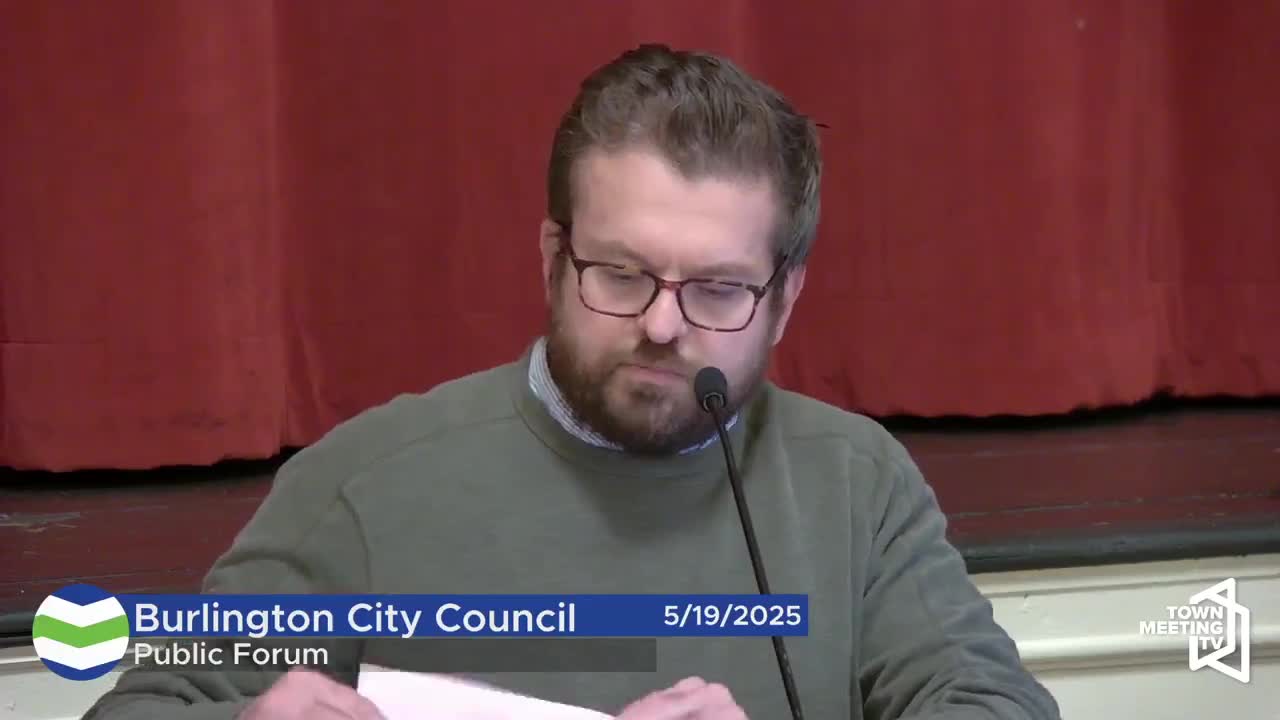
A lengthy public forum at Burlington City Hall on May 19 produced sustained testimony on the city's downtown conditions and a volunteer-run daily food distribution most commonly known as Food Not Bombs (also called Food Not Cops by some participants).
Hundreds of minutes of testimony split roughly between speakers who described the daily distribution at the Marketplace Garage as life-saving mutual aid and speakers who said downtown safety, shoplifting and visible drug use are discouraging customers and harming local businesses.
"People building community, reducing crime, reducing poverty, finding each other shelter, and bettering their lives," said Julie Masuda, an in-person speaker who described the distribution as "precious." Several volunteers, organizers and recipients told councilors that the distribution has provided warm meals, hygiene supplies, tents, blankets and other essentials for years.
Other residents and downtown business owners said they are seeing open drug use, petty theft and aggressive panhandling on Church Street and in the park areas near downtown. "We must act now for the future of Burlington," said Roberto Fitzgerald, who described increased open drug transactions and a mounting sense of fear in the downtown core.
Council action after forum
On the council agenda later that evening, a group of councilors introduced a resolution described by its sponsor, Councilor Max McKnight, as an attempt to support a "vibrant, welcoming, safe downtown" and to show attention to struggling small businesses. McKnight said the resolution was intended to be a first step and included a request that Food Not Bombs consider relocation assistance if it sought a more permanent site with water and restrooms. "No 1 is asking Food Not Cops to stop getting food to the hungry," McKnight said during debate.
The resolution prompted an extended floor debate. Several councilors and many public speakers opposed any requirement that the volunteer distribution relocate, saying forced moves could reduce attendance and increase risk to unhoused people. "I do not think Food Not Bombs food distribution should have to move at all," Councilor Max Broderick said when he brought an amendment to remove relocation language; that amendment passed. A second amendment asking staff to report back on relocation possibilities by mid-July was adopted.
After additional amendments and deliberations, the council approved the final resolution by roll call, 8'to'4 (ayes: Barlow, Carpenter, Litwin, McKnight, Neubieser, Schachter, Singh and Travers; noes: Bergman, Broderick, Grant and Kane). The passage followed a heated public debate and multiple amendments intended to reduce polarizing language.
What supporters and opponents want
Supporters of the distribution emphasized harm-reduction, mutual aid and immediate lifesaving services. Several speakers recounted receiving lifesaving supplies, Narcan, or warm clothing from volunteer distributions and urged the council to support more permanent services such as shelters, restrooms, an overdose prevention center and housing rather than removing volunteers who feed people.
Business owners and other residents emphasized public-safety and economic concerns: some asked for clearer enforcement of trespass and theft laws, more active policing downtown and measures to make downtown feel safe to shoppers and visitors. Several participants urged a joint approach that combines shelter beds, overdose-prevention services, public restrooms and better coordination with volunteer groups.
Why it matters
The exchange surfaced overlapping policy issues: immediate food access and mutual aid, public health and overdose response, downtown policing and trespass enforcement, shelter capacity and long-term housing solutions. It also underscored political divisions about how best to respond and who should be responsible for short-term and long-term solutions.
Next steps
Councilors adopted a resolution that calls for a set of short-term and longer-term actions to support downtown businesses while asking staff to continue negotiations with mutual-aid groups and to report back on potential site solutions for food distribution. Councilors and the mayor's office both said they would continue outreach to Food Not Bombs organizers, business owners and social-service providers.