Get Full Government Meeting Transcripts, Videos, & Alerts Forever!
Get email alerts on the Recycling And Public Works topic
No spam. Unsubscribe anytime.
Burlington approves DPW retention pay as recycling program faces staffing shortfall
Summary
The City of Burlington Board of Finance approved a memorandum of agreement to add recruitment and retention pay for Department of Public Works recycling staff as officials warned of multiple vacancies and the possibility of reduced recycling service.
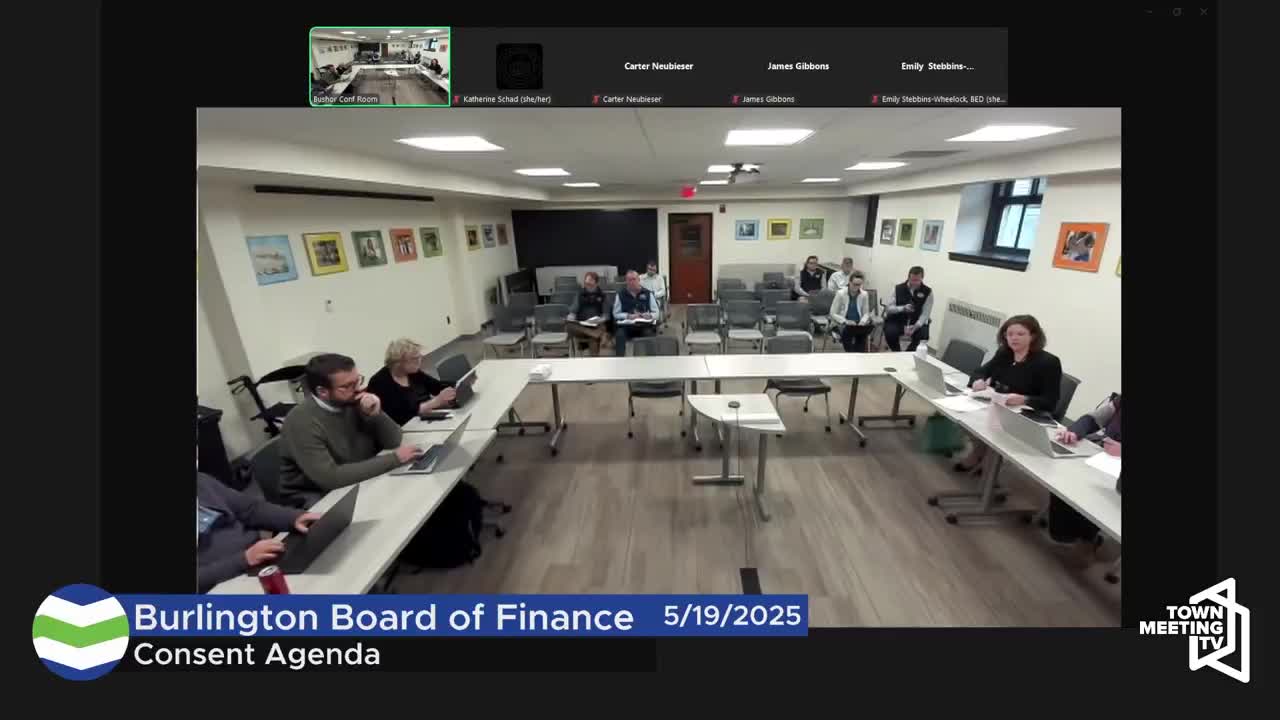
The City of Burlington Board of Finance on May 19 approved a memorandum of agreement with AFSCME Local 1343 to add pay premiums, hiring bonuses and referral bonuses aimed at retaining and recruiting Department of Public Works (DPW) employees for the city’s recycling and street maintenance programs.
City officials said the action is intended to keep the in-house recycling program running as the department copes with multiple vacancies and aging equipment. DPW Director Champion Spencer and Division Director Lee Perry told the board the short-term plan focuses on staffing stability; the medium- and long-term options include either a fully funded in-house approach for 3–5 years, contracting collection for 3–5 years, or evaluating a future consolidated collection system for trash, recycling and compost.
Spencer and Perry described immediate measures in the approved agreement: a $4-per-hour premium for CDL-holding street maintenance or recycling employees who volunteer to staff recycling operations; hiring bonuses and referral bonuses; retroactive premium pay starting April 22 through the end of the current fiscal year; and a budgeted continuation of those premiums and bonuses into fiscal year 2026 (through December). "We approached our streets and recycling staff back in April with the idea of offering premiums, hiring bonuses and referral card bonuses," Perry said. He added that if internal recruitment is insufficient, the department would first offer overtime to other city staff with CDLs and, as a last resort, assign duties on a vocational basis to streets employees.
Officials reported current staffing levels include three recycling vacancies and three street-maintenance vacancies, with street vacancies projected to rise to five within a few months. Perry warned that if recruitment efforts do not “move the needle,” the city may have to reduce recycling service levels, for example moving to every-other-week collection in some areas. Councilor Carpenter asked staff to evaluate options such as alternating-week recycling, pay-as-you-throw models, or adjustments in bin size and service frequency for dense neighborhoods.
Spencer also said the department had previously withdrawn an order for new recycling trucks, worth roughly half a million dollars, to avoid accepting expensive assets before the council decided a path forward. Fleet manager Dave Hammond explained that restarting a new order would require restarting procurement and could incur substantial fees.
Board members unanimously approved the motion to authorize the DPW director to execute the employee retention and recruitment memorandum of agreement with AFSCME Local 1343.
The board’s short-term focus is staffing and keeping the existing in-house recycling operations functional; medium-term work will compare the fully funded in-house option against contracting service, and long-term work will evaluate a consolidated citywide collection model. The DPW said its FY26 budget includes contingency funds to rent or purchase equipment if the department remains committed to an in-house model for the 3–5 year period.
Board members and a public commenter, former Councilor Sharon Buscher, urged the administration to quantify the household cost impacts of possible changes; Spencer said a proposed increase in the solid waste generation tax would be a monthly voter-billed charge and estimated the change to be about $5.10 per month for customers if implemented. Spencer said the tax is typically adjusted annually with the budget rather than midyear.