Get Full Government Meeting Transcripts, Videos, & Alerts Forever!
Get email alerts on the Impact Fees topic
No spam. Unsubscribe anytime.
Burlington staff say impact fees need overhaul; transportation and water targeted for updates
Summary
City staff told the Burlington City Council on May 19 that the city's impact-fee regime'last evaluated in 1992'is overdue for comprehensive review and recommended focusing new collections on transportation and water/wastewater projects while streamlining regulations into administrative rules.
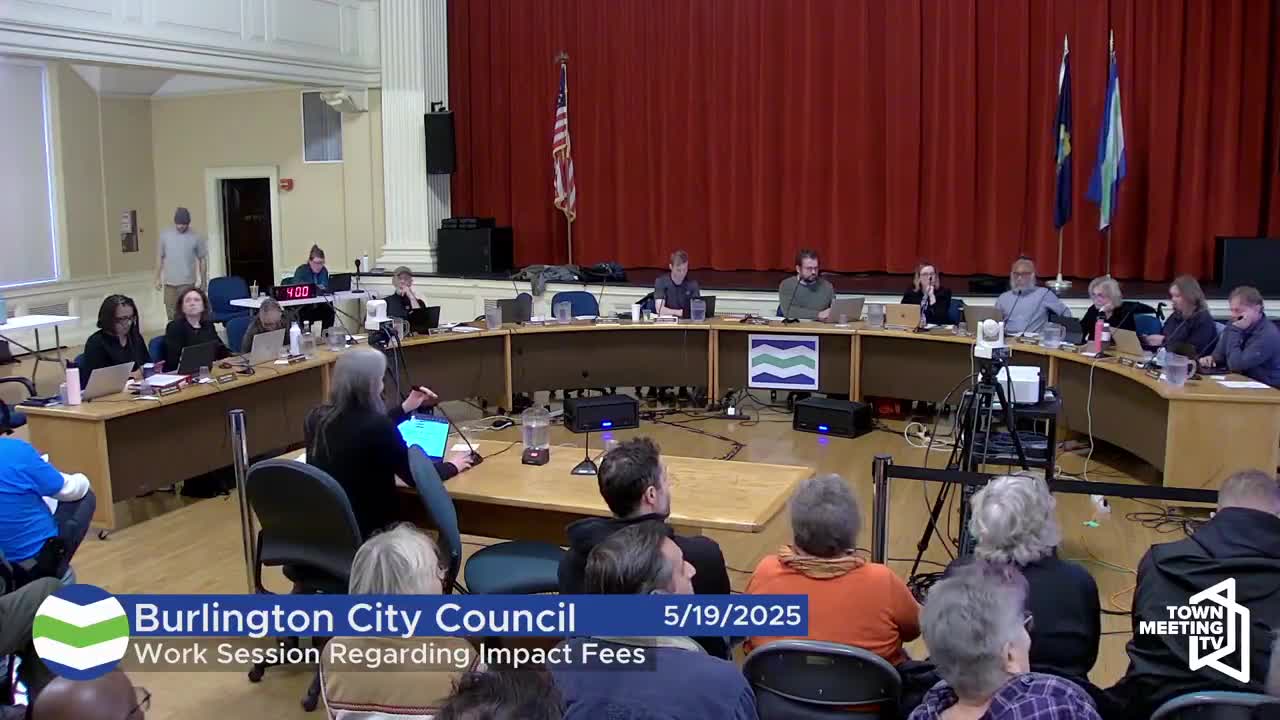
Burlington City Council members heard a work-session briefing May 19 on a multi-year review of the city's impact fees and draft ordinance changes aimed at updating a system last evaluated in 1992.
Consultant and city presenter Ashley Parker said the review inventoried capital assets, interviewed departments and the school district, and tested options for combining or shifting fee categories.
"Impact fees are generally fees that we charge new developments that help us defray certain capital costs," Parker said during the work session. She stressed that fees must fund capital projects that add capacity, not routine maintenance or fixes for existing deficits.
Parker summarized the city's current fee categories: a traffic fee (to be retooled as a transportation fee), fire, police, parks, library and schools; affordable housing is currently exempt. She said impact fees have produced modest revenue historically (staff presented a 10-year average and noted annual collections were small relative to total capital needs) and that the 1992 fee schedule does not reflect current costs or development patterns.
The consultant teams recommended continuing impact-fee collection while concentrating future fees on transportation and water/wastewater assets, Parker said, because those categories showed the strongest legal nexus to new development, the largest capital costs and the most robust 10-year project lists.
Parker described a draft policy direction for the transportation fee to be measured by new PM-peak-hour vehicle trips and noted water/wastewater buy-in fees would be sized by gallons-per-day of new usage. She also told councilors the city has three places with impact-fee language: a city ordinance, the zoning (CDO) ordinance, and administrative regulations; staff proposed streamlining to rely primarily on administrative impact-fee regulations and coordinated zoning amendments.
Nut grafs and timeline
Parker told councilors the update matters because impact fees are a supplemental revenue source that can stretch capital funds for capacity projects; fees must meet statutory nexus tests and be tied to eligible capital improvements. She said best practice is to reassess fees about every five years; Burlington has not done a comprehensive reassessment in three decades.
Staff outlined a schedule for the coming month: a first draft of city-ordinance language was posted and the planning commission reviewed zoning language in mid-May; staff anticipated a city-ordinance second reading and introduction of administrative regulations on June 2, with additional council workshops if needed.
Questions and next steps
Councilors asked about whether project lists included only currently planned capital projects or a broader set of possible projects; Parker said the studies evaluated projects already in the capital plan and stressed that adding new categories now would likely require further planning to identify eligible projects. Councilor questions also focused on competitive impacts compared with neighboring towns and whether the proposed fee stack would influence where developers choose to build.
Staff noted exemptions and waivers already in the regulations and said the administration will continue to work with the planning commission and the council on ordinance text and the accompanying administrative regulations.
Why this matters locally
Updating the fee schedule could shift how capital revenues are allocated across transportation, fire, police, parks, libraries and schools; the council will need to weigh legal nexus, project eligibility, and whether fee revenue can be spent within statutory timelines. Councilors signaled interest in both protecting housing affordability exemptions and ensuring Burlington remains competitive compared with nearby municipalities.
What's next
Staff will return with prepared ordinance language and administrative regulations for council and planning commission consideration; councilors were told a second reading and an initial administrative-regulation package were anticipated on June 2.