Get Full Government Meeting Transcripts, Videos, & Alerts Forever!
Get email alerts on the Land Use Zoning topic
No spam. Unsubscribe anytime.
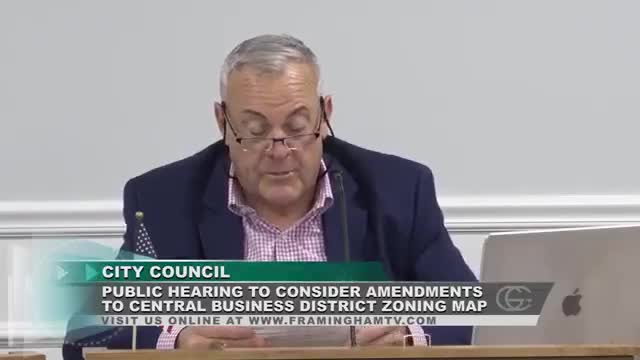
Framingham council approves first reading to shrink Central Business District, citing MBTA compliance
Summary
The Framingham City Council voted 10–1 on a first reading to reduce the geographic size and lower the allowable height in the Central Business (CB) District to meet MBTA zoning unit requirements, with council members and planning officials debating trade-offs for neighborhood impacts, density limits and planning control.
The Framingham City Council moved on a first reading to amend the Central Business District zoning map and related CB height and density provisions, voting 10–1 to send the measure to a second reading. The motion, made by Councilor Long and seconded on the floor, would reduce the CB district’s area, cap building height at 40 feet (four stories) by right, and prohibit waivers and variances for multifamily developments of more than 10 units.
Supporters said shrinking the CB district and lowering permissive height would limit out‑of‑scale development on side streets and address parking and traffic impacts that residents have raised for years. “This reduction to the CB District is much needed,” Councilor Long said during debate, adding the change is intended to meet the MBTA zoning unit requirement without allowing the larger, by‑right development that councilors and neighborhood residents have criticized.
The move follows months of discussion about MBTA zoning compliance and how Framingham should meet the state’s required unit totals while preserving neighborhood scale. Planning‑board member Mitch Maturum, speaking as a private citizen, backed reducing allowable height to four stories, saying 4‑story projects align better with historic buildings and give the planning board more practical leverage in shaping proposals: “Four story buildings don’t present the same problems as six story buildings in terms of overwhelming the existing buildings,” he said.
Opponents, including councilors who represent downtown neighborhoods, argued the change could chill investment and reduce the range of housing types developers can build. The Framingham Business Association wrote to the council opposing a reduction from six to four stories and warned it could “send a message to developers and investors that Framingham is still an unfriendly place to do business.” Councilors who live in and represent downtown countered that residents repeatedly tell them tall, dense projects have degraded quality of life on adjacent side streets.
Planning and council members also debated how the MBTA zoning rules interact with local control. Some councilors said shrinking the CB district produces a zone that complies with the MBTA unit target while preserving planning controls for adjacent parcels; others, including Maturum, cautioned that developers could instead build MBTA‑mandated housing elsewhere with fewer controls unless the council crafts a clear differential between MBTA as‑of‑right allowances and locally managed special‑permit processes.
The first reading passed on a roll call of 10 in favor and 1 opposed (Councilor Malek). Councilors also voted separately to request that the planning department study a “transition zone” adjacent to the revised CB district and return options to the council; that study motion passed unanimously. The council scheduled the second reading and final vote for a later session to allow further input and to ensure the submission remains consistent with any MBTA compliance requirements the administration finalizes.
What happens next: under council procedure the measure must return for a second reading and final vote. The council also asked the planning department to develop transition‑zone options for review so members can consider mechanisms that might smooth differences between the smaller CB district and neighboring residential blocks.