Get Full Government Meeting Transcripts, Videos, & Alerts Forever!
Get email alerts on the Middle School Redesign topic
No spam. Unsubscribe anytime.
Portland schools outline middle grades redesign: standards-based grading, expanded advisory and field trips, and '5 of 7' schedules
Summary
District staff presented a multi-year middle grades redesign at the May 19 meeting that will roll standards-based grading out across grades 6–8, require advisory access, continue eighth-grade capstones and field trips, and use a '5 of 7' teacher schedule to preserve collaboration time.
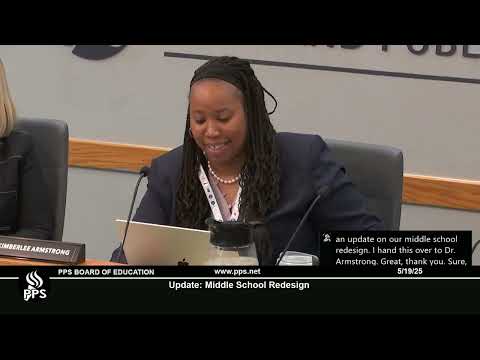
District leaders gave the Board of Education an overview on May 19 of a multi-year plan to redesign the middle-grade experience across Portland Public Schools.
The plan, described by district staff as grounded in racial equity and professional supports, lays out five priority areas and a mix of districtwide, phased initiatives intended to make middle school experiences more consistent across the district.
What the district described: staff said the redesign will move all 6–8 schools, including k–8 campuses, to a standards-based grading model next school year; expand advisory time so middle-grade students access at least 75 minutes per week; continue professional learning for educators; and support scheduling that uses a ‘‘5 of 7’’ model so teachers teach five of seven periods and have collaborative time. Staff said the 5-of-7 model is already in place in the district’s middle‑grade schools.
District staff described several practical program elements now underway or planned: weekly ‘‘eighth-grade success teams’’ at 28 sites that review data and student supports, a structured sixth-to-seventh transition program (including student mentors in 13 of 15 comprehensive middle schools next year), expanded field trips and capstone projects for eighth graders, and digital student portfolios that capture work from sixth through eighth grade.
Field-trip partnerships listed by the district include the University of Oregon, Oregon State University, Bonneville Dam (linked to shared-tribal-history curriculum), the Oregon Zoo, Portland State University, the Oregon Jewish Museum and Center for Holocaust Education, Hoyt Arboretum, Portland Workforce Alliance and others. Staff said they budget for transportation and partner fees so schools do not carry trip costs.
Staff described standards-based grading as replacing single-letter report cards in middle grades with multiple indicators (for example, ‘‘highly proficient’’ and ‘‘proficient’’) across sub-areas of each course. The district also said it has configured the Synergy student-information system to report standards-based grades.
Board members asked how the redesign applies at k–8 campuses, where staff said the core initiatives are intended to be implemented but may look different in practice because of differences in staffing and shared k–5 staffing models. Board members also asked about instructional minutes and class length. Staff said typical middle-grade periods average about 47 minutes under current schedules and that schedules have been adjusted to preserve required physical education minutes and core instructional time.
Ending: District staff framed the redesign as a multi-year, districtwide effort with implementation steps already underway and further work planned next year. The board did not vote on the redesign at the May 19 meeting; staff said schools will continue to receive support and that the district will monitor implementation and scheduling outcomes.