Get Full Government Meeting Transcripts, Videos, & Alerts Forever!
Get email alerts on the Education School Finance topic
No spam. Unsubscribe anytime.
House Concludes Major School-Funding Bill, Backing Teacher Retention Allotment and New Basic-Costs Allotment
Summary
The Texas House voted to concur with Senate amendments to House Bill 2, approving a package that directs roughly $8.5 billion to public schools, with targeted teacher pay increases and a new allotment for district non-classroom costs; the measure passed on a 22-13 recorded vote.
The Texas House on Wednesday concurred with Senate amendments to House Bill 2, approving the education funding package on a recorded vote of 22 ayes and 13 nays.
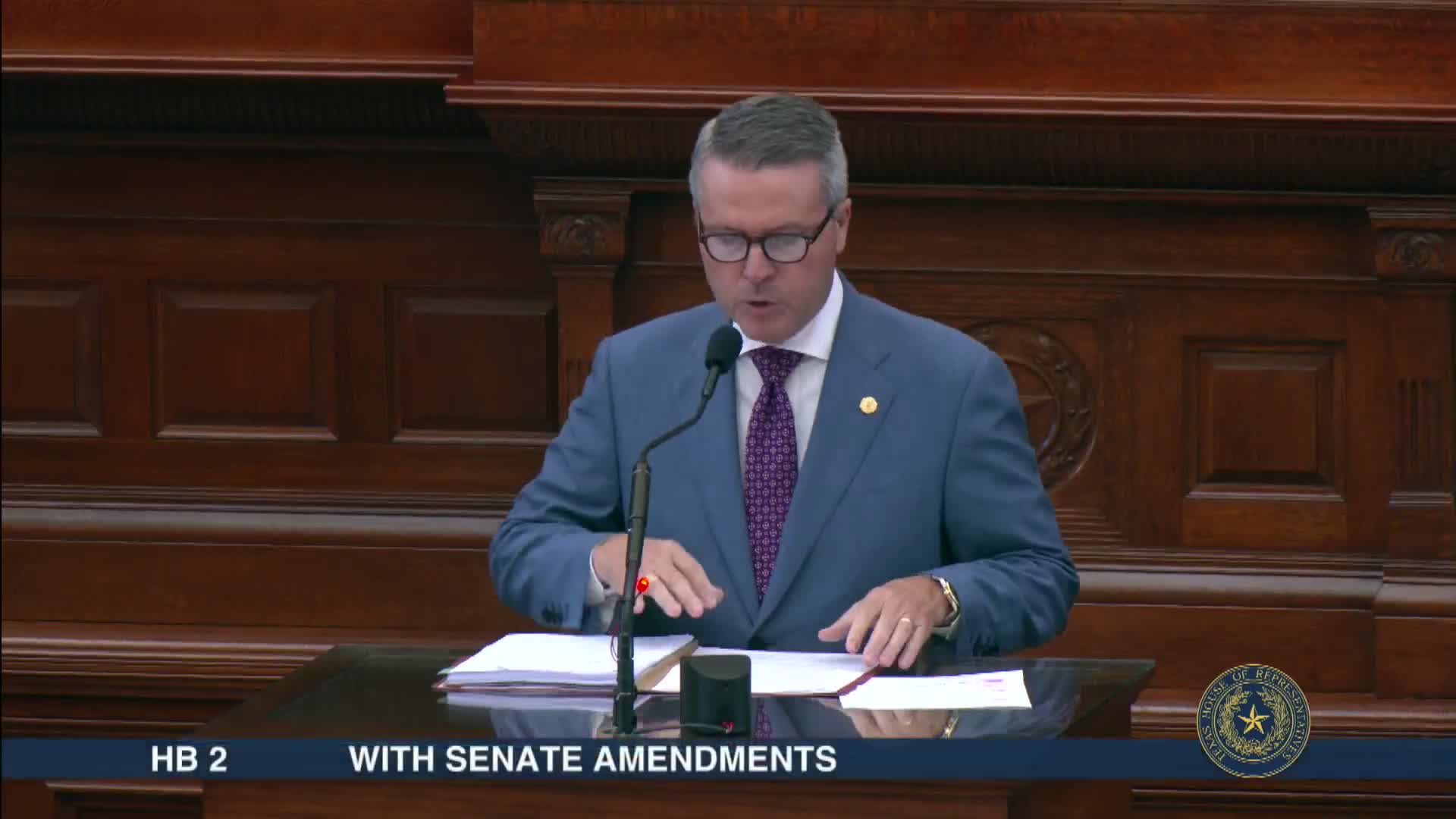
House leaders and the bill’s author, Dr. Buckley, described the measure as the largest investment in public schools in state history, directing about $8.5 billion to school funding and creating several new and altered allotments aimed at teacher pay, special education, early learning and operations.
Supporters said the bill combines a new teacher retention allotment, targeted increases for experienced educators, and a new “allotment for basic costs” (ABC) that is intended to pay for nonclassroom budget pressures such as utilities, transportation and rising insurance premiums. Dr. Buckley said the package includes roughly $4.2 billion for teacher compensation, $677 million for early learning, $850 million for special education and $1.3 billion for the ABC.
Opponents pressed the sponsor on the arithmetic and tradeoffs, asking whether the new ABC and targeted teacher allotments leave less direct per‑student base funding than the House’s originally passed version. Representative Talley questioned why lawmakers were creating a separate ABC rather than increasing the longstanding basic allotment. Dr. Buckley said the ABC was designed to direct funds for operational costs that have grown sharply and to preserve basic allotment dollars for classroom uses and tier‑one funding.
Dr. Buckley described the teacher retention allotment as experience‑based and targeted: in larger districts it would provide $2,500 for teachers with three to four years of experience and $5,000 for teachers with five or more years; in smaller districts the allotment tiers would be larger (for districts under 5,000 students he cited $4,000 and $8,000). He also said $500 million of the package is for flexible district use for nonadministrative staff pay raises.
Members pressed for comparisons with prior needs estimates: one member cited testimony that a roughly $1,400 increase to the basic allotment would be needed to restore 2019 funding levels accounting for inflation, and asked how the House’s original $395 per‑student increase compared to the conference package. Dr. Buckley responded the combined design of the retention allotment and the ABC produces an effect “on par” with earlier proposals when applied in districts, and emphasized the package’s guaranteed teacher pay increases and operational relief.
The House vote to concur concluded floor action on the Senate amendments. Passage of the hybrid package moves the bill toward final enrollment and, if enacted, would change how state school funding is distributed, shifting more dollars into the new targeted allotments described on the floor.
The House recorded the concurrence by a 22‑13 vote.
Dr. Buckley said the measure reflected bipartisan negotiation and credited committee members and leadership for changes made on the floor and in conference. The bill sponsor and several members framed the bill as a fiscally conservative, targeted approach intended to keep dollars flowing into classrooms while addressing rising district operating costs.
Implementation details — such as the operation of the new allotment, the precise distribution formulas by district size and the timetable for districts to use the flexible funds — will depend on final enrolled language and later agency guidance.