Get Full Government Meeting Transcripts, Videos, & Alerts Forever!
Get email alerts on the Louisiana International Terminal topic
No spam. Unsubscribe anytime.
Senate committee advances bill to enable Port of New Orleans to build Saint Bernard transportation corridor; opponents warn of local harm
Summary
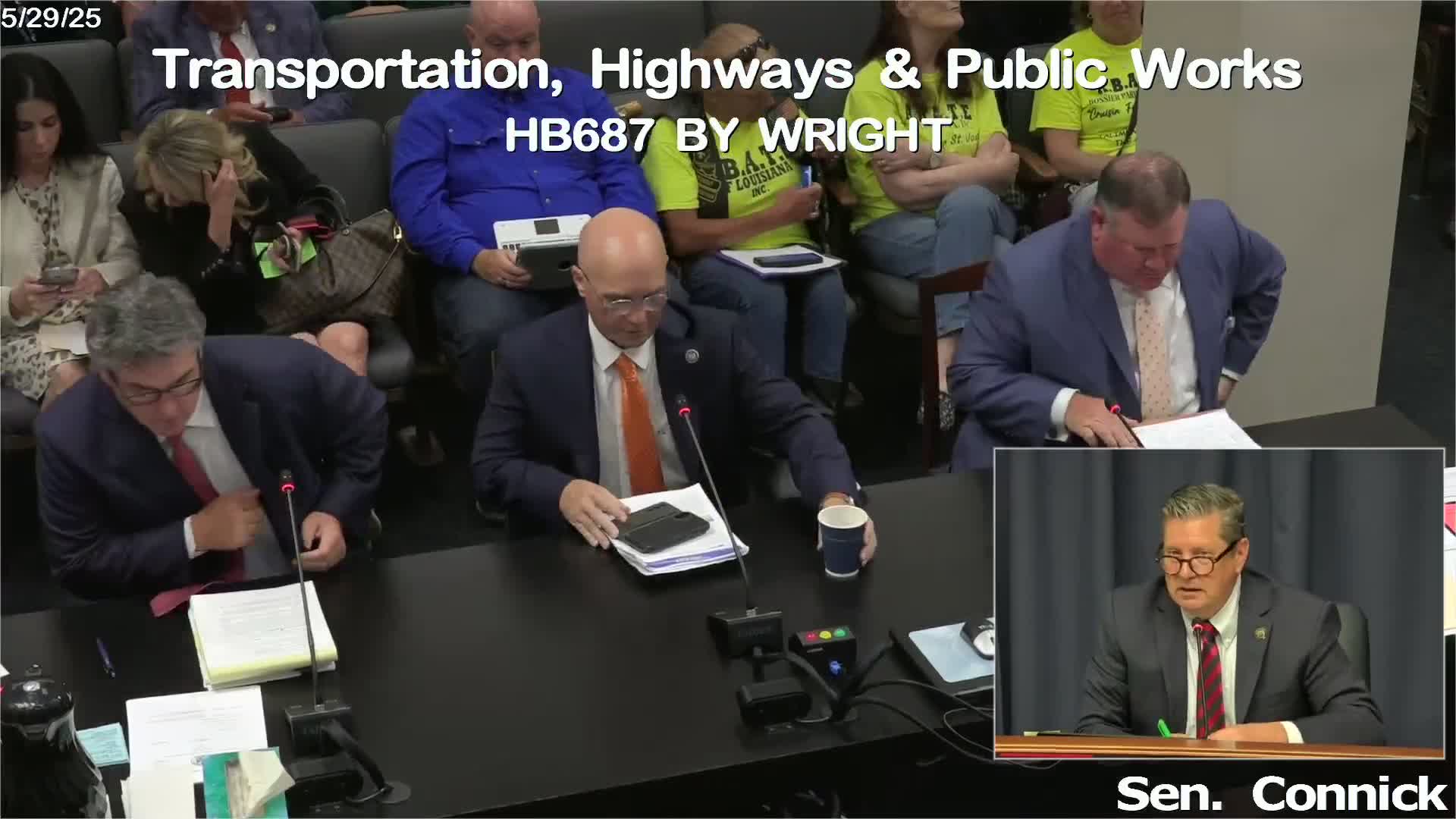
The Senate Committee on Transportation on May 29 voted to report House Bill 687 favorably, clearing a measure that would enable the Port of New Orleans to build, operate and maintain a Saint Bernard transportation corridor to serve the proposed Louisiana International Terminal.
The Senate Committee on Transportation, Highways and Public Works on May 29 voted to report House Bill 687 favorably, a bill that would create a streamlined process for the Port of New Orleans to procure, construct, operate and maintain a public–private Saint Bernard Transportation Corridor serving the proposed Louisiana International Terminal (LIT).
Supporters said the corridor is essential to the terminal and to statewide trade. Jean Paul Escojay, executive counsel for the Port of New Orleans, told the committee the project “represents a transformational investment in Louisiana's trade-based economy.” Michael Hecht, president and CEO of GNO, Inc., said the road is the “linchpin” for the larger terminal project, noting it would keep trucks off local streets and increase evacuation capacity.
Opponents — including Saint Bernard Parish officials, school board members, the parish district attorney and local residents — pressed the committee on environmental, education and local-government concerns. Carly Creason, a Saint Bernard Parish School Board member, said the plan "would be on top of Willie Smith Elementary" and argued the project "does not belong in our community." District Attorney Perry Nicosia recounted the parish's longstanding statutory port jurisdiction and said the presence of a school and other impacts had not been adequately addressed.
Committee members and state officials emphasized the bill sets process, not final approvals. Christopher Kane, outside counsel for the Port of New Orleans, noted the measure would not expand port powers over acquisition beyond existing law; DOTD secretary Joseph Donahue and the bill's author said federal permitting — including U.S. Army Corps of Engineers review — remains required before construction.
Funding and scope: port and project backers described a multi-billion-dollar funding package. Port representatives said federal grant commitments total about $300 million (a $226 million INFRA award plus other federal contributions), private investment about $800 million, and the Port of New Orleans and state capital-outlay commitments together rise into the hundreds of millions more; Port counsel said roughly $1.8 billion in commitments had been discussed. Port and business witnesses told the committee the terminal could generate thousands of jobs and substantial tax revenue by mid-century.
Public process, litigation and next steps: multiple speakers noted two pending lawsuits involving parish government and the project. Supporters said the Corps-led permitting process offers public hearings and environmental review; opponents said litigation and local opposition remain active. The committee recorded a motion to report the bill favorably; committee action does not alter pending federal or local litigation or permit processes.
Votes at committee: A motion to report House Bill 687 favorably passed by voice vote; the clerk recorded no roll-call tally in committee minutes and the committee chair announced the bill would be reported favorably.
Proponents and opponents who testified included port officials, economic development and business leaders, local elected officials, and school and parish representatives; the record shows numerous public-comments and a large in-person turnout at a Corps hearing earlier in the week. The bill now moves toward the full Senate calendar where further review and fiscal/implementation questions may be considered.
Ending: Committee passage advances statutory authorization for an expedited procurement path for a Saint Bernard corridor tied to LIT, but the project's timeline and ultimate siting remain subject to federal permitting, pending lawsuits and future state deliberations.