Get Full Government Meeting Transcripts, Videos, & Alerts Forever!
Get email alerts on the Permitting Backlog And Fees topic
No spam. Unsubscribe anytime.
Lawmakers and industry press DEQ on permit backlog, fee increase and business impacts
Summary
Lawmakers and industry pressed DEQ on May 29 for a plan and data to address a backlog of Title V permit renewals, the effects of a phased fee increase and whether a third‑party review is needed to restore timely permitting.
Lawmakers and representatives of regulated businesses used an informational hearing Thursday to press the Oregon Department of Environmental Quality for data and a timeline to clear a backlog of expired Title V permits and to evaluate the effects of a recent fee increase.
Chair Lively opened the session to allow DEQ to brief the House Climate, Energy and Environment Committee on permitting timelines and to hear from the regulated community. Director Leah Feldon and Air Quality Division administrator Ali Mirzakalili described program staffing, recent fee legislation and work the agency plans to reduce delays.
DEQ told the committee that in 2023 it proposed an 83% increase to Title V fees after not adjusting fees for more than a decade. Mirzakalili said the phased increase was approved by the Legislature to restore a sufficient fund balance and begin hiring for program vacancies. “That fee increase allowed the EQ to reestablish an adequate ending fund balance and begin to fill vacant positions,” Feldon said.
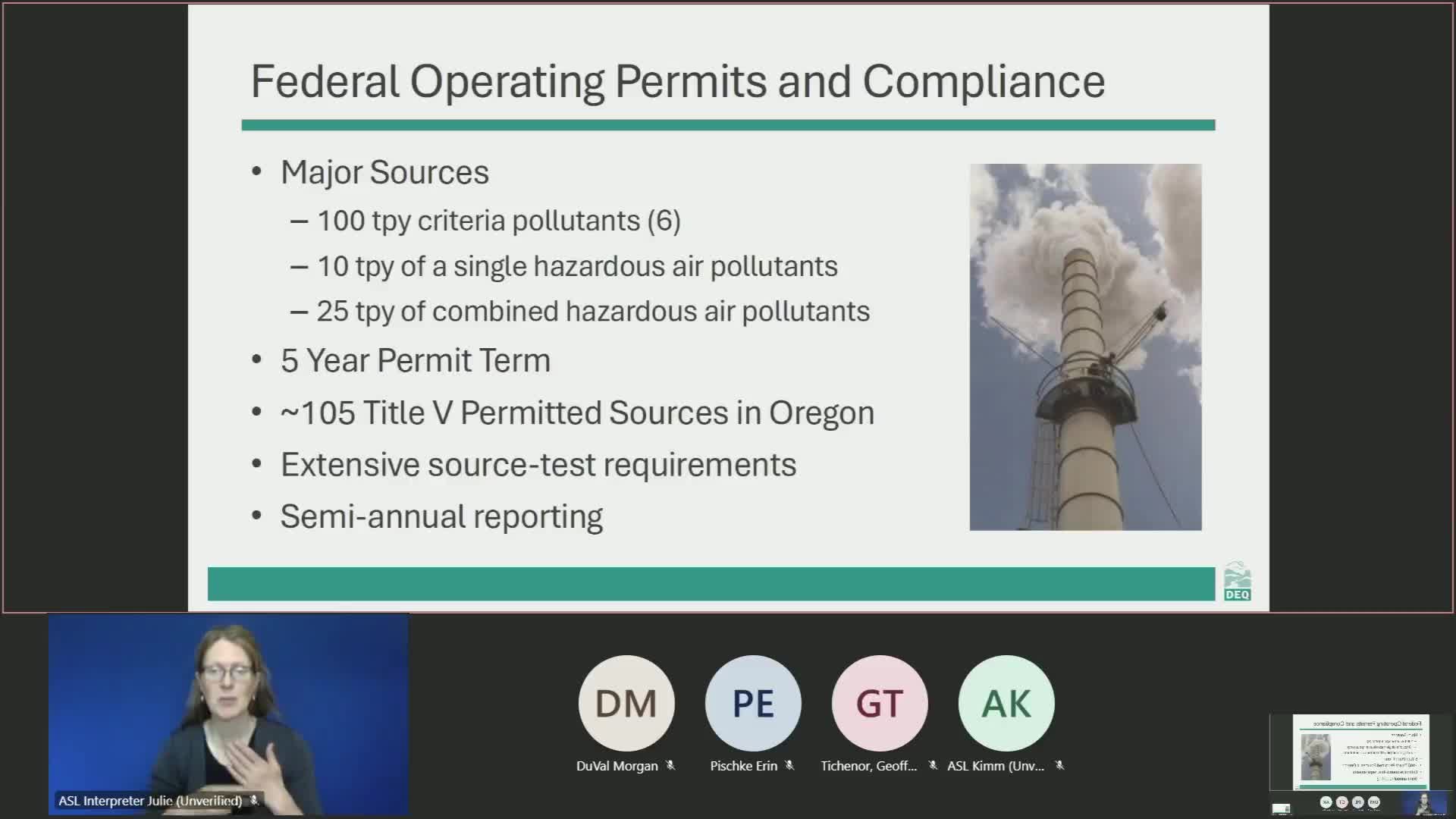
Several legislators questioned how permitting practice changed during the period of fiscal shortfall. Representative Owens said: “In the last 18 months, DEQ has been able to renew 9 Title 5 permits out of 105. Title 5 permits have been in those last 5 years, over 50% of those are now expired.” He asked whether the state should consider asking U.S. EPA to take over the delegated program to ensure regulatory certainty.
DEQ officials responded that revenues shortfalls had forced the agency to prioritize new permits and modifications that allow businesses to proceed, which contributed to slower renewal throughput. “When we are down on resources...we prioritize new applications, and those first come through the ACDP program,” Feldon said. She and Mirzakalili said administrative extensions allow facilities to operate while renewals are pending and that the program continues compliance activities, inspections and technical assistance during extensions.
Representatives of the regulated community said delays and changing rules have tangible costs. Sharla Moffat, senior policy director for Oregon Business and Industry, urged a third‑party review of DEQ permitting similar to the consultant review that helped reform water permitting. “A prudent action would be to include a budget note much like the one from 2015 that evaluated similar issues in the water quality program,” Moffat said.
Chad Darby, an air quality consultant with three decades of experience, told the committee that the Clean Air Oregon program’s requirements often result in long, costly reviews. “The CAO program is so overly complicated. Every facility is having to do a risk assessment,” he said, adding that DEQ had completed risk assessments for seven existing facilities and more than 300 remain to be reviewed. Darby said prolonged timelines and repeated rule makings can force applicants to redo work and discourage investment.
Industry witnesses also said Oregon’s Title V fees compare unfavorably with other states. Darby said he had benchmarked permit fees and found that some Oregon permittees will pay substantially more in annual fees than peer jurisdictions, while experiencing longer permit timelines.
Legislators from both parties pressed for follow‑up: data on the number and status of permits, how many facilities have closed or moved because of permitting timelines, and options for fee restructuring. Several committee members, including Representative Osborne and Representative Edwards, urged a detailed comparison with other states and asked DEQ to return with more data.
DEQ told the panel it is recruiting to refill vacancies and plans workload analyses and process improvements. Feldon said the agency is pursuing pilot changes, such as assigning permit writers who focus only on permit development rather than splitting time with inspections and enforcement, and continuing modernization of the Your DEQ online dashboard to improve transparency.
The committee adjourned after asking DEQ and stakeholders to provide additional materials and to plan follow‑up meetings. Committee members and industry representatives said they expect continued oversight and potential legislative or budget action depending on the data DEQ provides.
Quoted at hearing: Representative Owens — "In the last 18 months, DEQ has been able to renew 9 Title 5 permits out of 105." Sharla Moffat — "Clean air is essential. Jobs and a healthy, an economy are also essential and we have to figure out how to do both." Chad Darby — "The CAO program is so overly complicated. Every facility is having to do a risk assessment."