Get Full Government Meeting Transcripts, Videos, & Alerts Forever!
Get email alerts on the Air Permitting topic
No spam. Unsubscribe anytime.
DEQ briefs lawmakers on Oregon air permitting: notice‑and‑go, plant‑wide limits and Clean Air Oregon
Summary
Oregon Department of Environmental Quality staff described the state's air permitting system, recent 2022 rule changes that added a "notice‑and‑go" pathway and plant‑wide emission limits, and the Clean Air Oregon air‑toxics review process while answering committee questions about modeling, monitoring and timelines.
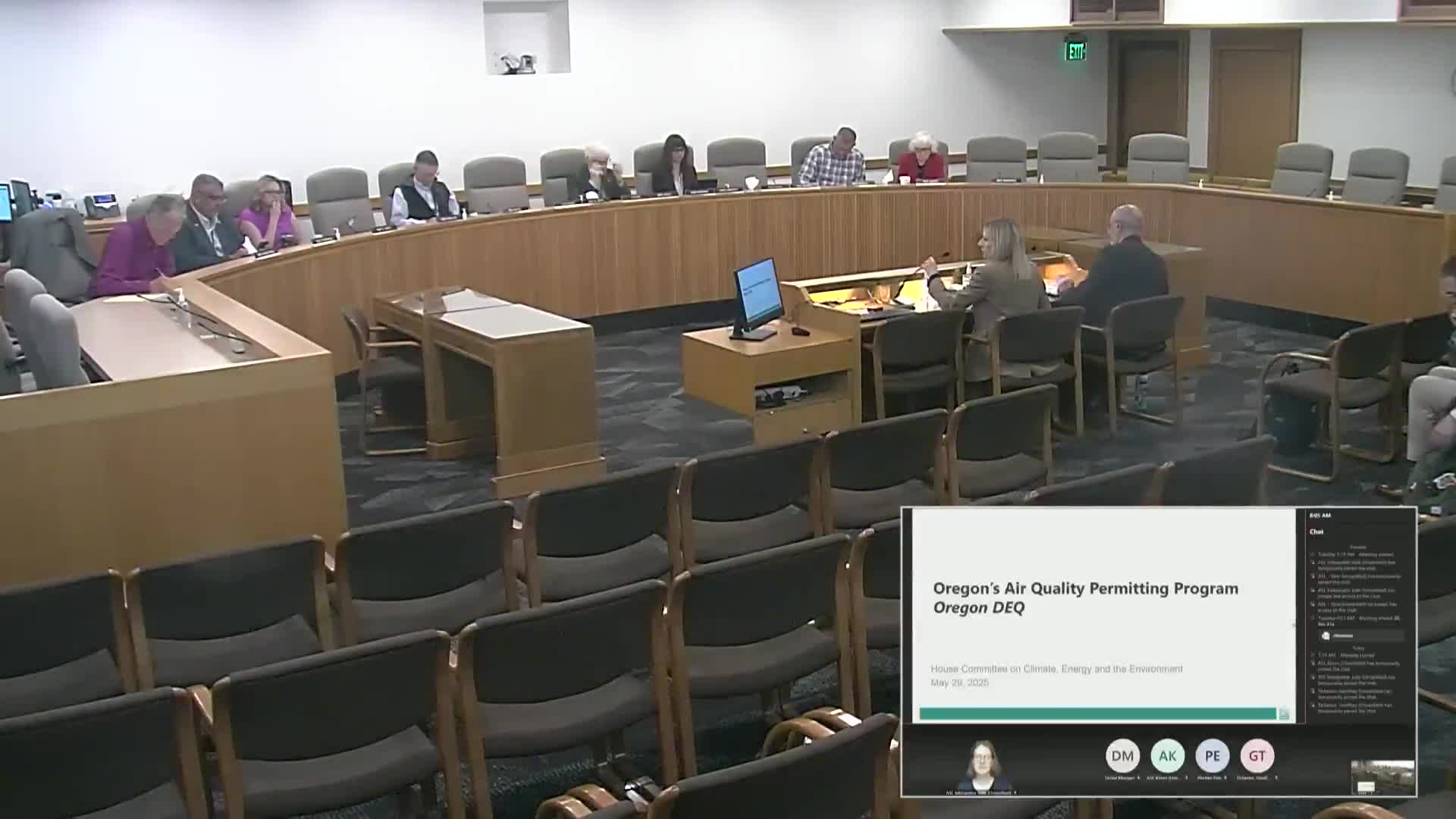
The House Climate, Energy and Environment Committee heard an overview Thursday from the Oregon Department of Environmental Quality of the state's air quality permitting programs, including ACDP (Air Contaminant Discharge Permits), the federal Title V program, and the state’s Clean Air Oregon air‑toxics process.
Leah Feldon, director of the Oregon Department of Environmental Quality, opened the briefing and said the agency would summarize “the air quality permit development process” and explain the three permitting programs that DEQ implements.
The presentation framed Oregon permitting against the federal Clean Air Act and U.S. EPA national ambient air quality standards, or NAAQS. “At a high level, through the Federal Clean Air Act, the US EPA set standards that states must meet for 6 criteria air pollutants,” said Ali Mirzakalili, DEQ’s Air Quality Division administrator. He said ozone and fine particles are Oregon’s greatest challenges relative to the NAAQS.
DEQ described permitting as a multi‑phase process that commonly includes a pre‑application consultation, application completeness review, technical evaluation, public notice and comment, final permit issuance and post‑issuance compliance. The agency emphasized that local land‑use decisions are separate from DEQ’s role of setting operating conditions so facilities do not violate ambient standards.
The ACDP program covers new sources and many smaller or mid‑sized sources. DEQ said ACDP handles notices of intent to construct and many notifications that do not require full permits. The agency reported the ACDP program is largely fee supported and has 37 budgeted FTEs. DEQ also noted that some ACDP permits were extended from five to 10 years in recent rulemaking to reduce renewal frequency and that the program increased use of short‑term activity permits.
DEQ described a major 2022 rule change affecting ACDP permits. The agency ended the practice of issuing generic annual plant‑site emission limits that did not account for short‑duration (daily or hourly) exceedances of NAAQS. Under the updated rules, applicants often must perform dispersion modeling and testing to demonstrate operations will not cause short‑term violations; the modeling assumptions then are incorporated into draft permits.
DEQ staff explained that Oregon’s use of plant‑wide emission limits for major sources is unusual nationally and can provide flexibility to allow certain modifications without triggering federal new source review so long as state plant‑site limits are not exceeded.
On the federal Title V program, DEQ said Title V permits apply to major sources by potential to emit and are issued for five years. The agency said Title V work is funded by annual fees rather than renewal charges and that the program is budgeted at 32 FTEs. DEQ also noted that administrative extensions allow sources to continue operating while renewals are pending.
The agency reviewed Clean Air Oregon, the air‑toxics program enacted by the Legislature in 2018 and implemented through SB 1541 requirements. DEQ described the program’s risk assessment sequence — emissions inventory, modeling protocol and risk assessment — and said that while some new or small facilities can be cleared relatively quickly, reviews of existing, complex sources often require substantial source testing and can take many months. DEQ said some simpler risk assessments have taken under three months, while larger reviews can take up to nine months.
Committee members asked about technical details and program resources. Representative Anderson asked how Oregon differs from other states. Mirzakalili said Oregon’s prior use of generic limits and the statewide plant‑site emission approach were unique features; the 2022 rules closed a gap by addressing short‑term standards. Representative Osborne and other members asked about the effect of new modeling requirements on timelines and costs; DEQ acknowledged the changes increased complexity for applicants and that the agency is providing guidance and tools to implement them.
DEQ said it is updating toxicity reference values for the Clean Air Oregon program on the statutory three‑year cadence and is working on permit‑timeliness improvements, including piloting permit writers dedicated to permit development and continuing modernization of the Your DEQ online system for permit tracking and public dashboards.
The agency said appeals to the Environmental Quality Commission or Oregon Court of Appeals can further extend permit timelines. DEQ also told the committee it will provide members follow‑up data on several items, including counts and timing associated with the notice‑and‑go category and other workload metrics.
The briefing closed with DEQ offering to return to answer further technical questions and with committee members asking DEQ and invited stakeholders for additional information in follow‑up sessions.
DEQ sources quoted: "We strongly encourage" pre‑application consultations, and "this process is frequently an iterative collaboration between the agency and the permit applicant," said Mirzakalili. Director Leah Feldon said the agency will pursue "improvements in the air quality permitting program" and pilot permit writers focused solely on permit writing to improve timeliness.