Get Full Government Meeting Transcripts, Videos, & Alerts Forever!
Get email alerts on the Climate Protection Program topic
No spam. Unsubscribe anytime.
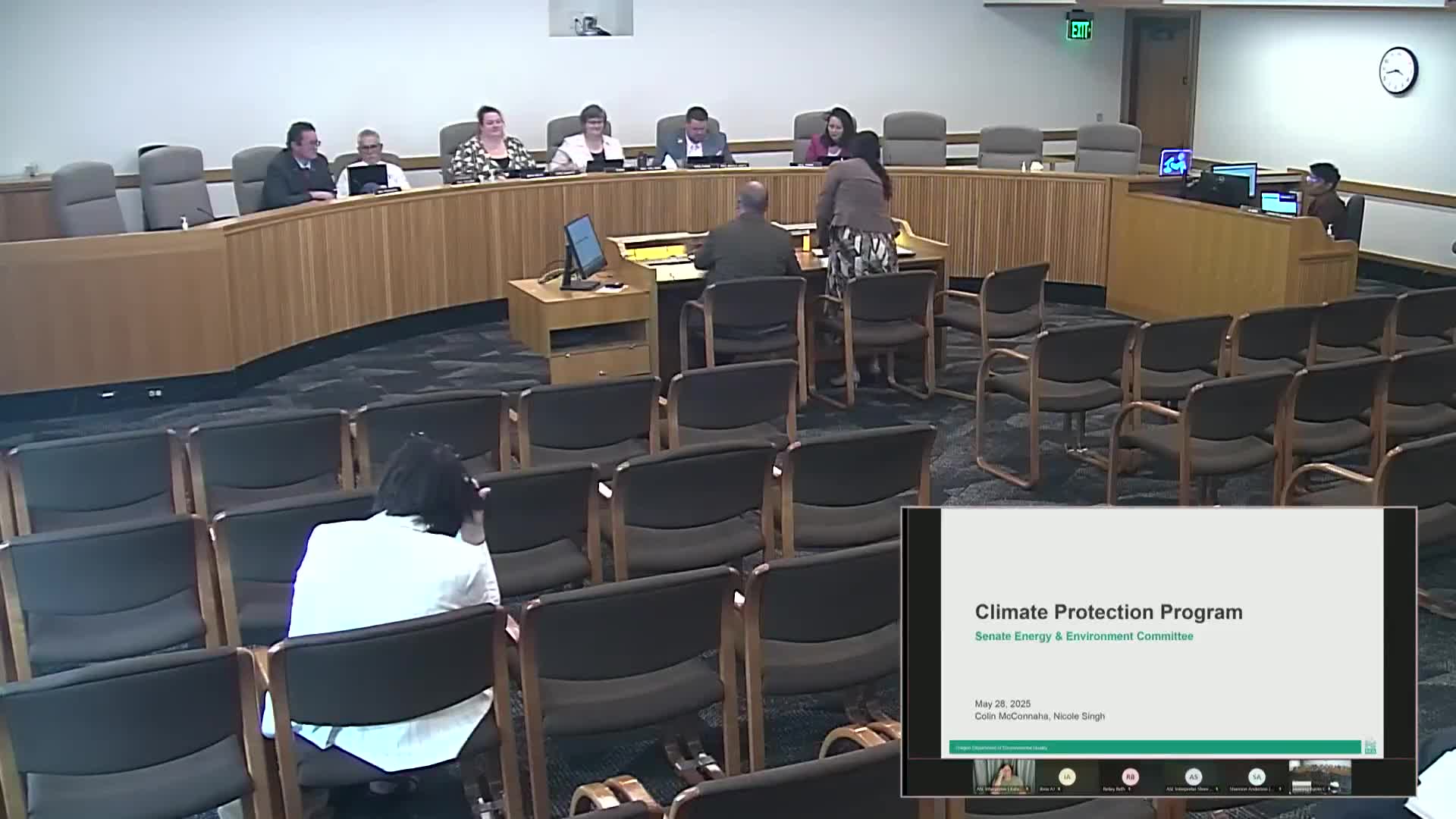
DEQ Officials Outline Reinstated Climate Protection Program, Emphasize Equity and Flexibility
Summary
DEQ updated the Senate Committee on Energy and Environment May 28 on the reinstated Climate Protection Program, describing mandatory, declining emissions limits for fossil fuels (excluding electricity), a community climate investments option and timing that phases some industrial facilities into compliance later to allow time for adjustments.
Colin McConaughey, manager of the Office of Greenhouse Gas Programs at the Oregon Department of Environmental Quality, told the Senate Committee on Energy and Environment on May 28 that the Climate Protection Program is a centralizing climate policy that establishes "mandatory, enforceable and declining year over year emissions limits on greenhouse gas emissions" for most uses of fossil fuels in Oregon.
McConaughey said a key design objective is an equitable transition: the rules include Community Climate Investments to direct funds toward projects that benefit environmental justice communities and to avoid leaving low-income, rural and coastal communities behind. "One of the core tenets for the Climate Protection Program ... is to do so in as equitable a fashion as possible to bring along Oregon's disadvantaged communities," he said.
DEQ staff described the program's history and recent rulemaking. The program first took effect in January 2022 and was implemented for nearly two years before the Oregon Court of Appeals invalidated program rules in December 2023 on a rulemaking-notice technicality. DEQ chose not to appeal and instead completed a second, extensive rulemaking process in 2024 to reinstate the program with revisions informed by implementation experience and thousands of public comments.
Nicole Singh of DEQ explained the program's key elements: an overall cap that declines toward 50% below baseline by 2035 and 90% by 2050 (the program excludes electricity), free distribution of compliance instruments to regulated entities, multi-year compliance periods and flexibility mechanisms such as banking and trading of compliance instruments. Singh said DEQ added measures to coordinate with the Public Utility Commission on natural gas price impacts and revised approaches for emissions-intensive, trade-exposed (EITE) industrial facilities, which will be phased into compliance after an initial multi-year period.
On Community Climate Investments (CCIs), Singh described a multi-step selection and oversight process. DEQ will convene an equity advisory committee, issue a request for applications for provisional CCI entities, and then contract with a selected CCI entity. Regulated entities may, within limits, earn CCI credits by contributing funds to an approved CCI entity; those credits can substitute for compliance instruments. Singh said the contribution amount to receive one CCI credit is set at $132 in current rules and noted DEQ will audit and monitor CCI entities and has authority to charge a fee to support oversight.
Committee members pressed presenters on supply of alternative fuels, likely cost impacts for consumers and how reductions will be tracked. DEQ officials said modeling and two years of program operation showed increased nonfossil fuel supplies entering Oregon markets and that macroeconomic modeling showed limited net statewide economic impact when health benefits were included. DEQ officials acknowledged uncertainty over how many regulated entities will use CCI credits and said they will report to the Environmental Quality Commission on CCI outcomes.
DEQ said it will distribute a one-time allocation of early-reduction compliance instruments to reflect emission reductions achieved while the prior version of the program was in effect. Officials described the 2025–2027 compliance period as three years (to allow time to adjust) and noted EITE facilities will not have compliance obligations during that initial period.
The hearing was informational. DEQ committed to continuing stakeholder engagement, publishing the equity advisory committee selection process, and reporting to the Environmental Quality Commission on program outcomes and potential impacts to energy prices and disadvantaged communities.