Get Full Government Meeting Transcripts, Videos, & Alerts Forever!
Get email alerts on the Transparency topic
No spam. Unsubscribe anytime.
Appropriations committee hears testimony on bill to codify earmark-transparency rule
Summary
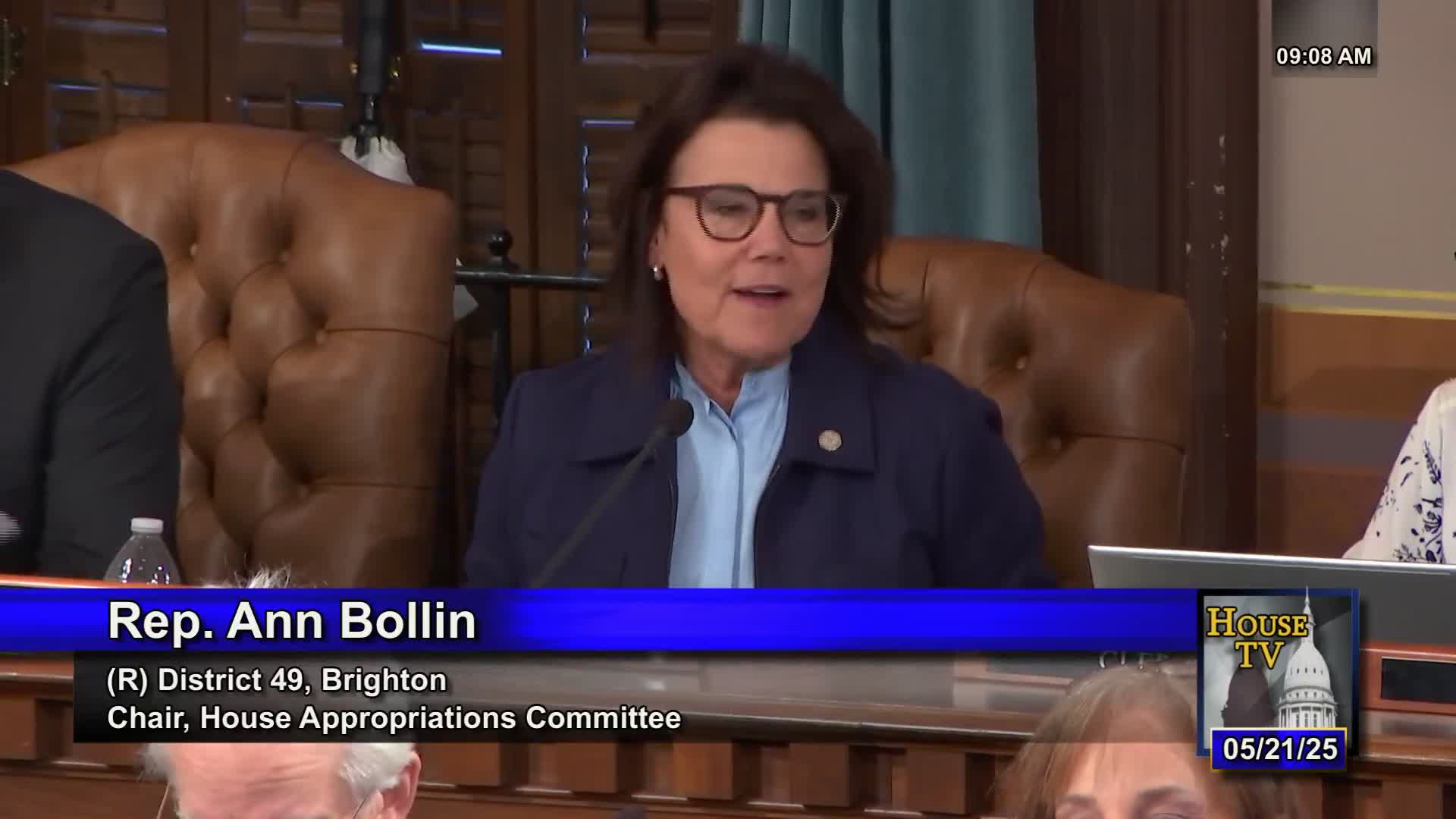
The House Appropriations Committee in Lansing heard testimony on House Bill 4,420, a measure to codify House Rule 14 into statute and require public disclosure of legislative-directed spending, often described as enhancement grants or earmarks.
The House Appropriations Committee in Lansing heard testimony on House Bill 4,420, a measure to codify House Rule 14 into statute and require public disclosure of legislative-directed spending, often described as enhancement grants or earmarks.
Supporters said the bill would bring greater accountability to how state dollars are distributed. Representative Coutts, the bill sponsor, told the committee, "House Bill 4,420 codifies into law the House Rule 14 and it's a transparency measure." Chair Boland, who sponsored the chamber resolution that prompted the legislation, said the bill "merely puts in statute what was passed unanimously in our chamber, setting forth the procedure for disclosure on enhancement grants."
Why it matters: Committee members framed the bill as a tool to let taxpayers see who requests state funds, the organizations that would receive them and what the money is intended for — information sponsors say is missing from omnibus budget bills. Former Appropriations Chair Shane Hernandez told the committee that the measure also improves the committee’s internal process, saying, "If you feel comfortable about this grant as an organization and as a representative, you should be willing to put it out there publicly."
Most important facts: The bill would enshrine into law the disclosure process the House adopted earlier as Rule 14; the sponsor said substitutes and corrections are expected and will return to committee for review. Committee members and witnesses discussed possible restrictions on allowable uses of enhancement funds — one example raised on the floor that the sponsor agreed to consider was a provision that would prohibit state funds from being used to pay back taxes.
Implementation and concerns: Several members raised practical questions about running and maintaining the public website that will publish the disclosures. Representative Farhat asked, "do you know how much it cost us to make the website and if we had any issues with the website?" Representative Coutts replied he did not have the number and later said the initial development cost was "minimal," adding the site was developed "in probably less than a week." Committee members pressed for a fuller cost estimate and whether an FTE or other recurring resources would be required for long-term maintenance.
Members also raised access and equity issues for smaller or nontraditional grantees. Representative McKinney and others urged the committee to avoid eligibility rules that would exclude organizations without a long-term physical office; the sponsor said a P.O. box would be an acceptable fiscal address and that the bill asks for both a fiscal address and the location where funds will be used. Former chair Hernandez said the bill includes a requirement that an organization have been in operation 36 months, a criterion he described as important for ensuring grantees have a proven track record before receiving state funds.
Outside witnesses: James Homen, identified as director of fiscal policy at the Mackinac Center for Public Policy, testified in support and emphasized two features: requiring lawmakers to explain the public benefit of a directed grant and listing the entity that will receive funds and the intended use. He said the bill "gives lawmakers a chance to argue that there are broader, public benefits from the grants that they're sponsoring." Several other advocacy groups and witnesses signed in supporting the bill.
What the committee did: No formal action on House Bill 4,420 occurred during the session. Committee members agreed that substitutions and clarifying language will be brought back to committee before any floor action. Staff from House fiscal and other offices were asked to supply additional implementation information, including cost estimates and guidance on programmatic versus competitive grant distributions.
Context and next steps: Committee leaders said the change is meant to be institutional and long-term amid larger budget work. Chair Boland framed the bill as a starting point for broader reforms, saying it would help the committee and the public "gain a better understanding of the needs and identify funding priorities and alternatives." The sponsor and members said they expect substitute language and additional hearings ahead of any floor votes.
Ending note: Committee members repeatedly described the proposal as bipartisan and characterized it as a policy change meant to increase public oversight of an $83,000,000,000 state budget; committee staff will supply follow-up information and the sponsor indicated new substitutions will be presented to the committee before the bill returns to the floor.