Get Full Government Meeting Transcripts, Videos, & Alerts Forever!
Get email alerts on the Public Transit Funding topic
No spam. Unsubscribe anytime.
Panel hears state transit funding has fallen as federal COVID aid ends
Summary
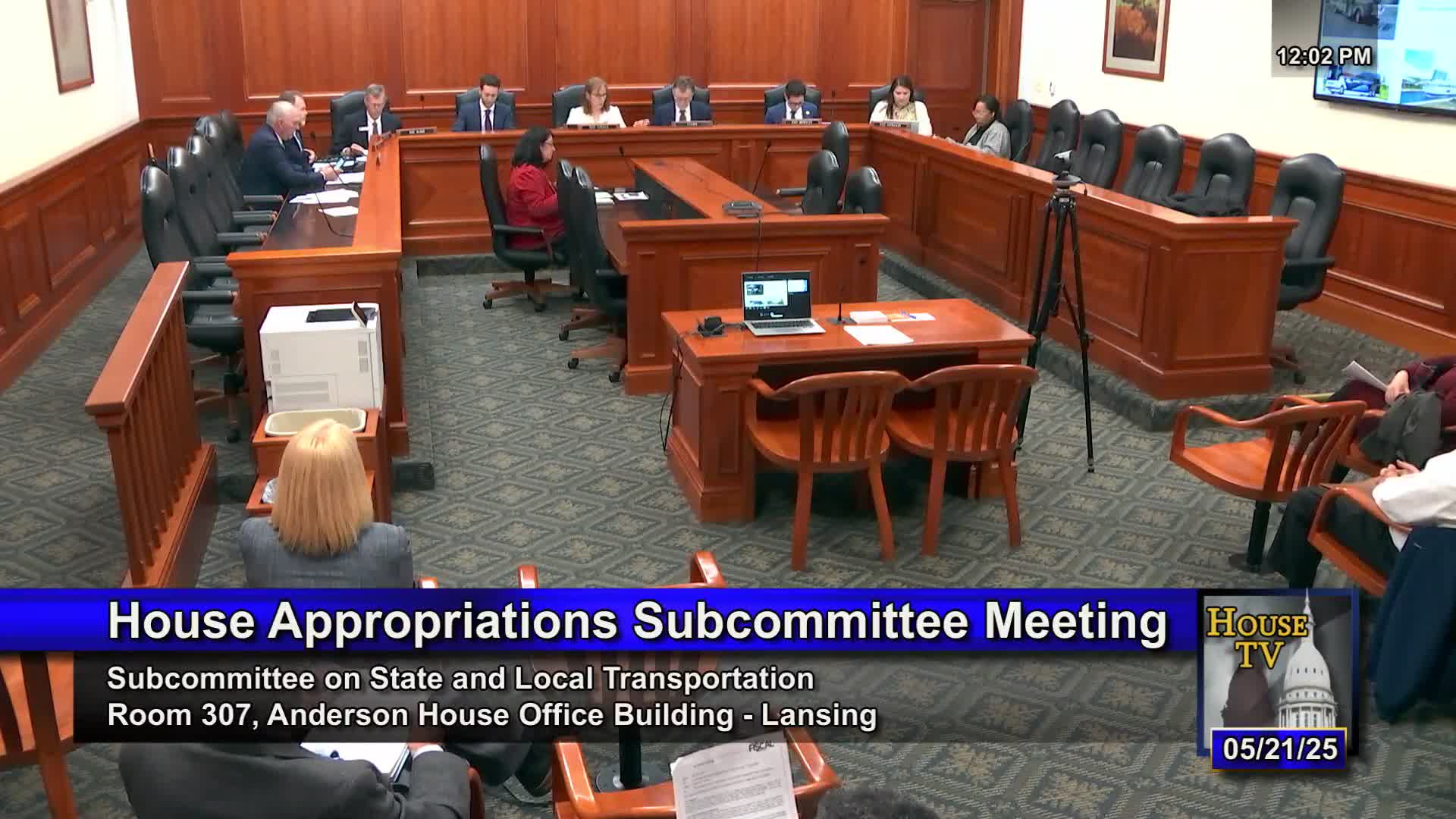
At a meeting of the Appropriations Subcommittee on the State and Local Transportation, committee members heard that Michigan’s long‑standing state assistance for local public transit is covering a smaller share of agencies’ operating costs as one‑time federal COVID relief funds expire.
At a meeting of the Appropriations Subcommittee on the State and Local Transportation, committee members heard that Michigan’s long‑standing state assistance for local public transit is covering a smaller share of agencies’ operating costs as one‑time federal COVID relief funds expire.
The committee’s fiscal analyst, William (committee staff), told members that “the primary state fund source in support of these programs is the Comprehensive Transportation Fund,” which receives a 10 percent earmark from the Michigan Transportation Fund and an earmark of auto‑related sales tax to support public transportation.
That Comprehensive Transportation Fund, or CTF, and the Michigan Transportation Fund together generate roughly $400,000,000 a year for public transit and related programs, William said. The biggest single line items are transit capital (largely to match federal grants for buses and other equipment) and local bus operating (LBO) assistance. According to the fiscal overview, recent appropriations for LBO were about $201.7 million in fiscal 2023, $261.7 million in fiscal 2024 and $246.7 million in fiscal 2025; the fiscal 2024 figure included $45 million in federal COVID relief funds and fiscal 2025 included $20 million in federal COVID relief funds.
Jean Roosterman, Administrator of the Office of Passenger Transportation at the Michigan Department of Transportation, clarified how the CTF is split inside state government: “we do share that pot of money with the Office of Rail. So the CTF is shared between the two offices. It's about a sixty‑forty split between Office of Passenger Transportation, Office of Rail.” Roosterman added that roughly two‑thirds of the CTF appropriations go to transit programs overall, and that within the LBO program the statutory distribution uses ceilings set by Act 51: agencies serving urbanized areas can receive up to 50 percent of eligible operating expense and non‑urban agencies up to 60 percent.
Roosterman and the fiscal overview both noted that those statutory ceilings are rarely reached today. “In 2025 it's estimated that urbanized agencies will receive 29 percent of their eligible operating expense and non‑urban agencies will receive 34 percent,” William said, reflecting long‑term erosion of the state share even when nominal appropriations have not fallen.
MDOT staff and industry representatives told the subcommittee that the one‑time federal COVID dollars have been propping up operating assistance and that the scheduled end of those funds will reduce state and federal support available for operating. Jean Roosterman said some federal grant programs require MDOT to administer funds and match federal capital grants, and that capital match and procurement pressures (including Buy America requirements and limited manufacturers) have increased costs for agencies.
Advocates and transit providers gave local examples to show demand and the role of local funding. Harmony Lloyd, Vice President of Planning and Innovation at SMART and Vice Chair of the Michigan Public Transit Association, said Michigan transit systems provide approximately 125,000 rides a day—about 47 million trips a year—and highlighted service expansions tied to local millages and state support. Lloyd cited recent local results: the Oakland County millage passed in 2022 helped boost ridership for NOTA, WOTA and People’s Express by major percentages; the Washtenaw Express between Ypsilanti and Ann Arbor carried about 84,000 rides since its May 2024 launch; and smaller rural systems such as Roscommon provided more than 65,000 rides in 2024 after expanding medical transport services.
John Dalmas, director of the Michigan Public Transit Association, displayed a longer funding history and told members that previous state revenue actions and many recent road‑focused funding packages did not restore transit’s relative share. “To say that let's fix roads and bridges, by not including transit, I don't think is actually a genuine solution,” Dalmas said, urging a predictable, shared funding stream for the CTF and LBO. Dalmas and other speakers said full funding needs are substantially higher than current appropriations; MPTA analysis presented to the committee estimated that about $200 million additional per year into LBO would be needed to stabilize the current system, not to expand it.
Megan (Transportation Riders United) framed the funding issue around riders’ needs. “Everyone should be able to get where they need to go, regardless of whether they drive,” she said, and described use cases ranging from seniors and people with disabilities to workers dependent on transit for employment.
Speakers identified several recurring pressures on local providers: rising vehicle and parts costs (vehicle prices up roughly 50 percent in recent years), higher insurance and labor costs, complex federal and state procurement and reporting requirements, driver shortages, cybersecurity and data tasks (including GTFS‑RT/GTFS feed work to make rural services discoverable in trip planners), and procurement delays tied to Buy America and limited manufacturers.
MDOT described several ongoing state initiatives and pilot projects: the Michigan Mobility Challenge (a $8 million state program that funded 13 demonstration projects), a mobility wallet and equitable mobility challenges, GTFS/GTFS‑RT support for rural providers, an economic benefit analysis tool for transit, and a federal road‑usage‑charging research project conducted with Via Transportation to study possible effects on ridership. Roosterman said the agency is working on a more comprehensive statewide transit plan and expects to pursue the effort in the coming year, pulling together local plans and national best practices.
Committee members asked for follow‑up materials. Roosterman said MDOT maintains ridership reports and other data and offered to provide agency ridership figures and a breakdown of operating cost components; she agreed to share those through committee staff. The subcommittee adopted minutes of its May 7 meeting by unanimous consent before the testimony began.
The hearing record shows that local transit systems rely on a mixture of federal capital grants, state CTF appropriations, local millages (57 agencies were reported to have transit‑specific millages) and other local revenues. Witnesses emphasized that predictable state support for local bus operating is necessary to prevent service cuts as one‑time federal COVID relief funds are exhausted.
With no further questions, the committee adjourned after the presentations and follow‑up commitments.