Get Full Government Meeting Transcripts, Videos, & Alerts Forever!
Get email alerts on the Education topic
No spam. Unsubscribe anytime.
Committee Hears Testimony on Bill to Ban Certain Additives from School Meals
Summary
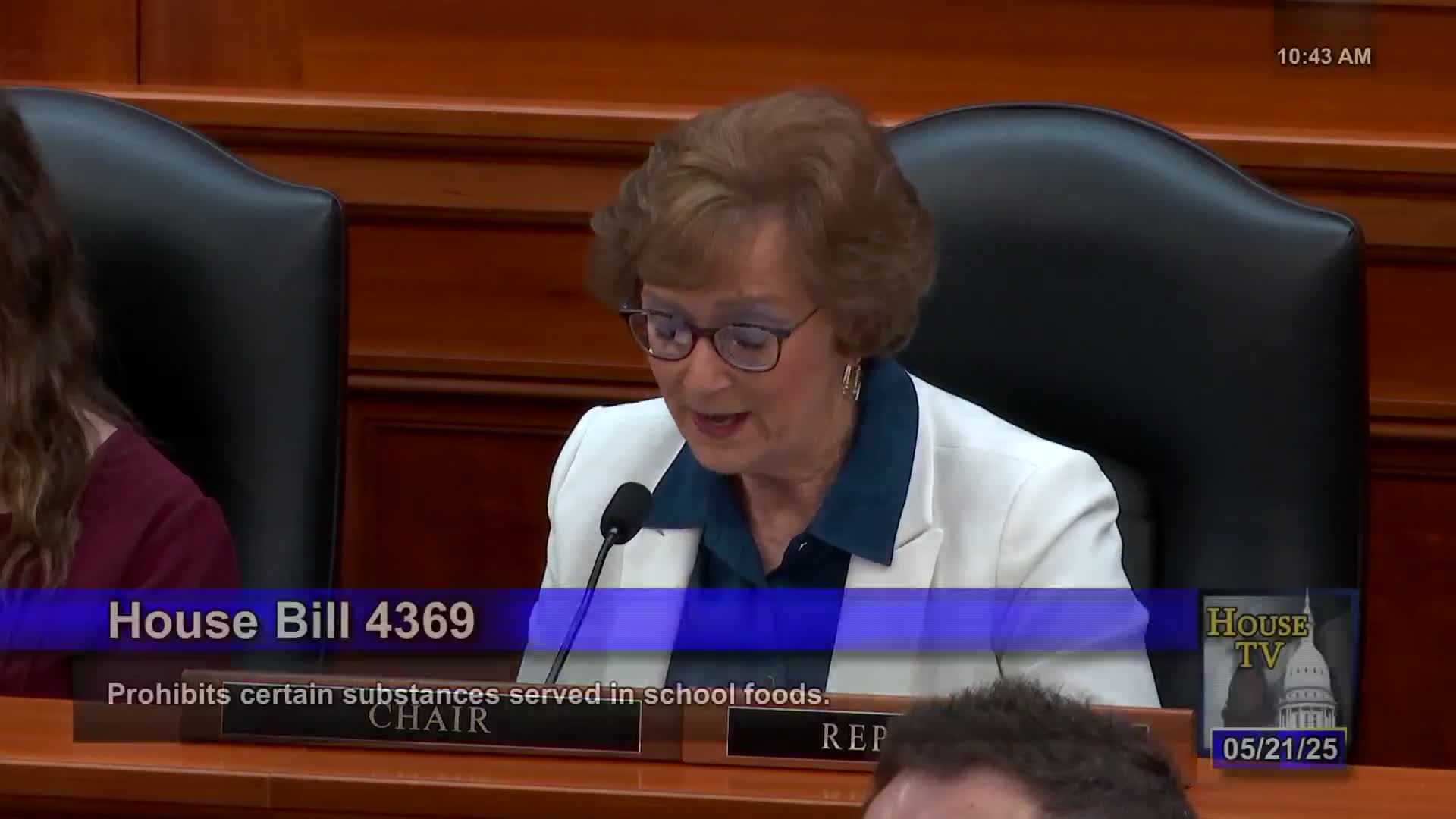
Supporters including nutritionists, advocates and parents told the House Education and Workforce Committee that House Bill 4,369 would remove artificial dyes and other specified additives from foods served with taxpayer dollars in Michigan schools; members asked about vendor regulation, costs, kitchen capacity and next steps.
Representative Matt Paquette introduced House Bill 4,369 and called witnesses, including nutritionist Liana Werner‑Gray and several advocates, to testify in favor of removing specified artificial dyes and additives from food served using taxpayer dollars in schools.
Liana Werner‑Gray, who identified herself as a certified nutritionist, said studies link artificial food colors such as Red 40, Yellow 5 and Yellow 6 to behavioral issues in children and cited a 2007 randomized, double‑blind, placebo‑controlled study published in The Lancet as evidence that food colors and preservatives can increase hyperactivity. She said the Michigan program should favor “real nourishing foods” and noted the European Food Safety Authority and other countries have restricted some dyes. Werner‑Gray also referenced animal studies and a 2022 study she described as a joint FDA‑NIH study raising concerns about brominated vegetable oil (BVO).
Grace Price, an investigative journalist testifying by remote connection, said ultra‑processed foods and additives can “hijack the brain’s reward pathways” and said several ingredients named in the bill are banned in other countries. Danielle Ganske, a psychiatric drug reform advocate, and other witnesses gave personal testimony that removing additives from school meals improved mood and behavior for children they knew or represented.
Committee members repeatedly focused on implementation questions. Representative Colazar asked whether regulating third‑party vendors rather than schools would be more effective; the sponsor said the bill is modeled on California law and that vendor regulation could be one approach the committee considers. Representative Burns and others pressed the sponsor on cost, asking for a fiscal estimate and warning that many districts rely on prepackaged, heat‑and‑serve meals and lack scratch‑kitchen capacity. The sponsor acknowledged those concerns and said he would prioritize funding supports and that language could be revised.
Members discussed possible approaches: regulate vendors, require districts to use locally sourced options, or put statutory language in a different part of law such as the School Aid Act. Representative Boyce and others cautioned that without an appropriation and attention to kitchen capacity, tighter ingredient rules could increase costs or create access problems; several members said they wanted a cost analysis and more conversations with the Michigan Department of Education and relevant budget committees before advancing the bill.
No committee vote occurred during the hearing. Supporters urged lawmakers to view school meals as a public‑health and mental‑health intervention and to craft the bill to address vendor relationships and funding to ensure districts can comply.