Get Full Government Meeting Transcripts, Videos, & Alerts Forever!
Get email alerts on the Health Professional Licensure Privacy topic
No spam. Unsubscribe anytime.
Committee hears bill to limit mental-health questions on health professional license forms
Summary
House Bill 4277 would amend the public health code to restrict licensing questions to current fitness-to-practice items and bar look‑back mental‑health diagnosis/treatment queries; proponents said the change would reduce stigma and encourage clinicians to seek care without endangering patient safety.
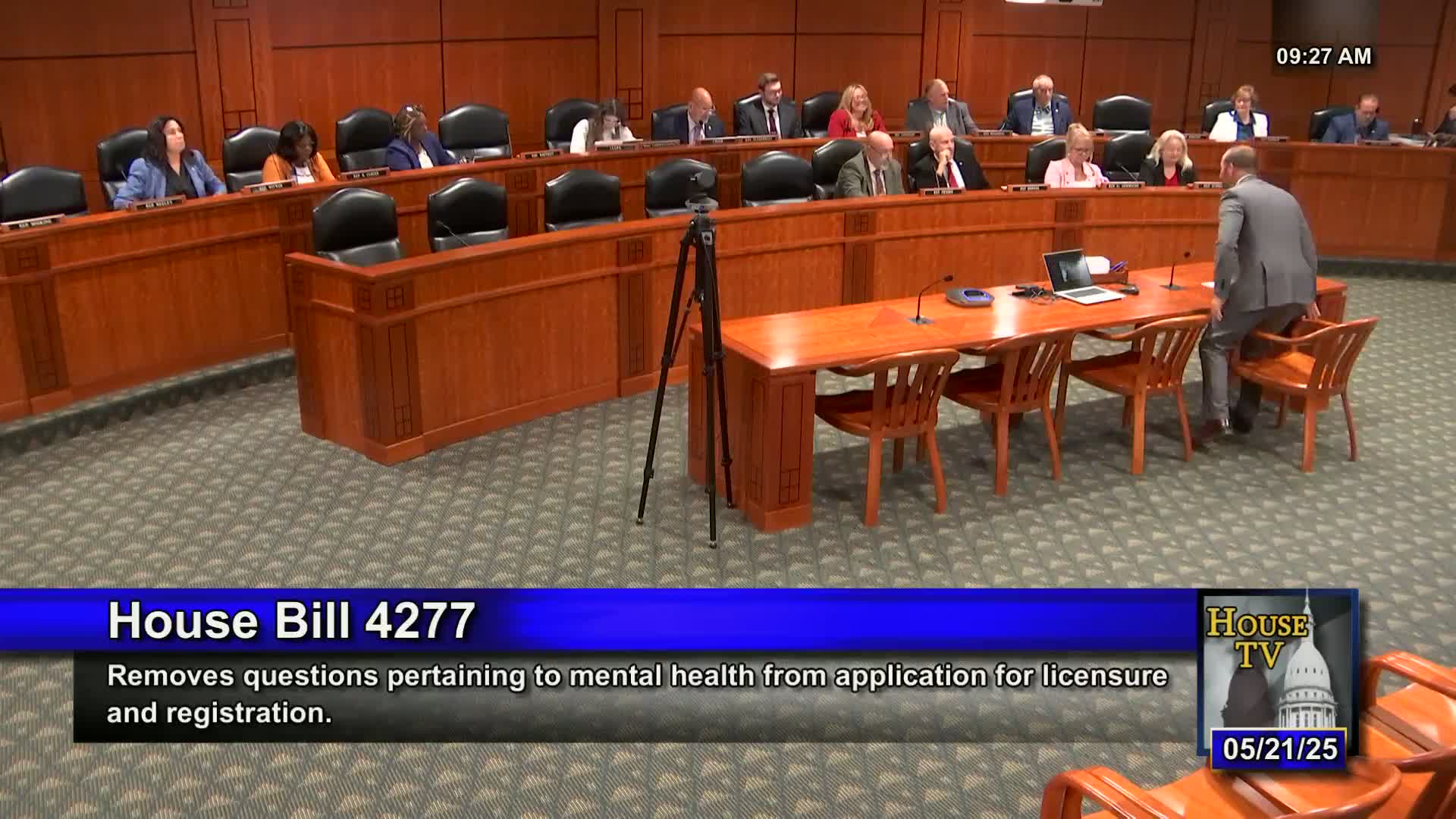
Representative Bierlein presented House Bill 4277 to the House Health Policy Committee, saying the bill would limit licensure and renewal application questions to two narrowly drawn items about current risk and ability to perform essential functions.
Bierlein said overly intrusive questions on some states' applications have discouraged clinicians from seeking mental health care and that HB4277 seeks to prevent that outcome in Michigan. "These questions ... have actually discouraged medical professionals from seeking the mental health care they need," Bierlein said. He clarified that such invasive questions are not currently on Michigan's applications and described the bill as a preemptive statutory protection.
Dr. Brittany Taylor, who identified herself as a double-boarded internist and pediatrician practicing in Flint, testified in support on the grounds of physician well-being and patient safety. Taylor cited high rates of depression and suicide among physicians and said ambiguity in licensing or credentialing questions can deter clinicians from accessing care. "Physicians need to know they're protected not just now, but in the future," Taylor said, urging codification of current practice.
Dr. Stephanie Simons, chief medical officer for the Dr. Lorna Breen Heroes Foundation, also testified in support. Simons described Lorna Breen's case and said codifying removal of mental-health history questions increases transparency for licensees and can improve workforce retention. She cited an example from another state where changing licensing language and public communication increased self-reporting for mental-health care.
Committee members asked whether the bill would leave checks in place to protect patient safety. Simons and Taylor said HB4277 preserves questions aimed at current impairment and ability to perform essential functions, and pointed to existing monitoring programs and hospital credentialing and oversight that address impaired practitioners. Simons noted state professional health programs and employer resources that can monitor and treat impaired health care workers.
The committee read submitted cards from multiple professional associations expressing positions; no committee vote on HB4277 is recorded in the transcript excerpt.