Burlington seeks to fully fund recycling program; solid-waste tax to rise to $12 per unit
Loading...
Summary
Department of Public Works told the Board of Finance the city is proposing a 66% increase in recycling program revenue and a jump in the solid-waste generation tax from $6.90 to $12 per unit per month to make consolidated recycling sustainable in FY26.
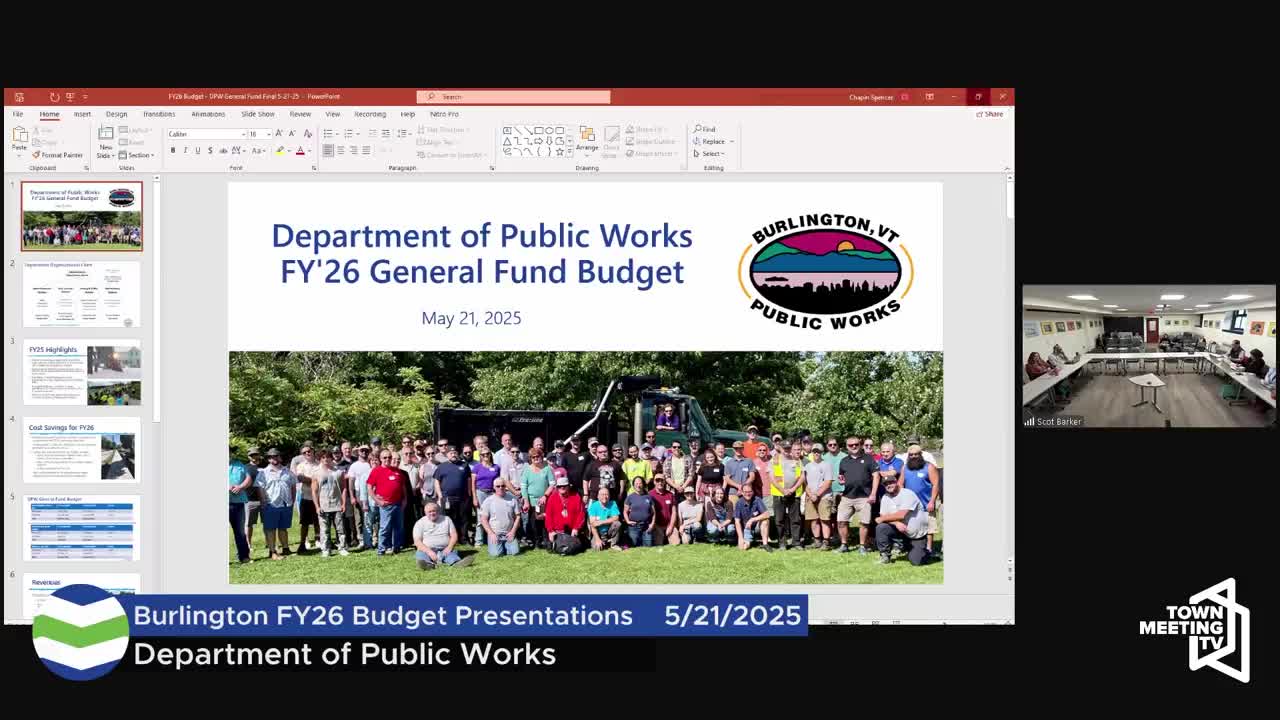
City of Burlington Department of Public Works officials told the Board of Finance on May 21 that the department proposes a major revenue increase to sustain the municipal consolidated recycling program and to cover indirect program costs.
Jason Spencer, director of public works, said the city is "seeking to sustainably fund the municipal consolidated recycling program" and proposed increasing recycling program revenue from $1,000,000 to $1,700,000, "which is a 66% increase." He said the change will be funded in part by a rise in the solid-waste generation tax applied to trash bills: "your monthly solid waste generation tax on that bill will go from $6.90 per unit per month to $12 per unit per month."
Nut graf: The DPW presentation framed the increase as a one-time structural step that will both expand staffing for recycling collection and cover indirect costs historically borne by the general fund. Officials said the overall DPW net impact on the general fund is expected to fall slightly even as recycling and solid-waste line items grow.
DPW described how the added revenue would be used. Spencer said the recycling program budget adds $440,000 in revenue to the recycling line and funds 2–3 additional full-time equivalent positions so the city does not rely on street maintenance staff when recyclers are absent. The presentation also said DPW will allocate more to vehicle and equipment maintenance and cover indirect costs that were previously not charged to recycling. Spencer described a $160,000 debt-service item tied to a recently acquired soil-management facility, and $100,000 budgeted to begin scoping repairs to a post-closure landfill with aging gas and leachate collection systems.
Discussion vs. decision: Councilors asked about household impacts and collection from residents who self-haul. Division director Lee Perry explained that the Chittenden Solid Waste District (CSWD) charges by weight at drop-off and remits revenue to the city under an established formula, so self-haulers are captured indirectly. Councilor Barlow asked about the cost of seasonal Christmas tree pickup (DPW estimated roughly $8,000 in direct salaries and equipment time for street crews); DPW said eliminating the service would free crews for billable work but warned of potential public-response issues.
Officials flagged risks and tradeoffs: a large tax increase is politically difficult, they said, but the department preferred a single structural adjustment rather than repeatedly revising rates. Spencer also listed threats including possible changes to federal grant funding and difficulty filling vacancies that would reduce earned revenue tied to billable work.
Ending: The Board of Finance received the presentation and put further questions on the record for follow up; no formal vote on program funding occurred at the meeting.