Get Full Government Meeting Transcripts, Videos, & Alerts Forever!
Get email alerts on the Advisory Program topic
No spam. Unsubscribe anytime.
Salem High advisory program reports higher participation, plans summer academy
Summary
District staff told the Salem School Board on May 20 that Salem High School's advisory program is entering its third year, showing gains in staff and student survey measures and hosting new activities such as a 32-team advisory basketball tournament; staff plan a two-day summer academy and continued monthly MOA meetings with the SEA.
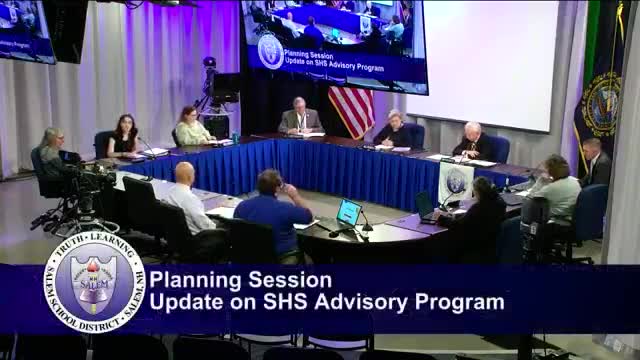
The Salem School Board received an update May 20 on the advisory program at Salem High School, where staff said multi-year survey results and new extracurricular activities suggest the program is gaining traction.
At a planning-session presentation, Mara Palmer, superintendent, said staff are “looking to grow and make this sustainable” and pointed the board to recent survey results and the advisory calendar as evidence of progress. Bernie Campbell, the advisory coordinator at Salem High School, reviewed activities and data and described plans for a two‑day summer advisory academy in June.
Why it matters: School leaders said advisory is intended to strengthen student connections, support well‑being and improve the overall school experience. The program is a continuing board priority tied to an existing memorandum of agreement between the school board and the SEA; staff said monthly MOA meetings are used to monitor implementation.
Campbell described the year’s new and continued activities, including an advisory basketball tournament that drew 32 teams from roughly 100 advisories, an advisory “feud” competition, paper‑airplane and Wordle challenges, a trivia tournament and community service like a mac‑and‑cheese collection for a hunger relief effort. He said some activities drew less interest (a lip‑sync video contest had no submissions this year) and that sophomore engagement remains a challenge.
Campbell also summarized results from a climate and culture survey administered April 10. He told the board that, speaking in percentages to account for year‑to‑year response variation, the share of staff who “strongly agree” they enjoy advisory rose from about 12% in 2022–23 to about 30.7% in 2024–25. On the student side, the percentage who “strongly agree” they enjoy advisory rose from about 31.4% to about 40.8% over the same span. Campbell said the larger change he finds notable is a decline in strongly negative responses: for some questions the share of students who “strongly disagreed” with positive statements about advisory declined year to year.
Board members asked for operational details. Kelly Moss asked about adviser group size; Campbell said advisories average about 10 students, with a maximum of 12 and typically somewhat larger incoming freshman groups to allow for attrition by senior year. Moss also raised whether students unhappy with an advisor can switch; staff said they historically discourage wholesale switching to avoid segregation by friendship groups but will move students when there are interpersonal conflicts or safety concerns.
On student representation in advisory planning, Campbell said the advisory committee previously had as many as 10–12 active students but that at the two most recent meetings he referenced only about two students attended; he said staff plan targeted recruitment outreach before the school year ends.
Palmer and Campbell emphasized that advisory is a long‑term effort. “Advisory is a patience game,” Campbell said, noting relationship gains often appear over multiple years. Palmer said the advisory memorandum of agreement remains in effect as an addendum to the collective bargaining agreement with the SEA and that board, administrators and the SCA president meet monthly to monitor the MOA.
Next steps: staff said they will run a two‑day summer academy to review the year’s data and set the calendar and activities for 2025–26, continue monthly MOA oversight, and work on recruitment for student advisory committee participation.