Get Full Government Meeting Transcripts, Videos, & Alerts Forever!
Get email alerts on the Oeo Initiatives topic
No spam. Unsubscribe anytime.
Carlos Contreras outlines OEO priorities: apprenticeships, manufacturing training, micro‑loan program
Summary
In his confirmation hearing, Carlos Contreras described workforce initiatives at the Arizona Office of Economic Opportunity including the Build It AZ apprenticeship push, ReadyTechGo advanced manufacturing partnerships, a microbusiness loan program, and published evaluations of workforce programs.
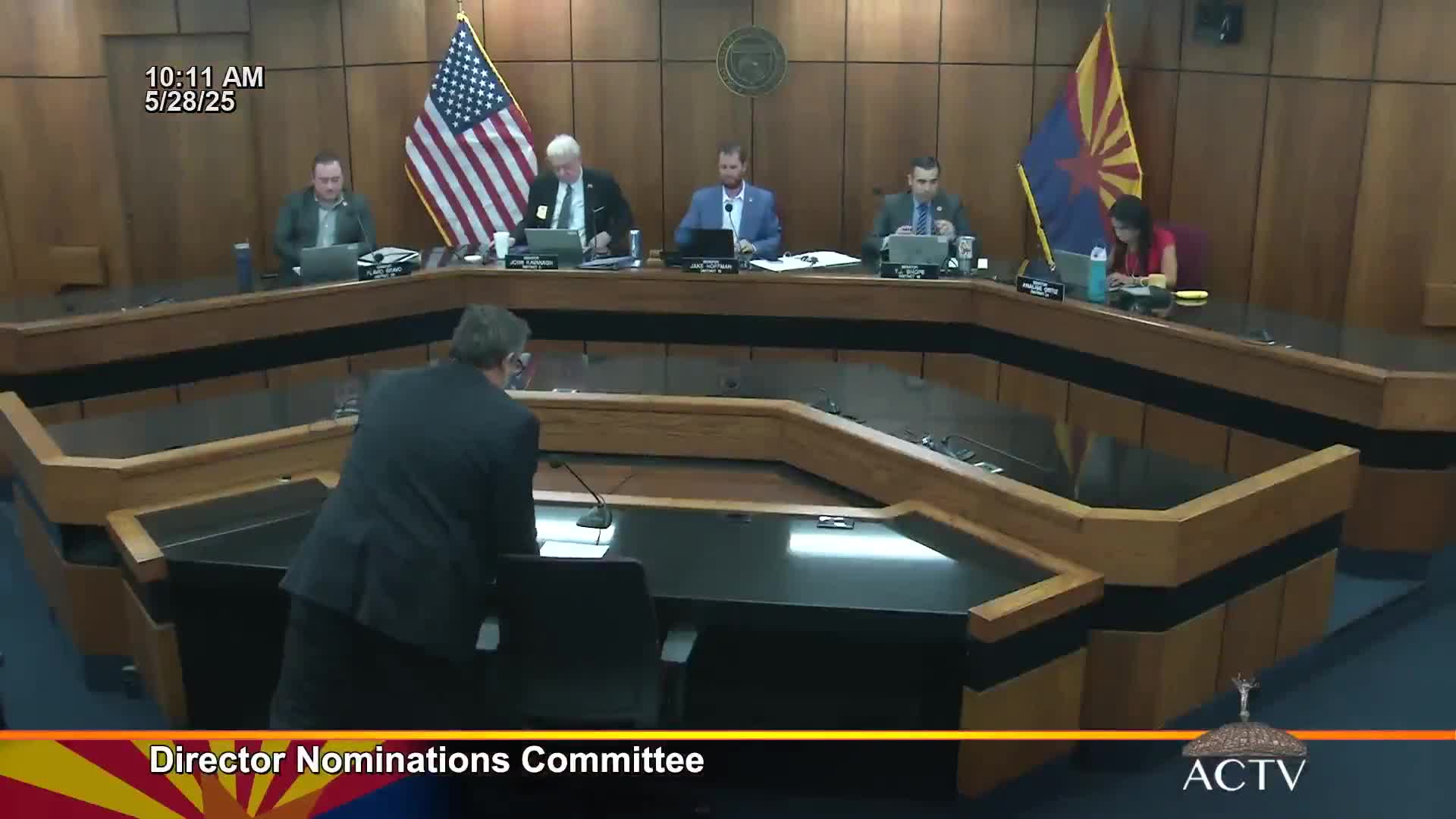
Carlos Contreras, nominee for director of the Arizona Office of Economic Opportunity (OEO), told the Senate Committee on Director Nominations on May 8 that his office is focused on industry‑driven workforce development, data‑driven decision‑making and expanding pathways to training across Arizona.
Contreras, who served 26 years at Intel and later led industry‑partnership training programs, said OEO’s priorities include scaling apprenticeships in construction through Build It AZ, expanding advanced manufacturing training through ReadyTechGo, and delivering small‑business support through a state microbusiness loan program.
"These Arizonans inspire me and our team to do the work that we do," Contreras said in his opening remarks, recounting workers who used apprenticeship and community college programs to find higher‑paying jobs.
On Build It AZ, Contreras said the program aims to double registered apprentices in construction and trades by 2026 and that OEO had allocated $3 million in capacity grants to support industry partnerships. He said OEO is "two thirds of the way to the goal" and that the program uses registered apprenticeship pathways that combine classroom instruction with on‑the‑job learning.
Contreras described ReadyTechGo as a partnership between industry leaders and community colleges to train workers for high‑demand advanced manufacturing jobs in semiconductor, aerospace, electric vehicle, pharmaceutical and battery sectors. He said the program initially covered Maricopa, Pima and Pinal counties and recently added Coconino, Yavapai and Mojave community colleges.
The nominee outlined the Arizona micro business loan program, funded through session law and administered by OEO, noting the program provided $5 million in state funding to lenders to issue microloans up to $50,000 while leveraging approximately $15 million in private funds. "To date, seven lenders across rural, tribal and urban counties have been selected and over 31 microbusiness loans have been funded," he said.
Contreras also discussed agency operations: OEO completed its separation from the Arizona Commerce Authority and has developed a five‑year plan, published its first statewide evaluation of workforce programs, and hired staff to strengthen procurement, grants and financial controls. He said an interagency service agreement that previously routed payments through the Arizona Commerce Authority was closed and that the agency addressed prior audit items.
When senators raised questions about past audit findings, Contreras said OEO removed the interagency service agreement that had created unclear accounting for payments and that the agency adopted standard state finance rules and hired staff to meet compliance needs. He acknowledged a previous Auditor General review for 2020–2022 and said OEO had worked to close the audit items.
Contreras described OEO’s approach to emerging technology and labor market change as cautious and industry‑driven. He said OEO tracks job postings to detect how artificial‑intelligence skills are appearing across occupations and is working with community colleges to adapt curricula. "We started an AI program for community colleges here in Maricopa and it expanded to over a hundred," he said.
If confirmed, Contreras said he would continue prioritizing partnerships with employers, community colleges, local workforce boards and rural communities to expand training availability and improve data transparency for policymakers and the public.