Get Full Government Meeting Transcripts, Videos, & Alerts Forever!
Get email alerts on the Coastal Restoration topic
No spam. Unsubscribe anytime.
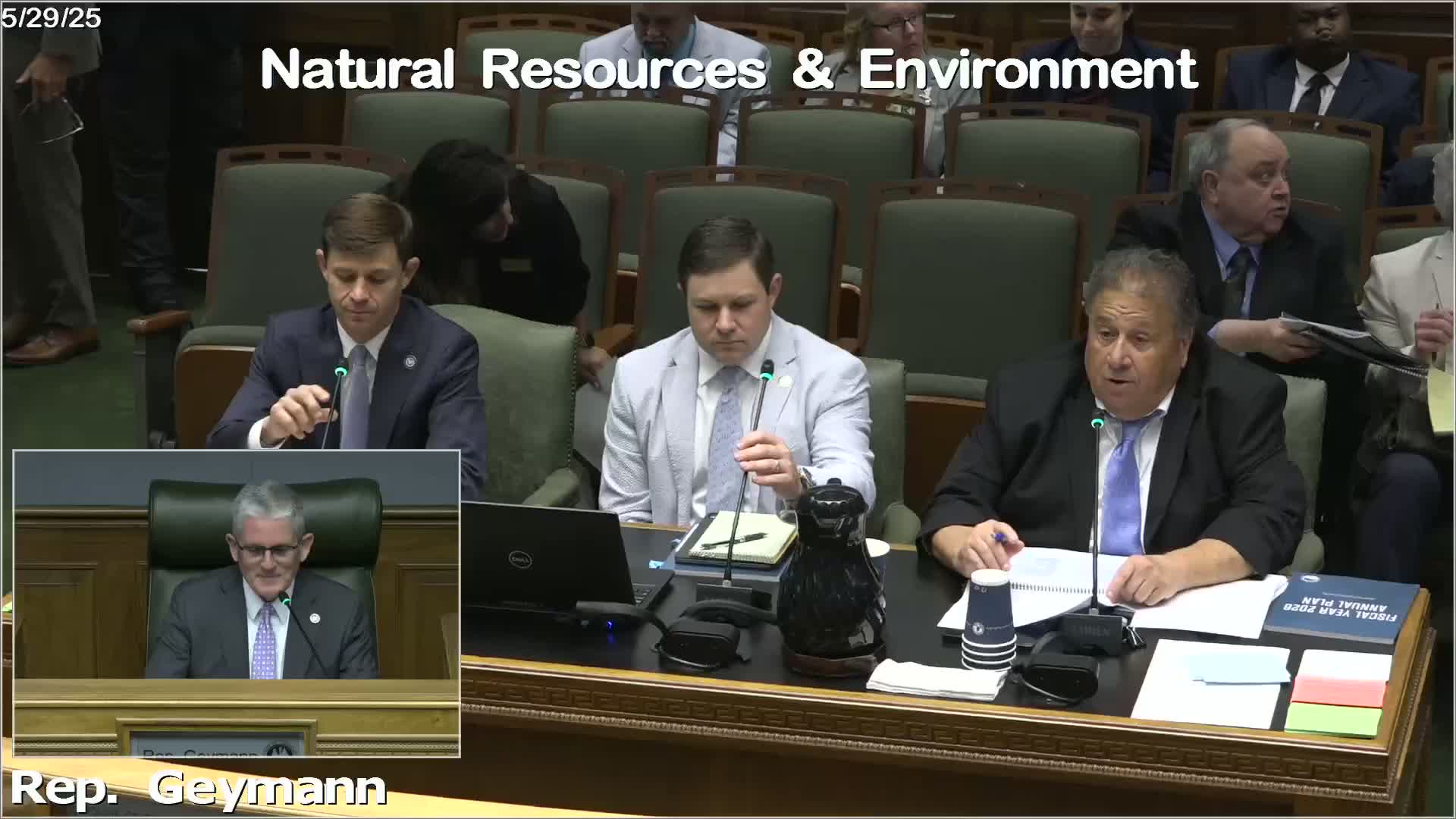
House Natural Resources Committee advances CPRA FY2026 annual plan after heated debate over Mid Barataria diversion
Summary
The House Natural Resources Committee voted 12–3 to report HR 36 — CPRA’s FY2026 annual plan — after a presentation from CPRA and extended debate about the Mid Barataria sediment diversion and alternatives.
The House Natural Resources Committee voted 12–3 on May 29 to report House Resolution 36 — the Louisiana Coastal Protection and Restoration Authority (CPRA) fiscal year 2026 annual plan — to the full chamber after a presentation from CPRA leadership and extended debate about the program’s largest, disputed project, the Mid Barataria sediment diversion.
CPRA Executive Director Glenn Laday told the committee the FY2026 plan totals “just under $2,000,000,000 in total, 1,980,000,000.00, approximately 1.57 for construction,” and that “over 93% of these expenditures are actually dedicated to projects and only 2% goes back to CPRA for operations.” The plan covers 146 projects across roughly 20 parishes and lists dozens of regional projects ranging from marsh creation to levees, pump stations and home elevations.
Why it matters: The annual plan programs federal and settlement funds and directs how CPRA will prioritize coastal restoration and flood‑risk projects for the next fiscal year. Several of the plan’s largest items — the Mid Barataria and Mid Breton sediment diversions — were the focus of the meeting and of public testimony; CPRA leadership said the agency will not proceed with Mid Barataria as previously authorized and plans to pursue smaller, Corps‑led alternatives.
Most important facts - Committee action: Motion to report HR 36 favorable carried on roll call, 12 yes, 3 no (mover: Representative Domingue). The committee transcript shows the roll call votes and the final tally announced as “12 yeas, 3 nays.” - Budget and scope: CPRA presented a FY2026 plan totaling about $1.98 billion, with roughly $1.57 billion shown for construction work, 146 projects across 20 parishes, 46 active projects, and 21 dredging projects highlighted in the plan. - Revenue sources: Laday listed recurring state and federal revenue streams supporting the plan, including GOMESA (offshore energy dedication), Deepwater Horizon settlement funding (listed in the presentation as Restore, NFWF and related trustee funds), and CWPPRA; CPRA said roughly $300 million of this plan comes from GOMESA and about $125 million from CWPPRA in the current year. - Big projects called out in the presentation: Southwest Coastal (federal program with a nonstructural home‑elevation component covering roughly 4,000 homes across Calcasieu, Cameron and Vermilion parishes), Calcasieu‑Sabine large‑scale marsh creation (~$260 million), Morganza‑to‑the‑Gulf components including the Homa Navigation Canal lock complex, West Shore Lake Pontchartrain Hurricane Protection System, the Chandeleur Islands barrier‑island restoration (13.5 miles) and the Lake Bourne marsh creation project (~3,100 acres).
What CPRA told the committee CPRA staff framed the FY2026 plan as the product of a year‑long public process. Laday walked members through the plan’s revenue mix and regional highlights and said the agency is working with the U.S. Army Corps of Engineers on several large, federally authorized projects. He emphasized that a high share of plan dollars — the presentation noted “over 93%” — go into project delivery rather than agency overhead. Laday and Gordon Dove, who identified himself as “chairman of the governor’s office of Coastal Affairs within CPRA,” repeatedly described both the value and complexity of major federal partnerships.
Key numbers (as presented to the committee) - Total FY2026 plan: $1,980,000,000 (approx.) - Construction portion (presented): roughly $1.57 billion - Percent of plan to projects (presented): 93% - CPRA operations (presented): ~2% of plan - Dredging: 21 dredging projects in the plan; presentation says dredging work can build/nourish up to 16,000 acres with more than 70,000,000 cubic yards of material - Economic impact cited: “over 13,000 direct jobs” and roughly $773,000,000 in labor income
Contentious policy issue: Mid Barataria and alternatives Much of the committee’s time was taken up by debate about the status of the Mid Barataria sediment diversion, long studied as a large river‑reconnection project. Chairman Dove and Laday said the state will not proceed with the previously designed, larger Mid Barataria diversion and instead intends to pursue alternative, smaller diversion(s) that would be designed or built by the Corps of Engineers, including a so‑called “medium” Myrtle Grove diversion described during testimony.
Dove described funding constraints tied to Deepwater Horizon trustee funds and warned that the federal/state cost‑share and remaining settlement money affect what projects can be built. He told members the NRDA/RESTORE/NFWF money that had been allocated to the large Mid Barataria work is essentially exhausted and that a Corps‑led, medium diversion would have a 65% federal / 35% state match — an outcome he said would “save over $1,000,000,000” of state match compared with the larger diversion.
Opposition and public testimony The meeting included more than an hour of public testimony. Local elected officials from coastal parishes — including Grand Isle Mayor David Commendell, Iberia Parish President Larry Richard and Plaquemines Parish representatives — urged continued funding for local projects and emphasized shoreline protection work tailored to ports and communities.
Environmental and fisheries groups spoke against cancelling Mid Barataria without additional science and public process. Katie G. Daniel of the Environmental Defense Action Fund said approving the annual plan while CPRA has “publicly decried the cornerstone project … is nothing more than a legal fiction.” National Audubon, the Pontchartrain Conservancy, Restore the Mississippi River Delta, the National Wildlife Federation Action Fund and others submitted written and oral comments urging adherence to the science‑based coastal master plan and warning that abandoning major reconnection projects could undermine the program’s credibility and future funding.
Representative and member concerns Committee members pressed CPRA for details on funding, program mechanics and the effects on fisheries and drinking‑water salinity. Several members said they supported the broader annual plan but objected to the process by which the Mid Barataria decision was made; Representative Ogeron (vice chair) announced a symbolic “no” vote on the resolution’s referral because of concerns over how the diversion decision was handled.
Formal action and next steps Representative Domingue moved to report HR 36 favorably. The roll call listed the names of members and their votes and ended with a 12–3 tally in favor. CPRA staff said the board and other committees had previously approved the CPRA plan and that reporting the plan favorably sends the FY2026 package to the full House.
What remains unsettled CPRA leaders told the committee they will pursue Corps‑led alternatives in the Barataria basin and work to reallocate some settlement funds for other projects if the large diversion remains off the table. Environmental groups and some coastal stakeholders asked the Legislature to direct CPRA to either revise the annual plan to match CPRA’s stated intent or delay committee approval until the agency presents the alternative project with supporting engineering, environmental analysis and public engagement.
Votes at a glance - Motion: Report HR 36 (CPRA FY2026 annual plan) favorable (mover: Representative Domingue). Outcome: reported favorably by roll call, 12 yes, 3 no.
Ending Committee members and CPRA staff left the hearing with the FY2026 package advanced to the House. Members of the committee and many coastal stakeholders said they planned additional meetings and follow‑up requests for data, and several asked CPRA to return with clearer documentation of the alternative projects, their environmental analyses and specific funding plans.