Get Full Government Meeting Transcripts, Videos, & Alerts Forever!
Get email alerts on the School Receivership topic
No spam. Unsubscribe anytime.
Senate advances bill that forces school board seats vacant after state receivership; critics call it punitive
Summary
House Bill 26‑10, passed by the Arizona Senate May 28, deems school board seats vacant 31 days after the State Board of Education places a district in receivership unless a waiver is granted; supporters say it addresses mismanagement, critics call it overreach that disenfranchises voters.
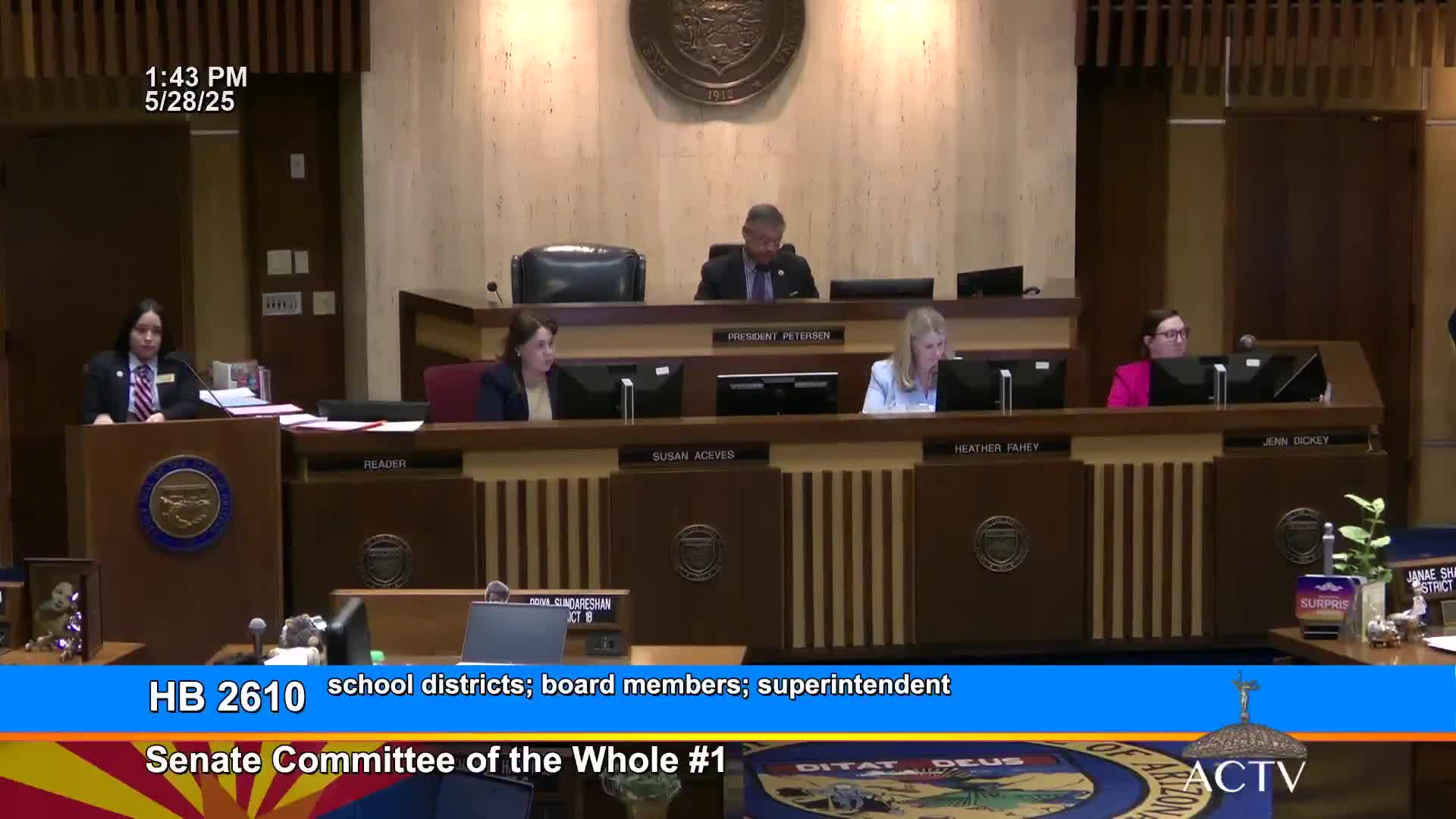
The Arizona State Senate on May 28 passed House Bill 26‑10 after adopting committee amendments. The bill changes the rules for governing‑board members when the State Board of Education (SBE) places a school district in receivership, deeming each governing‑board seat vacant 31 days after the SBE action unless the SBE waives that requirement under limited criteria.
Senator Warner explained a floor amendment that “specifies that each seat of a school district governing board is deemed vacant 31 days after the State Board of Education places the school district in receivership” and described the waiver process and evidentiary materials a member must submit. The amendment removed a requirement that the SBE investigate board members’ performance before granting a waiver and defined “supporting evidence” to include minutes, recordings and voting records.
Supporters framed the bill as a tool to address fiscal mismanagement in districts placed into receivership. Opponents, including Senator Bravo in an explanation of vote, said the measure could be punitive and asked whether it would help students; Bravo cited the Isaac School District receivership and said receivers had presented plans including school closures.
Senator Kuby also argued that forcing board resignations should be a matter for voters, not the Legislature, and warned that appointments made by county superintendents (a partisan office in Arizona) could politicize local school boards.
The Senate approved the bill on third reading; the clerk recorded the action as passed and the measure was transmitted to the House. Recorded floor votes on third reading showed the bill passed by voice and recorded tallies indicated the measure carried (clerk read final record as passed).