Get Full Government Meeting Transcripts, Videos, & Alerts Forever!
Get email alerts on the Law Enforcement Training topic
No spam. Unsubscribe anytime.
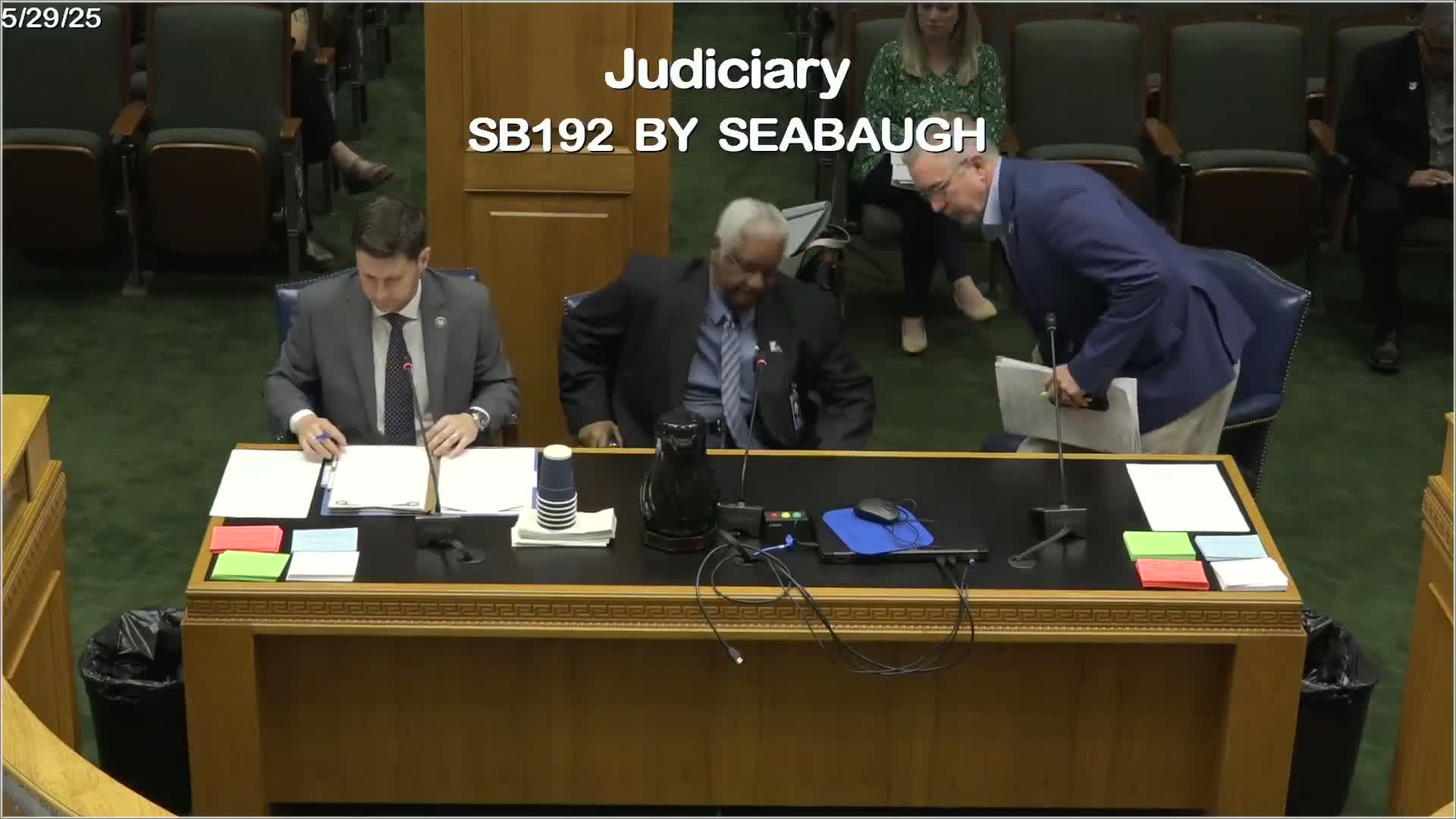
Committee backs bill creating 'auxiliary' law-enforcement role, debates training and certification
Summary
The House committee reported Senate Bill 192, a measure from Sen. Seba addressing tactical medical professionals and a new auxiliary officer classification, favorably after extended testimony and debate.
The House committee reported Senate Bill 192, a measure from Sen. Seba addressing tactical medical professionals and a new auxiliary officer classification, favorably after extended testimony and debate.
The bill would define a "tactical medical professional" and set when such professionals can operate in support of tactical operations; it would also create an "auxiliary deputy" or "auxiliary officer" classification with a reduced training requirement compared with full POST certification. "This bill does 2 things," Representative Mallory said in opening remarks, explaining the tactical-medical and auxiliary provisions and that the auxiliary role was intended primarily to staff community events and provide ride‑along assistance in rural parishes.
Supporters including Sheriff Kevin Cobb of the Louisiana Sheriff's Association said sheriffs requested an avenue for volunteers who cannot leave full‑time jobs to complete a multi‑month academy. "It gives them another set of eyes, another set of ears," Sheriff Kevin Cobb said, describing event coverage and ride‑along duties. He confirmed auxiliaries would receive firearms training: in committee exchange, when asked "Are you going to let them wear guns?" he answered, "Absolutely."
Opponents and regulators urged caution. Fabian Blush, executive director of the Chiefs of Police Association, said his organization opposed the measure originally because POST is the statewide standard and reducing training hours concerns chiefs. Rebecca Taylor Hill of the Louisiana Commission on Law Enforcement (POST) outlined current POST minimums: a Basic Academy includes 496 hours overall, with an 80‑hour firearms block and 12 hours of standalone use‑of‑force training and a minimum of 8 hours annual firearms requalification and 4 hours annual officer‑survival/in‑service use‑of‑force training. Hill also said POST has no current definition for a "tactical medical professional." "The requirement for use of force in the Basic Academy is 12 hours of stand alone and then that training is also integrated throughout the entirety of the 496 hours," she told the committee.
Representative Jordan and others pressed whether auxiliaries and tactical medical professionals would be required to be POST certified; Jordan said he would not support lowering standards that confer statutory immunities. Sheriff Cobb and other sheriffs told the committee the auxiliary classification was intended to require a defined training block—committee discussion referenced a 100‑to‑120‑hour minimum in the draft—and to require that auxiliaries operate "under supervision" of POST‑qualified deputies.
The committee recorded a roll call after Representative Chennavier moved to report the bill favorably and Representative Jordan objected; the clerks recorded 10 yeas and 3 nays and the bill was reported favorably. The committee did not adopt a final statutory curriculum; POST staff told members that any specialized curriculum for tactical medical professionals would be a decision for the POST council.
Next steps: the bill was reported out of committee and will proceed through the legislative process. Committee debate left open whether language will be amended to specify POST certification requirements or to adjust the hour minimums and supervisory limits.