Get Full Government Meeting Transcripts, Videos, & Alerts Forever!
Get email alerts on the Historic Preservation Signage topic
No spam. Unsubscribe anytime.
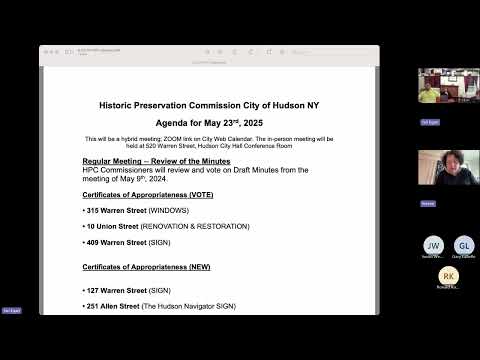
Hudson preservation commission denies Certificate of Appropriateness for large illuminated “Hudson Navigator” sign
Summary
The Hudson Historic Preservation Commission voted to deny a Certificate of Appropriateness for a proposed internally illuminated sign for the Hudson Navigator, citing concerns about scale, internal illumination and material appropriateness in the historic district.
The Hudson Historic Preservation Commission voted to deny a Certificate of Appropriateness for a proposed illuminated sign for the Hudson Navigator, a business on Warren Street in Hudson. Commissioners said the sign’s size, internal illumination and materiality were not appropriate for the building and the surrounding historic district.
Commissioners said the application had been through multiple revisions but continued to raise the same core concerns about scale and light. The applicant, Matthew Saenz, provided measurements and a scaled photo during the meeting and defended the dimensions of the sign: “the circle part of the sign is less than 4 feet. It’s 44 inches,” Saenz said when asked to confirm size.
Why it matters: Commissioners framed the decision as an application of the city’s historic-district code and guidance on compatibility with existing architecture and neighborhood character. Multiple commissioners said that even a well-designed sign can be inappropriate when its scale and illumination conflict with a residential-scale historic façade.
In the discussion, commissioners and members of the public debated three distinct technical issues: scale (how the sign’s size relates to the wall and the building), illumination (internal backlighting versus externally mounted lighting), and materiality (plastic/illuminated cabinet versus more traditional materials). Commissioners noted that the building wall section where the sign was proposed measures roughly 16 feet and that the applicant provided a tip‑to‑tip overall sign dimension of about 69.73 inches (about 5 feet, 9 3/4 inches).
Commissioners said internal illumination raised concerns about light pollution and compatibility with the district; alternatives such as a wood sign with an external gooseneck light were discussed but not directed as a condition of approval. Public comment reiterated concerns about visual impact and the number of illuminated signs already appearing on nearby buildings.
Decision and next steps: After a roll-call discussion, commissioners voted to deny the certificate of appropriateness for the submitted design. The commission’s staff told the applicant he may submit a new or revised application and that any new submission should address scale, material and lighting concerns raised in this meeting.
The commission handled other agenda items before and after this discussion; the denied application will return if the applicant files a new proposal that responds to the commission’s compatibility concerns.