Get Full Government Meeting Transcripts, Videos, & Alerts Forever!
Get email alerts on the Wastewater topic
No spam. Unsubscribe anytime.
Greenfield officials: wastewater plant near capacity; state funding uncertain, rates likely to rise
Summary
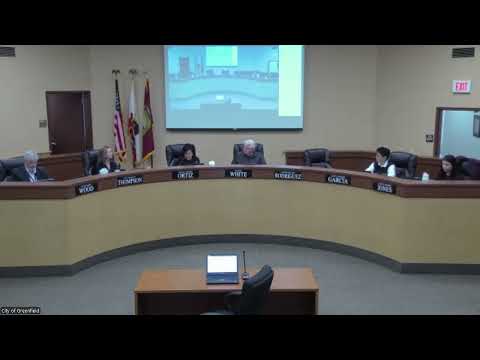
At the May 27 Greenfield City Council meeting, city staff briefed the council on the status of the Greenfield Wastewater Treatment Plant and said the plant will need phased expansion and new rate revenue if state funding does not materialize.
At the May 27 Greenfield City Council meeting, city staff briefed the council on the status of the Greenfield Wastewater Treatment Plant and said the plant will need phased expansion and new rate revenue if state funding does not materialize.
Luis, a city utilities staff member, said the city adopted a wastewater treatment master plan in 2021 evaluating membrane bioreactor technology as an alternative to an oxidation ditch. “The state of California then came back and informed us that they did not have the money available,” Luis said, describing an earlier expectation that the state would cover most costs. He told the council the city spent about $4 million to make the project shovel-ready and later applied for a $15 million state grant or low-interest loan.
The city reported a recent failure in one rapid infiltration basin that caused a minor spill and noted staff repaired the basin and expanded spray-field capacity to reduce pressure on the system. “We did get an approval to expand the spray field,” Luis said, noting regulators also allowed the city to spray for longer periods during higher wind conditions.
Why it matters: several housing projects — including Greenfield Commons (phase 1 and anticipated phase 2) and Walnut Terrace phases 2 and 3 — are expected to come online and increase wastewater flows. City staff said the plant’s effective permitted capacity is now about 1.2 million gallons a day (the city previously had a 1.5 million‑gallon figure before the spill and subsequent recalculation). To address projected growth, staff outlined a two‑phase expansion: a near term increase to roughly 1.6 million gallons a day and a later expansion to about 2.0 million gallons a day.
Luis said that with the state backing away from full funding, the city will look to a mix of the city’s funding and state low‑interest loans and that the wastewater fund’s recurring revenue source is user fees. “We’ll have to raise our rates again since we did this just last year,” Luis said. City Manager Paul Wood told the council the city is lobbying state officials and has visited Sacramento to meet with the State Department of Finance, Senator Laird and Assembly Member Rivas. “We need some real help, and we need help from our electeds,” Wood said.
Council members pressed staff about options to appeal the state water board’s decision to lower the city’s permitted flow; staff said engineers believe an appeal is unlikely to succeed. Staff said the city plans to submit a rate‑study proposal to the council and expected to return with additional details at the June 10 or June 24 council meeting.
Next steps: staff will proceed with a rate study and seek formal funding agreements with state agencies if a $15 million loan/grant becomes available. The city also continues short‑term operational fixes (spray‑field expansion, belt press, pump repairs) while pursuing the two‑phase expansion and associated financing.