Get Full Government Meeting Transcripts, Videos, & Alerts Forever!
Get email alerts on the Multilingual Education topic
No spam. Unsubscribe anytime.
McFarland Middle School reports rising proficiency for multilingual learners; 11 students met state exit criteria
Summary
McFarland Middle School leaders presented assessment results showing growth for multilingual learners, reporting 11 students meeting state exit criteria (WIDA composite), targeted interventions for 105 students and literacy gains for 56 students.
McFarland Middle School administrators told the Othello School District board they have seen measurable gains for multilingual learners after a year of targeted instruction and interventions.
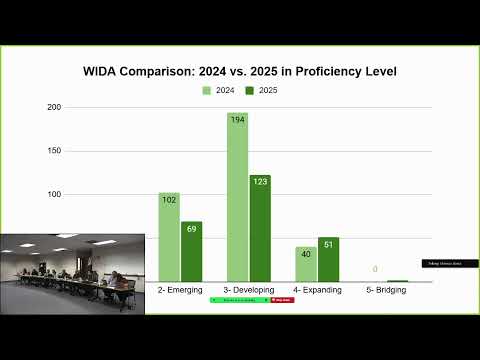
Principal Carlos Gonzales and multilingual support lead Nikki Wilkins reported that 11 students met state exit criteria based on the WIDA ACCESS composite (state threshold referenced by staff) and that another six students remained on a watch list pending additional ESPA results. Wilkins said the district’s approach recognizes the WIDA composite and the state’s practice of counting students scoring 4.3–4.6 with ESPA proficiency as exited and monitoring them for two years.
Wilkins said McFarland has about 288 multilingual learners (approximately 40% of the school) and that targeted interventions produced gains in writing: of 105 students targeted to improve expressive writing, 56 made measurable growth. “We have 11 students who have met exit criteria,” Wilkins said, adding that more students could be added as ESPA results finalize.
Gonzales described schoolwide work to improve instruction, including 621 classroom walkthroughs focused on reading strategies, a principal professional-learning community, and alignment efforts with Othello High School. He said the school is refining curriculum and assessment practices to raise rigor and alignment, and that some high-school credit courses will be kept in a traditional grading model to avoid dual gradebooks.
Staff described curricular steps planned for summer and August professional development, a rubric to decide which courses use standards-based grading, interventions during STAT time, and collaboration with OHS to support newcomers through foundation literacy, sheltered content courses and a joint newcomer support team.
The board heard subgroup Smarter Balanced and ESPA data broken down by grade and subgroup; administrators cautioned that some Smarter Balanced reporting was still incomplete at the time of the presentation. Gonzales said seventh- and eighth-grade trend lines show incremental improvement but emphasized the need for continued work to move the district’s overall proficiency trends.
Administrators said a summer plan will include professional development in high-impact reading strategies, exemplar planning, and alignment on writing across content areas so that writing expectations and rubrics are consistent across grades and subjects.