Get Full Government Meeting Transcripts, Videos, & Alerts Forever!
Get email alerts on the Trash Policy topic
No spam. Unsubscribe anytime.
Councilman withdraws proposed ordinance to move trash cans nearer homes after extended debate
Summary
Councilman Justin Heideck introduced a proposal on May 27 to require residents to move trash and recycling containers to within five feet of their homes after pickup and to authorize fines; after an extended discussion of enforcement, contract issues and safety, he withdrew the request.
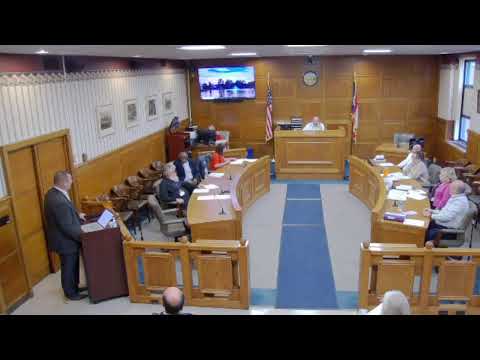
Councilman Justin Heideck introduced legislation at the May 27 meeting of Barberton City Council seeking to amend the codified ordinances to require that trash and recycling containers be moved off the public right-of-way and "relocated to a minimum of 5 feet from the residential structure" the day after collection, with a fine of up to $20 for failure to comply. After sustained debate about wording, enforcement and unintended consequences, Heideck withdrew the request.
Heideck opened the proposal during the rules/charter session and asked that the ordinance amend Barberton Codified Ordinances §1060.02(b)(7) so containers would not remain visible in the public right-of-way. "I think it's high time we start cleaning up the city a little bit and just pull it back," Heideck said, arguing that containers left at the curb make yards and streets look untidy.
Council debate focused on three practical issues: the ordinance's precise wording, how a ticketing and enforcement program would work and who owns the collection containers.
- Wording and distance: Members questioned whether the draft intended a minimum or maximum distance from the home. Several councilors suggested revising the text to require that containers be "within five feet of the residential structure" to avoid ambiguity about moving cans even farther into yards.
- Enforcement and cost: Director Shreve and other staff described enforcement logistics and costs, noting that sending staff across town to issue single tickets may not be efficient. "Those are some things that should probably be taken into account also while you're thinking about what the funding should be," Shreve said. He and other staff said ticketing would require personnel and mileage, and that any fine schedule should account for enforcement costs.
- Ownership of cans and sticker enforcement: The mayor raised a practical concern about sticking tickets or stickers to cans, saying the containers are supplied by the contractor, not the resident in some cases; a sticker might damage a can and could be problematic when companies change contractors. "They belong to the trash company," the mayor said.
Public-safety and fire-safety concerns also surfaced. One attendee said placing cans closer to houses could raise fire risk because modern vinyl siding burns quickly if ignited; that prompted suggestions to consider a placement range that keeps cans away from both the curb and the house.
After questions and continued discussion about outreach, appeals and signage, Heideck withdrew the request, saying he would rework the proposal with colleagues before resubmitting. "I'm withdrawing my request. Until everybody can get together and come to a consensus, put it on paper. I'm so tired of talking about it," he said.
Outcome
No ordinance was adopted or referred from the May 27 session; Heideck withdrew the request and said he will rework the language and enforcement plan with staff and other council members before bringing it back.